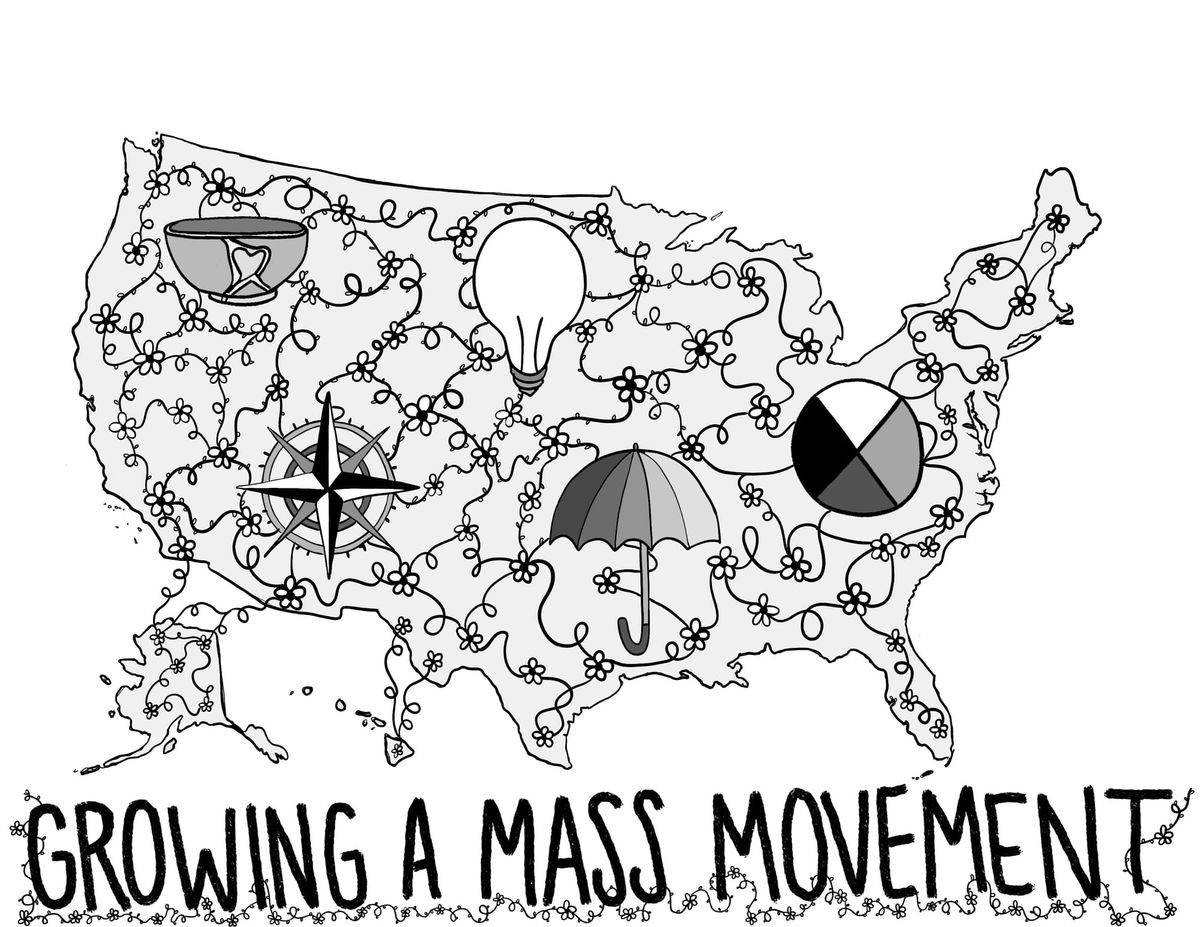
At its core, The Daisy Chain is a heuristic, which (by definition) is a creative device that helps people think through challenges and solve problems. Heuristics take many forms, but they often rely on an easily remembered metaphor or compelling visual. The Daisy Chain relies on the image of a flower as a heuristic to help people imagine how to organize into neighborhood hives.
Before we dive in, it’s important to state that The Daisy Chain reflects observable patterns of human behavior, which exist now and have existed throughout space and time, whenever a people’s backs are against the wall. The Daisy Chain is not a grand theory; it reflects back people’s best qualities under duress and reminds people, who may feel scared and helpless, that we already have a plan. We simply need to follow it.
Visual of the Daisy Chain Heuristic
In the visual representation of The Daisy Chain below, the center of the daisy represents a problem or goal neighbors must confront—whether it’s increasing a sense of neighborhood camaraderie, developing neighborhood responses to climate-related emergencies, protecting our neighbors from being targeted by violent political abusers, or anything in between. We can accomplish any goal and meet any problem in front of us by working together. The Daisy Chain reminds us of this truth.
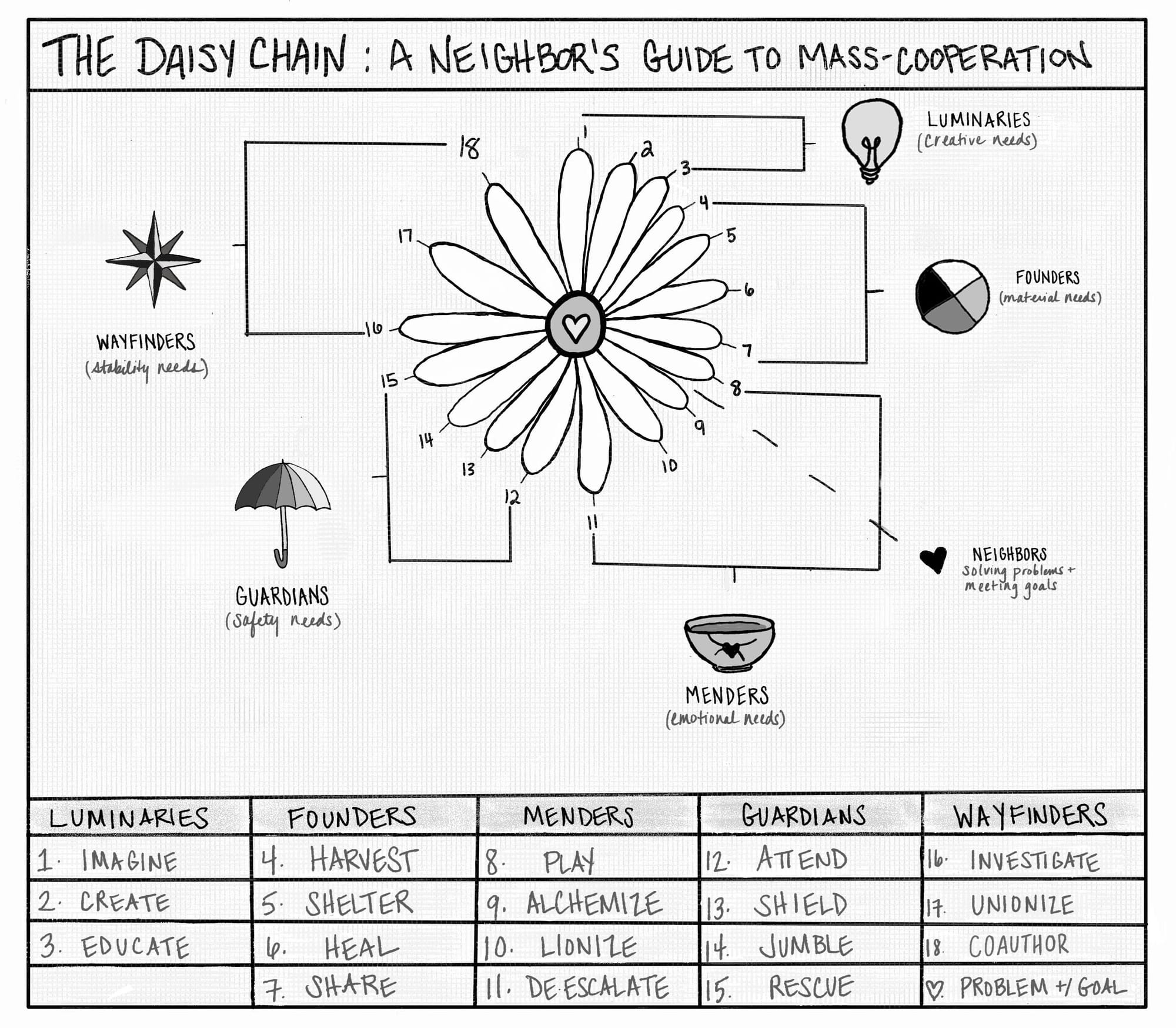
Taking a closer look. The daisy center is surrounded by 5 thematic petal clusters, comprising 18 petals total. Each petal represents different action-types that neighbors— with diverse skillsets, perspectives, and resources—can leverage to collectively solve a problem or achieve a goal. This is about pooling our collective genius.
This heuristic helps us harness our collective energy, redirecting our millions of protest numbers into a neighborized national movement, capable of helping people across an entire nation flock together in a massive networked murmuration. This is how we build the kind of movement, across large land masses, capable of uprooting an authoritarian coup and growing a world that centers ordinary people and the planet.
[Caption: Overview of The Daisy Chain’s Five Clusters]
Before zooming in further, familiarize yourselves with a brief description of the 5 Daisy Chain clusters, the symbols that correspond with each cluster, and the 3-4 petals that fall under each cluster. Refer to the table below:
- Luminaries (lightbulb; 3 petal types) help neighbors imagine the world they want, educate their neighbors of all ages, and create art of all types that amplifies this vision.
- Founders (medicine wheel; 4 petal types): help neighbors harvest food, secure reliable shelter, access the medical and psychological supports needed to heal, and share what they have with each other.
- Menders (kintsugi bowl; 4 petal action types): help neighbors play together to boost morale, collectively alchemize big emotions, lionize scapegoated community members, and deescalate security forces that have been manipulated to turn against their neighbors.
- Guardians (umbrella; 4 petal types): help neighbors attend to their communities and create a felt sense of safety, shield their communities from prying eyes, jumble abusers’ ability to effectively target scapegoats, and rescue neighbors from ecological (or other) disasters that require an emergency response.
- Wayfinders (nautical wheel; 3 petal types): help neighbors investigate those enacting political abuse, unionize into neighborhood groups that organize their communities, and coauthor a plan that articulates their neighbors’ vision of the future into fine print.
Flipping the Script: Moving in Formation
Unlike project management, the central question of The Daisy Chain isn’t just how an objective might be met but, rather, how neighbors might accomplish whatever is in front of them with a level of creativity, play, and joy that inspires bystanders to become upstanders.
- Bystanders simply wish things would change.
- Upstanders intervene in the world to make change happen.
Rather than work separately or receive top-down orders, we let power flow horizontally between neighbors by: encouraging neighbors to leverage their unique skills, getting out of each other’s way, and flocking together to get things done.
It’s not enough to say “no” to chronic political abuse.
We must create a viable alternative through insistent, joyful daily practice.
Flocking Isn’t Just for the Birds: Why Murmuration Works
[Caption: Like Starlings, Darlings — by Nikolas Lee]
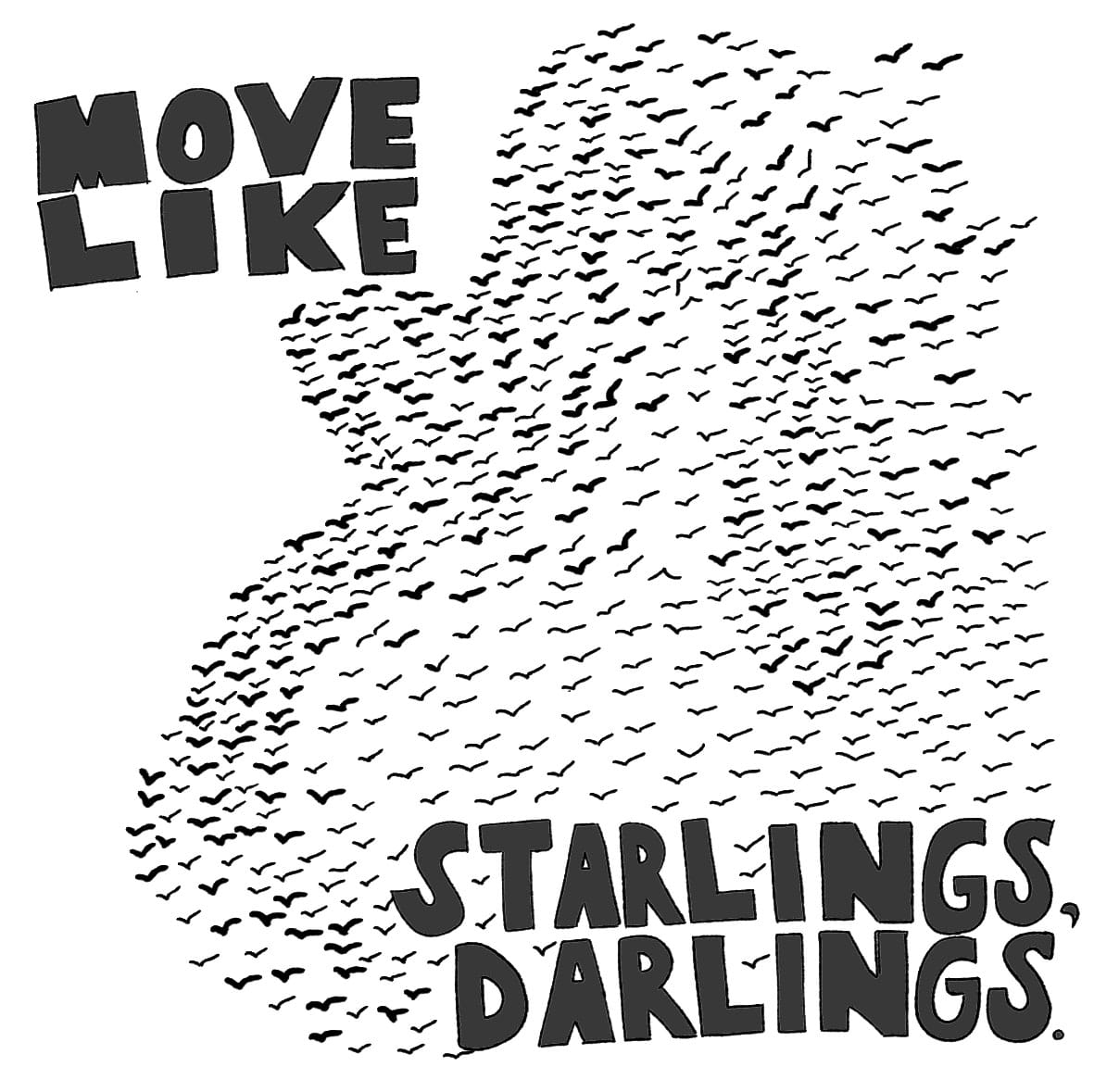
To explain what is meant by a murmuration, please refer to the image below of starlings moving together. Each starling, like each person, is (on their own) small. They are unique, separate beings, yet they move together as a whole.
If you want to develop a kinetic understanding of how tiny units can work together as a whole, consider renting the children’s film Big Hero 6[1] from your local library. If you do watch this cartoon, pay close attention to the main character’s invention of microbots.
Better still, since the organic is always better than the artificial, you can also learn how starlings move by looking to the sky—or, you can watch it here.
It’s time to move like starlings, darlings.
A Taxonomy of The Daisy Chain Petals
The Daisy Chain heuristic helps us resist political abuse and transition to a way of living that actually works for people and the planet. Thankfully, we do not have to ask our political abusers for permission[2] to do this work. The following section gives readers a basic understanding of the types of actions people can take to collectively address problems and meet goals in their neighborhoods.
Specifically, we review the five thematic clusters of The Daisy Chain:
- Luminaries cluster
- Founders cluster
- Menders cluster
- Guardians cluster
- Wayfinders cluster.
Each cluster section opens with a symbolic image that depicts that cluster, along with a description of what the cluster does. Underneath the description of each cluster are brief descriptions of the 3-4 petals that grow within that cluster, including an explicit description of why activating each petal is necessary to uproot political abuse.
Note: Petal descriptions below do not include itemized actions people can take in their neighborhoods. To understand how each of The Daisy Chain’s 18 petals can be mobilized into 300+ everyday actions, it is essential to engage with the Appendix, which closes out this guide[3]. The Daisy Chain’s Appendix is not skippable; it illustrates how to move from an idea of building people-power to actually practicing people-power.
Cluster 1: An Overview of The Luminaries Cluster
Luminaries Cluster — by GPat Patterson & Nikolas Lee
Luminaries give us permission to believe in the world we want. They freely offer various forms of community art and craftsmanship to boost neighborhood morale. They hold an exquisitely expansive vision of education that embraces local genius and supports local learners of every age and experience. Luminaries are an essential cluster of The Daisy Chain because they help us shift from simply responding to political abuse to shaping the world we wish to bring into being. The Luminaries cluster includes the imagine, create, and educate petals, whose descriptions follow:
Imagine Petal
Imagineers host events and create spaces for their neighbors to come together and discuss a vision of our near (and far) future that would actually feel life-affirming for ordinary people and life-protecting for the planet, which sustains life itself. Because of their systems-level thinking, Imagineers center often ignored voices, because they understand that to build a genuinely functional society, no one can be left behind. Similarly, Imagineers seek out young people’s perspectives about the world they will inherit, and they amplify young leaders in the movement toward our collective liberation and evolution. Neighbors who are drawn to this petal are those allergic to cynicism and micromanagement. They rebuke gatekeeping phrases like “that’ll never happen” and, instead, listen to their community’s desires for a functioning society by responding, “yes, tell me more!” Imagineers collaborate across all petals of The Daisy Chain, but they have a special relationship with the Coauthor[4] petal, of the Wayfinders cluster.
Note: The Imagine petal provides the counterweight to political abusers, who claim their vision of the world is the only one that exists so that ordinary people assume things can never change for the better. For details about the kinds of actions Imagineers might take to uproot political abuse and meet long-term community goals, refer to the Appendix.
Create Petal
Neighbors engaging with the Create petal ground a movement in possibility by creating community art (of all kinds) that amplifies our agency and asserts our collective right to self-determination. People drawn toward this petal understand that art transforms pain into possibility, which is why there is often a proliferation of artists who burst through the cracks during troubling times. In particular, those drawn to the create petal rebuke the snobbery of alleged perfection and are especially drawn to collaborative art, freely given to the People as a way to boost community spirit.
Note: The Create petal provides a counterweight to political abusers, who often strip people from their culture and impose sterile and cruel caricatures of art in the form of national propaganda. For details about the kinds of actions Creators might take to uproot political abuse and meet long-term community goals, refer to the Appendix.
Educate Petal
Neighbors engaged in the Educate petal preserve communities’ diverse cultural knowledge and educate people, of all ages, in ways that preserve pro-social values and skillsets that ensure our collective survival. People who might be drawn to this work may certainly include those currently or previously employed in education, but this petal has an expansive view of what it means to educate. This includes teaching that includes hands-on skillsets and lifeways that are just as important as traditional scholarly content. Those drawn to the Educate petal understand the particular usefulness of play-based models of education.
Note: The Educate petal provides a counterweight to political abusers, who tell people what to think and punish independent thinking that points toward our collective liberation. For details about the kinds of actions Educators might take to uproot political abuse and meet long-term community goals, refer to the Appendix.
Cluster 2: An Overview of The Founders Cluster
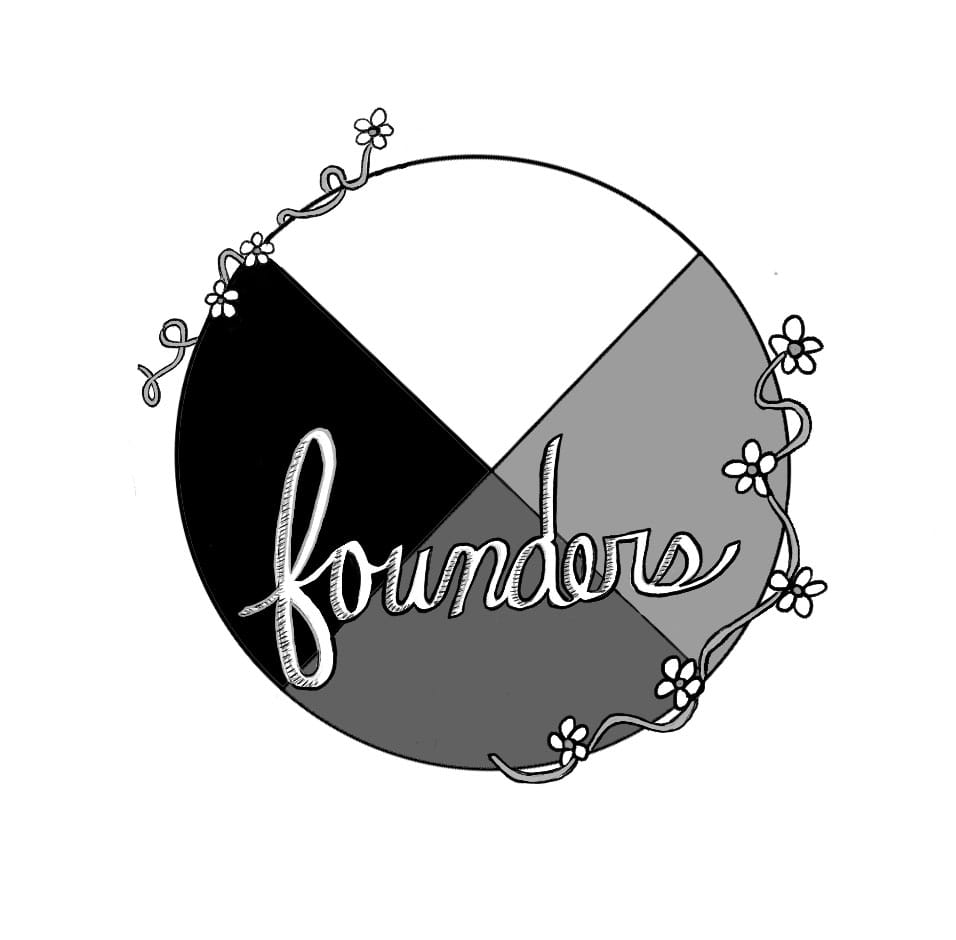
[Caption: Founders Cluster — by GPat Patterson & Nikolas Lee]
Founders restore a neighborhood’s dignity and sovereignty by pooling community resources to make sure people’s most basic needs are met. The goal is to prevent political abusers from reducing communities to desperation and division. The Founders cluster includes the harvest, shelter, heal, and share petals, whose descriptions follow:
Harvest Petal
Neighbors engaged in the Harvest petal create a systematized way to grow, store, preserve, and share food. People drawn to this petal may have green thumbs, enjoy feeding their neighbors, and understand permaculture. They help neighbors relearn traditional ways of accessing food and water that don’t deplete the ecosystem we all rely on to survive. Those drawn to the harvest petal also understand that there’s no substitute for breaking bread together when you’re building, protecting, and sharing with community. Rather than hoard food for one’s insular group, the goal is to work together with neighbors to grow, store, preserve, and share food, all while having fun in the process of re-approaching food systems.
Note: The Harvest petal provides a counterweight to political abusers, who often collapse food systems and food inspection services as a way to create a hungry population willing to turn on their own neighbors just to be able to feed themselves and their loved ones. For details about the kinds of actions Harvesters might take to uproot political abuse and meet long-term community goals, refer to the Appendix.
Shelter Petal
Neighbors who engage in the Shelter petal find creative ways to keep neighbors housed with dignity. Those drawn to this petal understand that communities cannot make affordable housing materialize overnight, but they understand the value of using the already-existing resources in their communities to coordinate housing for displaced neighbors. They also work to make sure those with housing do not lose their homes because of an inability to keep up with repairs and other housing costs. Rather than rely on colonial versions of housing that center around a couple and their children and pets, those drawn to the Shelter petal have a vision for reclaiming ancestral models of housing that reclaim the village and center around collective housing models.
Note: The Shelter petal provides a counterweight to political abusers, who often run people out of their homes—whether through intimidation, property seizure, property destruction, criminalizing homelessness, or by intentionally creating conditions that make being able to afford a place to live impossible. For details about the kinds of actions Shelterers might take to uproot political abuse and meet long-term community goals, refer to the Appendix.
Heal Petal
Neighbors in this petal use the community’s collective skills and resources to provide each other with various forms of medical care. People drawn to the Heal petal may include current or former nurses, doulas, doctors, dentists, herbalists, veterinarians, chiropractors, bodyworkers, and any other person who practices the healing arts. Those engaging in the Heal petal understand why the United Nations and the World Health Organization articulate universal healthcare both as a matter of human rights and national security: when abusers overwhelm people’s ability to take care of themselves and their neighbors, it pushes entire communities into trauma and makes them easier to control. The heroes of the healing petal refuse to let that happen when they have skills on hand to help.
Note: The Heal petal provides a counterweight to political abusers, who frequently sabotage people’s ability to access medical care, be it through criminalizing healthcare access, exposing people to contagious diseases, pricing people out of healthcare, or even shuttering medical facilities. For details about the kinds of actions Healers might take to uproot political abuse and meet long-term community goals, refer to the Appendix.
Share Petal
Neighbors engaged in the Share petal take part in solidarity and well-being economies that prioritize people over profit. People drawn to the Share petal come from all walks of life and experience. They may include neighbors with interest in time banks, those practiced in bartering, swap-meeting, skill-sharing, and creating communal libraries of commonly needed items. The people in the Share petal understand that creating parallel “we-conomies” prevents neighbors from turning on neighbors. It strips abusers of the upper hand they seek in controlling resources.
Note: The Share petal provides a counterweight to political abusers, who intentionally impoverish their targets, through encouraging mass layoffs, barring certain groups from being able to work, busting labor unions, driving down the value of currency, or looting treasuries and communal resources. For details about the kinds of actions Sharers might take to uproot political abuse and meet long-term community goals, refer to the Appendix.
Cluster 3: An Overview of The Menders Cluster
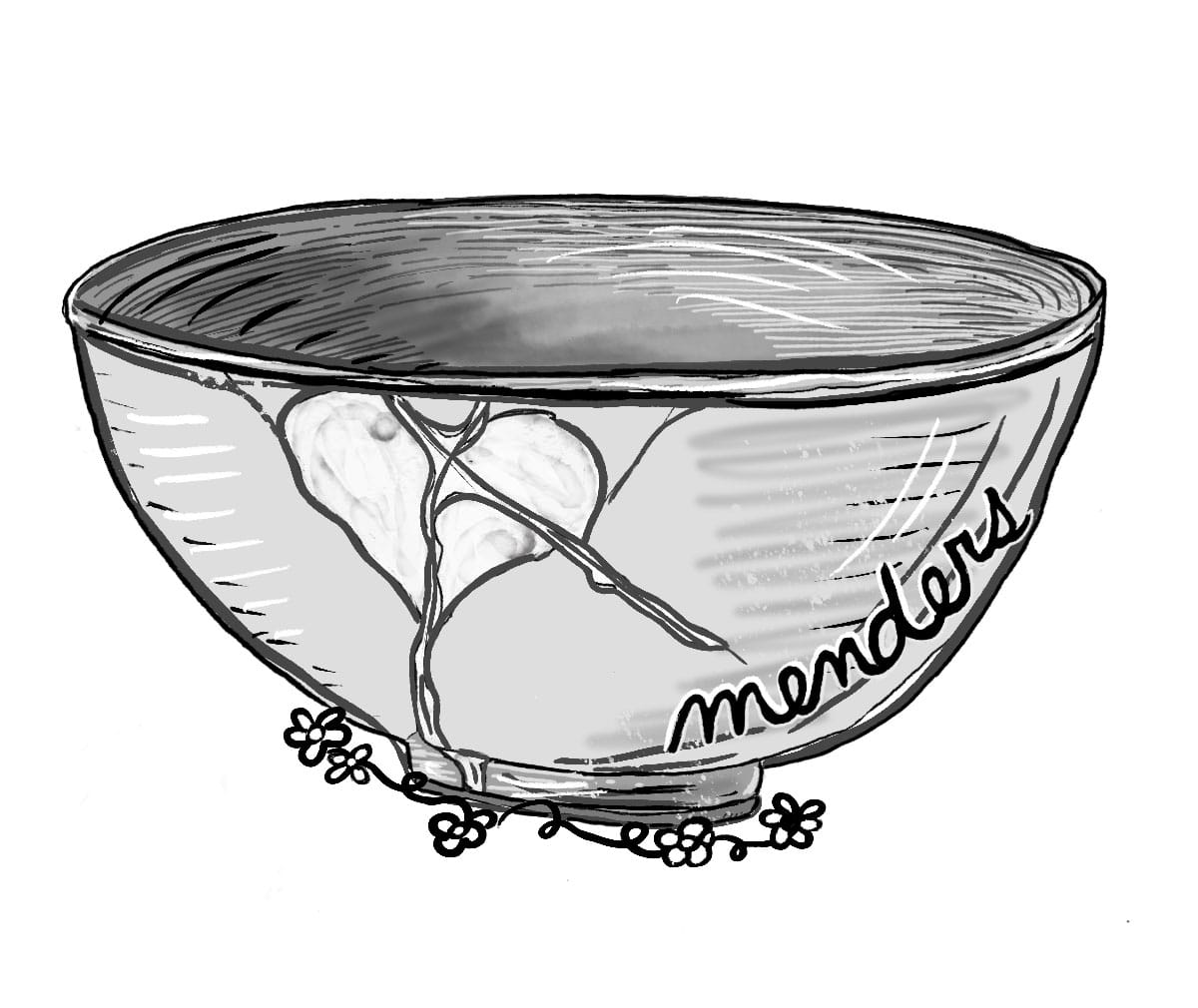
Menders Cluster — by GPat Patterson & Nikolas Lee
Menders focus on repairing the social fabric of their communities to drive out the isolation and scapegoating that keeps neighbors divided. Menders recognize that genuine human connection is the engine behind every thriving neighborhood and society. The Menders cluster includes the play, alchemize, lionize, and deescalate petals, whose descriptions follow:
Play Petal
Neighbors engaged in the Play petal create regular opportunities for community members to spend time with one another off-screens. Those drawn to the Play petal understand that people who play together stay together. They may also understand the unique attributes play has on our neurobiology as human beings: creating opportunities for parallel play and non-competitive play helps people co-regulate their nervous systems, boosts creativity, increases positive community feeling, and lessens the isolation that allows political abuse to spread.
Note: The Play petal provides a counterweight to political abusers, who intentionally rip apart the social fabric, so that people feel hopeless, mistrustful, and apprehensive toward their neighbors. In this particular moment, political abusers benefit from people remaining behind their screens and stuck in echo chambers, thinking they have no common cause with the people down the street. For details about the kinds of actions Players might take to uproot political abuse and meet long-term community goals, refer to the Appendix.
Alchemize Petal
Neighbors engaging in the Alchemize petal help their neighbors transmute strong emotions into grounded action to prevent their communities from becoming tinderboxes of frustration and despair that could boil over into senseless tragedies. Elders, healers, counselors, social workers, religious and spiritual leaders, body workers, grief doulas, and art- animal- and play-therapists may be uniquely equipped to help their neighbors ground with each other. Alchemizers attune themselves to the unique emotional, embodied, and spiritual needs of their neighbors—particularly those directly impacted by political abuse. They do this work, not from a formal top-down institutional (or nonprofit) space, but informally and with the spirit of peer to peer neighborly camaraderie.
Note: The Alchemize petal provides a counterweight to political abusers, who intentionally try to break people’s spirits with a stream of unrelenting cruelty, hoping that their targets will remain frozen in fear, numbed out in grief, or so angry that they make reckless decisions that play into abusers’ hands. For details about the kinds of actions Alchemizers might take to uproot political abuse and meet long-term community goals, refer to the Appendix.
Lionize Petal
Neighbors engaged in the Lionize petal understand that the proper response to scapegoating is to loudly embrace their targeted neighbors and make sure they have tangible support from their community. Those drawn to this work also know that political abusers tend to target misunderstood social groups, not because they are “weak” but because these groups often possess unique insights about how to stand up to oppression—knowledge that directly threatens political abusers, who rely on a docile public. Rather than treat their targeted neighbors as pariahs, they lionize them as community leaders who, like all leaders during times of crisis, must be flanked and protected from bad actors.
Note: The Lionize petal provides a counterweight to political abusers, who intentionally offload their own misdeeds onto misunderstood social groups—targeting them with smear campaigns, flagging them for institutional abuse, and grooming bystanders into socially and physically abusing their neighbors. This kind of cruelty can leave targets afraid to leave their homes or, sometimes, afraid to remain in their communities. These campaigns of abuse can also cause bystanders to fear becoming targets themselves and leave them feeling helpless, without a solid plan to effectively stand up for those being targeted. For details about the kinds of actions Lionizers might take to uproot political abuse and meet long-term community goals, refer to the Appendix.
Deescalate Petal
Neighbors engaging in the Deescalate petal employ nonviolent communication to persuade security forces to refuse political violence and come home to their neighbors. They also model what it means to intervene in and resolve local community conflicts in healthy ways, minimizing neighbors’ unhealthy (and, too often, deadly) over-reliance on law enforcement to “solve” problems. People drawn toward the Deescalate petal have a keen awareness that those who rely on violence to scare their targets are actually moving out of profound weakness and lack of self-control. Such neighbors center the recovery needs of those directly harmed, rather than relying on the narrative that arbitrary forms of punishments and legal procedures lead to repair.
Note: The Deescalate petal provides a counterweight to political abusers, who intentionally engage in physical violence to intimidate neighbors into submission. Sometimes political abusers encourage law enforcement, military members, and paramilitaries to view their own neighbors as “enemies from within,” in order to dehumanize targets as a pretext for annihilation. For details about the kinds of actions Deescalators might take to uproot political abuse and meet long-term community goals, refer to the Appendix.
Cluster 4: An Overview of The Guardians Cluster
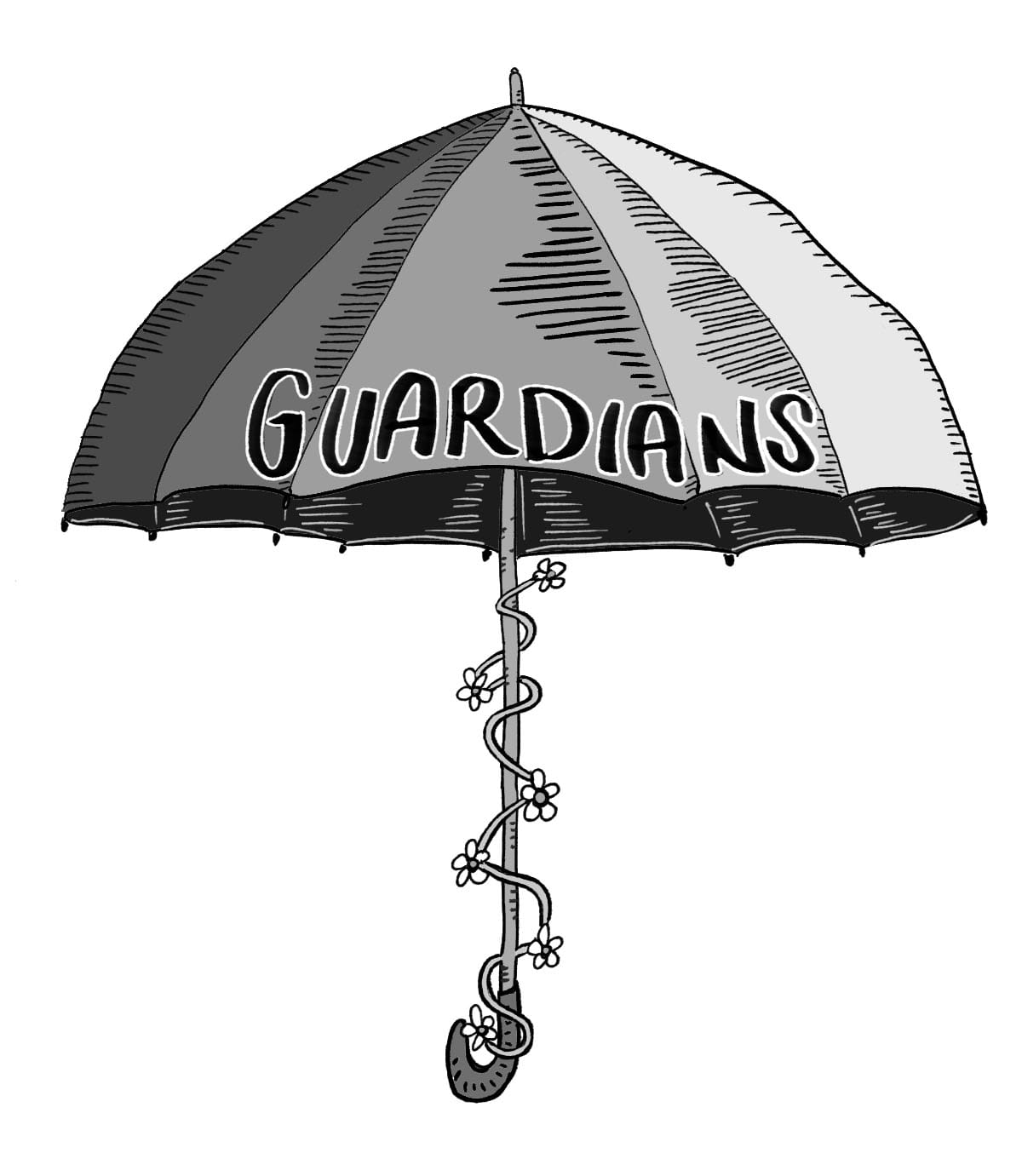
Guardians Cluster — by Nikolas Lee
Guardians create a sense of safety through establishing baseline community practices and emergency preparedness plans to provide a bulwark against the chaos and panic abusers rely on to control people. The Guardians cluster includes the attend, shield, jumble, and rescue petals, whose descriptions follow:
Attend Petal
Neighbors engaged in the Attend petal intentionally create a felt sense of safety in their neighborhood by establishing a visible friendly neighborhood presence—one that communicates to neighbors that each person is valued and looked after. Those drawn to the Attend petal are those who understand that, just like in childhood, ordinary people (even as adults) can gain a sense of security from a grounded, compassionate neighborhood presence. Rather than respond to a culture of fear by reverting into a ghost town, those who take part in the Attend petal do the opposite. They make it a point to coordinate a friendly ever-present fixture in their neighborhoods so that no neighbor ever feels preyed upon in their own community.
Note: The Attend petal provides a counterweight to political abusers, who manufacture, through propaganda and street violence, a pervasive sense of fear that leaves ordinary people afraid to move freely through their communities. For details about the kinds of actions Attenders might take to uproot political abuse and meet long-term community goals, refer to the Appendix.
Shield Petal
Those engaging in the Shield petal offer a set of tools and practices, both old-school and technological, to help neighbors avoid being stalked and surveilled. Those drawn to this petal may include those with technological skills, counter-surveillance skills, communications skills, domestic abuse prevention skills, code-talking skills, map-reading skills, costuming skills, and a kaleidoscope of old-school luddite skillsets.
Note: The Shield petal provides a counterweight to political abusers, who stalk people, digitally and physically, in order to violate their personal boundaries. They rely on technology and psychological tricks so that people feel like they’re under constant surveillance. When this abuse continues uninterrupted, people begin to police themselves. They may even start to police their neighbors, thinking that collaborating with their abusers will garner them safety[5]. For details about the kinds of actions Shielders might take to uproot political abuse and meet long-term community goals, refer to the Appendix.
Jumble Petal
Neighbors who engage in the Jumble petal understand that a massive amount of local human capital is required for abusers to access the information and physical resources needed to terrorize local communities. Those drawn to this petal are keenly aware of the historical deployment of coordinated un-helpfulness to ensure that occupying or colluding forces have a difficult time orienting within neighborhoods, locating information, accessing needed surface area, or receiving basic services needed to harm communities. Rather than understanding this approach through the lens of hostility, it is more accurate to frame the Jumble petal as an expression of healthy emotional boundaries: good neighbors do not roll out the welcome mat for abusers.
Note: The Jumble petal provides a counterweight to political abusers, who rely on the compliance of ordinary people to oppress political scapegoats and, by proxy, the larger population. For details about the kinds of actions Jumblers might take to uproot political abuse and meet long-term community goals, refer to the Appendix.
Rescue Petal
Neighbors engaging in the Rescue petal develop plans, practice drills, and respond to emergencies and disasters when they arise. Those drawn to this petal operate under the motto that no neighbor will be left behind, and no one in need will be turned away during a crisis. They know that, when crisis hits, following the credo of “every person for themselves” often ensures the downfall of an entire community. Neighbors who may find a sense of purpose in the Rescue petal include veterans, nurses, paramedics, firefighters, scouts, outdoorsmen, geographers, homesteaders, home repairers, and those skilled at planning and executing emergency drills. Above all, those who engage in the Rescue petal operate from a sense of compassion and communal wisdom—trusting what has always been true of the best of us: when crisis hits, we remember how to find each other, forge ties, and innovate to survive and thrive.
Note: The Rescue petal provides a counterweight to political abusers, who routinely abandon people to life-threatening conditions during emergencies; they often use disasters as opportunities to rob people of their resources and drive them from their communities. For details about the kinds of actions Rescuers might take to uproot political abuse and meet long-term community goals, refer to the Appendix.
Cluster 5: An Overview of The Wayfinders Cluster
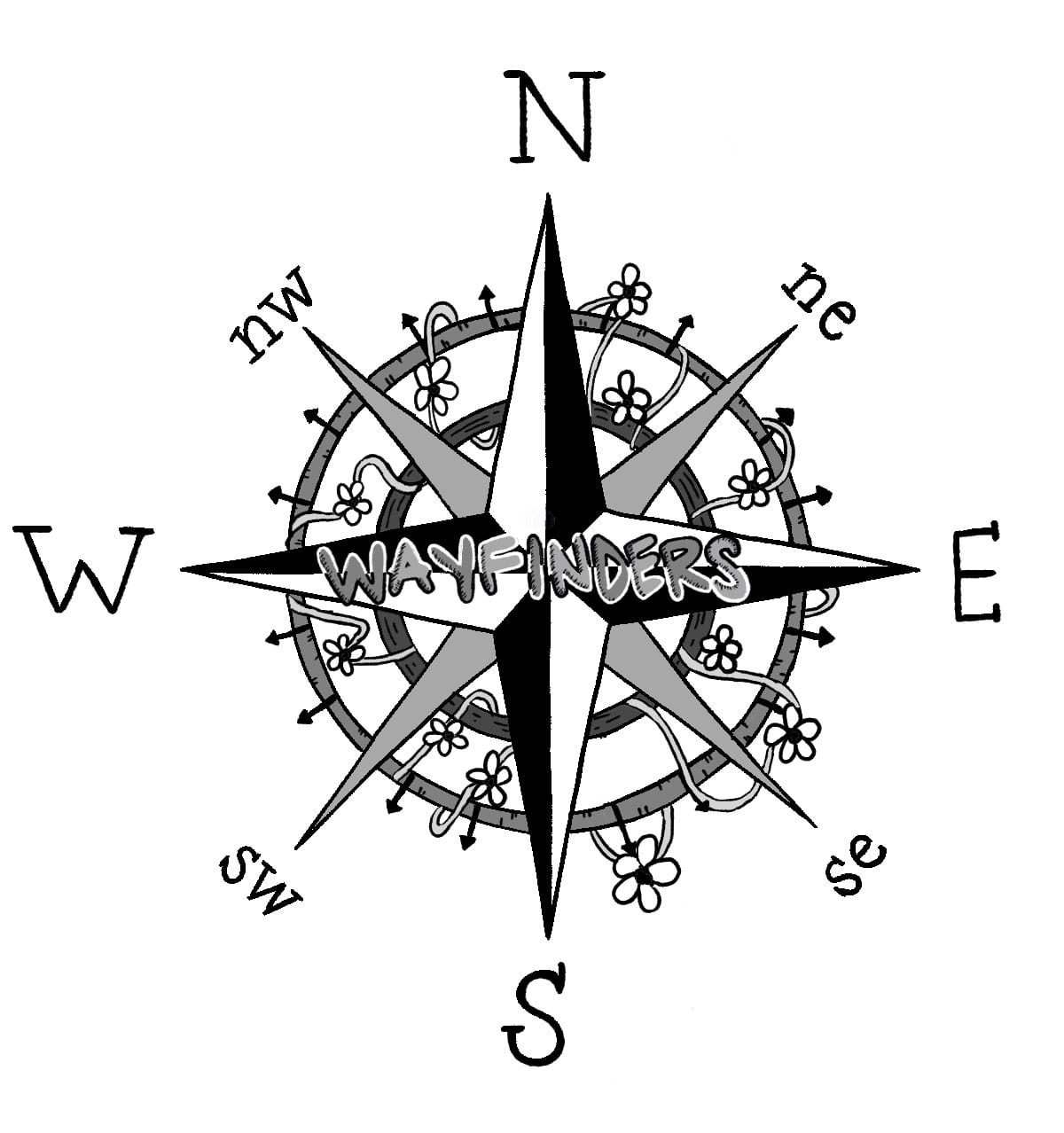
Wayfinders Cluster — by GPat Patterson & Nikolas Lee
Wayfinders move necessary information to neighbors, develop decentralized leader-full networks, and translate ideas about self-governance into processes the community can act on. This work prevents political abusers from manipulating the chaos they create to claim that a people are in too much disarray to govern themselves. The Wayfinders cluster includes the investigate, unionize, and coauthor petals, whose descriptions follow:
Investigate Petal
Neighbors who engage in the Investigate petal put abusers under the microscope so that every action they and those who collude with them take gets documented. Neighbors in this petal collect and securely store evidence demonstrating political corruption, constitutional violations, war crimes, and other human rights abuses. In so doing, the Investigate petal restores community confidence that engaged neighbors will step in for each other, even if formal watchdogs neglect to honor their commitments. Those drawn to this petal may come from all walks of life but may feel especially aligned for journalists, archivists, photographers, videographers, scrapbookers, diarists, and those who are skilled in collecting and preserving people’s firsthand testimonies.
Note: The Investigate petal provides a counterweight to political abusers, who try to convince their targets that they won’t face any consequences for the abuse they cause. For details about the kinds of actions Investigators might take to uproot political abuse and meet long-term community goals, refer to the Appendix.
Unionize Petal
Neighbors engaging in the Unionize petal prevent leadership vacuums by reclaiming what it means to model leadership: they help their peers recognize how their already-existing talents, interests, and energy can be used to benefit the community. Those drawn to the Unionize petal will possess talents across the spectrum but are especially keen on employing the collaborative decision-making process called sociocracy[6] to help their neighborhoods develop and sustain parallel support systems that keep communities resilient. It is especially important for those operating in this petal to understand leadership as a form of lamp-lighting, not gatekeeping. Those operating in this petal also call back power to their communities by creating neighborhood unions, where people can reorient, access vetted information, and glean information about pertinent community action plans.
Note: The Unionize petal provides a counterweight to political abusers, who corrupt or otherwise cower to institutional figureheads so that people panic and think they have no leaders to help them orient through political crisis. For details about the kinds of actions Unionizers might take to uproot political abuse and meet long-term community goals, refer to the Appendix.
Coauthor Petal
Neighbors engaging with the Coauthor[7] petal acknowledge societal destruction while also reframing it as an opportunity to collaborate toward a vision of society that works for everyone. People drawn to this petal work closely with those in the Imagine petal (Luminaries cluster) to facilitate local conversations about our democratic futures. They collaborate with Luminaries in other postal codes across the country, with the aim of coalescing into a representative group that drafts a mission statement and foundational documents for our collective political future. Their efforts boost community members’ resilience and ability to take on risks because they’ll know there’s a plan waiting for when political abusers’ plans inevitably fail. This work keeps people’s eyes fixed on self-governance and staves off additional future political abusers plotting in the wings.
Note: The Coauthor petal provides a counterweight to political abusers, who often rewrite laws and policies in order to fuse themselves to state (and other cultural) institutions. Abusers assume that if they destroy social norms and societal pillars, ordinary people will feel like there’s no way out and just collapse. For details about the kinds of actions Coauthors might take to uproot political abuse and meet long-term community goals, refer to the Appendix.
―❀―
It is important to emphasize at the close of this chapter: Daisy Chain petals are not meant to be exclusive teams. It is more helpful to think of the petals in terms of the talents and resources any person might be able to tap into, in order to collaborate with their neighbors. Related, while it is true that many hands make light work, not all petals need to be activated from the outset in order to begin experimenting with The Daisy Chain in your neighborhood.
More petals will spring forth as people become engaged in their neighborhoods. Lastly, keep in mind that The Daisy Chain is not prescriptive or predictive of your community’s evolving needs. If you find there’s a missing petal, take that as an opportunity to grow a new one.
For those just getting started, it can take as little as three people in a neighborhood to begin playing with The Daisy Chain. While recruitment[8] is certainly important, you don’t need critical mass in order to begin. As elder Grace Lee Boggs[9] reminds us: movements are born of critical connections, not critical mass.
Once more with feeling, if you would like more details about the specific types of actions related to the eighteen petals described above, see the Appendix. The Appendix is not skippable. Read it[10].
[Caption: Seriously, Read the Appendix, by Nikolas Lee]
“What Can I Practically Do, Besides Read This?”
If you want to show your appreciation for these words + illustrations, we would be honored if you spent 2-3 hours each week in humble service to your neighborhood: together, offline, off-screen, and outside institution-time.
Chapter 2 Footnotes
Big Hero 6 clearly got the idea of “microbots” from watching starlings move together. Human beings always learn from animals; they’re wiser because they’ve been around a whole lot longer than humans. ↩︎
They need us. We do not need them. ↩︎
If you’re reading this guide as part of its chapter by chapter release on Substack, you are going to have to wait until the end. This guide is long, the illustrations are created by hand, and I’m one tired community college professor, with a tiny team of volunteers. We work on human time, but you will have complete access to the content before the US midterm elections. In the meantime, I encourage you to keep reading, take notes, allow the information to digest, and (most importantly) talk to your neighbors (offline) about this. ↩︎
The Coauthor petal is the last petal discussed in this chapter. The Imagineers and the Coauthors are presented here as intentional bookends, whose petals overlap and complete the circle of The Daisy Chain. ↩︎
It never does. ↩︎
For decision-making in The Daisy Chain to work, it will be important for at least a handful of neighbors to have a basic grasp of sociocracy, which allows people to work from their strengths and avoid pitfalls that commonly arise in social movements around issues of consent and control. For more information, please see: https://www.sociocracyforall.org/sociocracy/. ↩︎
In Chase Hughes’s The Ops Manual, he describes a manipulative authoritarian figure, called the Author, who hides behind the scenes and controls other people’s destinies. Describing the author, Hughes writes: “The Author chooses the outcome and defines the plot of the story. Although often, unseen, they are the true architects of reality. An Author, as opposed to a Lead Character, is the only one who truly decides the meaning of a story, the development of a plot, and even the decisions of the Lead Characters. Most are unaware of the Author’s presence, as their true nature is often hidden from those around them. They may secretly be acting like the Lead Character, or even ‘The Character,’ while simultaneously dictating the outcomes in their life, the lives of those around them, and the lives of many people in the world” (4 Hughes). This is a settler-colonial vision of power, rooted in dishonesty, coercion, and a corruption of power. For these reasons, The Daisy Chain features Coauthors—to suggest an open, transparent, highly visible collective of people in each neighborhood who attend to their neighbors’ collective vision of the world. Rather than gate-keep, Coauthors work together—across daisy clusters and across regions—to share the meaning of our collective story, articulate how we’ve collectively decided to do things moving forward, and articulate flexible guidelines, honorable agreements, and accountability mechanisms for getting us all where we want to go. Rather than a group of landed looters, who thought they could own people, deciding the fates of a people 250 years into the future, Coauthors listen to and collect their neighbors’ stories, take them seriously, and turn them into the project management documents we need moving forward. The Coauthor petal exists because our future is for ALL of us to decide. ↩︎
Always be recruiting, folks. ↩︎
Boggs reminds organizers of this concept in her book The Next American Revolution: Sustainable Activism for the 21st Century. It’s essential reading for this political moment. ↩︎
The Appendix hasn’t yet been published. It’s at the end of the guide. Please keep reading. This entire thing will be released before the 2026 midterms. While you wait for the full drop, share this with your friends—offline. Start playing with it. ↩︎

Member discussion: