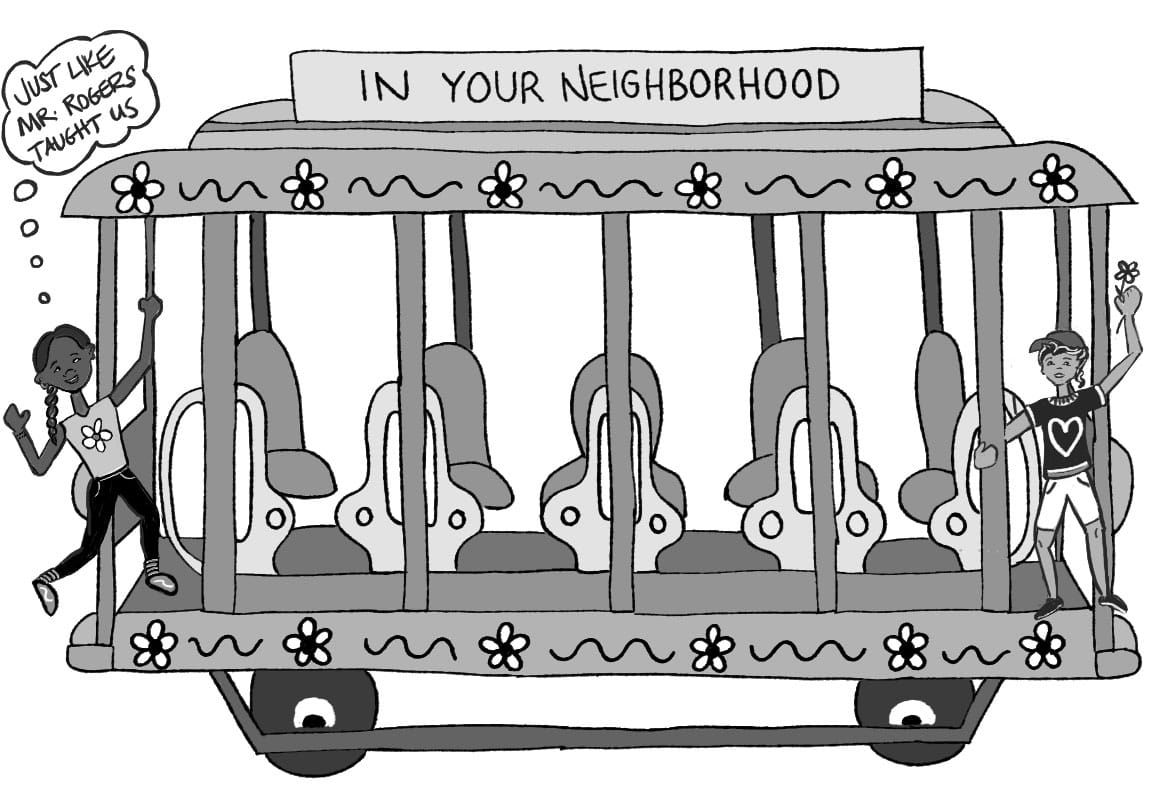
It’s not an accident that flowers are often used as symbols in people-powered movements. While flowers are symbols of peace and of a more beautiful world that neighbors wish to create together, flowers also share a deeper wisdom. They implore generation after generation to remember how social movements grow and spread: from the ground up, starting with the ground under our feet. The Daisy Chain: A Neighbor’s Guide to Mass-Cooperation speaks from this tradition.
In usual discussions of power, we are instructed to view those with access to institutional levers as leaders. We have been told our “voice” comes solely from the ballot box and appealing to elected (and appointed) officials to demand they stop abusing their positions. This narrative, that ordinary people have a limited number of tools to intervene in the world around them, is false—but it gets circulated as truth because it benefits political abusers to bamboozle a people about what power actually is, where it lives, and what true leadership actually looks like.
What Power Is & How It Grows
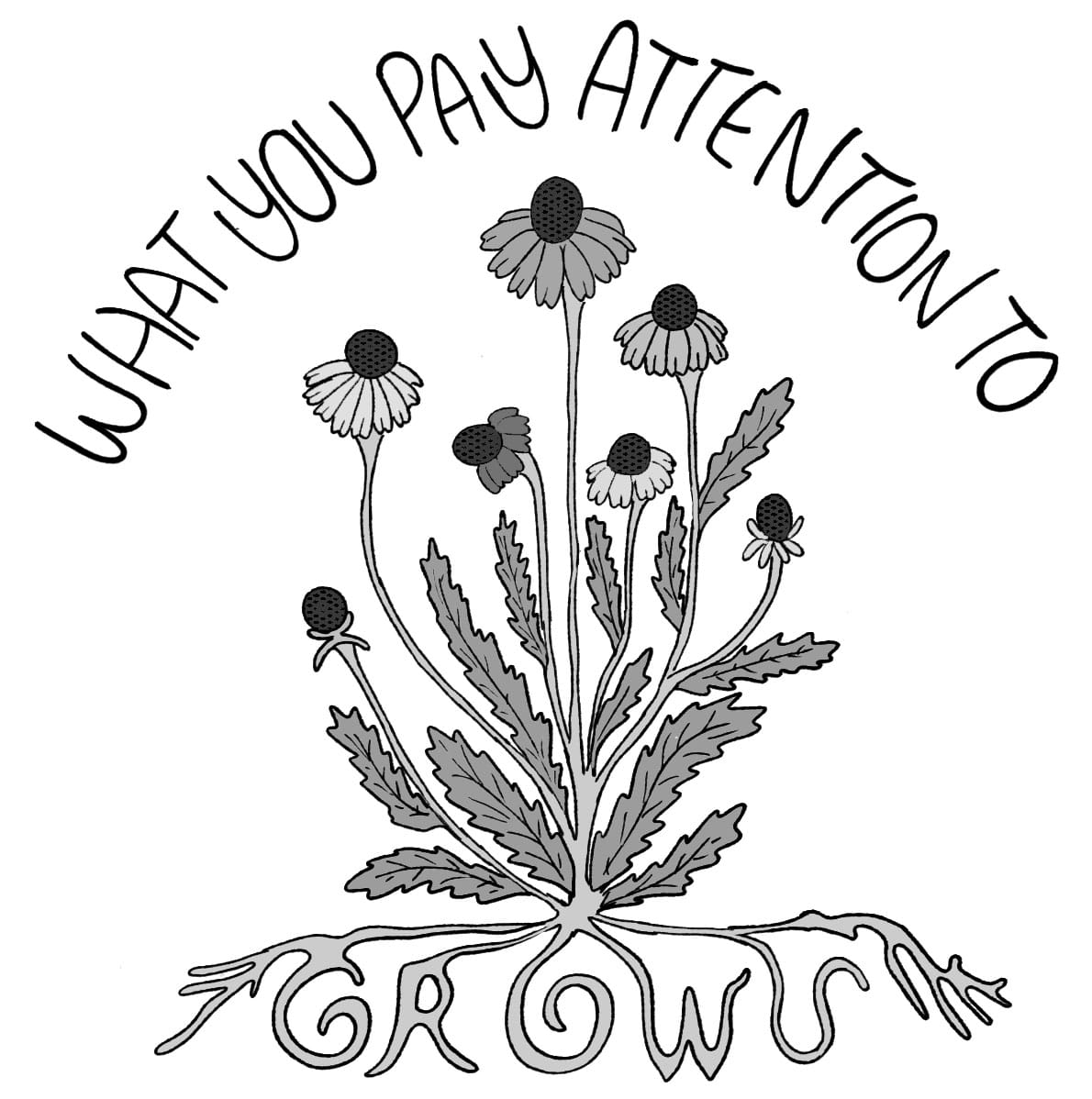
[Caption: What You Pay Attention to Grows — by Nikolas Lee]
Power is an energetic current, that flows in the direction of wherever ordinary people spend their time, attention, and energy. The figureheads, traditions, and institutions we deem as “powerful” only ever access power on loan—from us. The moment a people devote their time, attention, and energy elsewhere: power shifts.
To be clear, power does not live in institutions, formal decision-making positions, financial institutions, cultural figureheads, nation-states, or political parties. Power does not live in bank accounts or stock-market exchanges. Power doesn’t live in the ability to threaten, mislead, surveil, or cause harm to people or the planet.
Power lives with the people, as a collective, and it flows based on wherever WE choose to devote our time, attention, and energy. In short, if we want to uproot political abuse, we must stop acting as if they “have power” and understand that the People have always been able to repossess our power when figureheads forget themselves.
Ordinary people can redirect and imbue their power anywhere they want. If we’d like our living conditions to change, we would do well to start focusing our time, attention, and energy on each other.
This Is an Invitation to Play, Not Marching Orders
Power lives with us, in our neighborhoods, and it always has. There is a reason why our political abusers cut access to Sesame Street at the exact time they flooded our airwaves with hyper-scale propaganda. They are terrified of the collective impulse toward neighborliness, because they know power lives with the people.
They might have lied to us about what power is, but they know when we turn our time, attention, and energy toward each other that power returns to us. This is why they strive to keep us divided: to dam the flow of our energy.
Their schemes will not and cannot work without our passivity and indifference.
We prevail by practicing similar patterns of “the neighborly arts”— learning how to mass-cooperate at the neighborhood-level, first— then flexing our power in waves that reverberate across city, country, region, state, province, and nation.
The ideas in this field guide illustrate how we rug-pull political abusers by practicing the neighborly arts. If we approach this field guide with beginner’s mind and play toward cultivating people-power, we will also help bring into being the world we wish to live in and leave behind for our young people.
Crucially, in order to prevail, we must allow ourselves to tap back into our long-abandoned genius that makes us open to creativity, curiosity, compassion, and play. Kids have this in abundance. Adults, who allow themselves to be broken by the world, surrender their state of play; joylessness keeps adults trapped in undesirable situations.
If we don’t learn how to harness our collective power, through playing together and moving together, we will allow ourselves to be steamrolled by amoral, untalented, unrepentant villains. Worse still, we will have abandoned our children to bad men.
The poly-crises we face are serious, but the task before us is not insurmountable.
We already have the time, talents, and resources to prevail.
We must be the adults in the room and act to disrupt political abuse.
Neighbors Have Always Been Our Leaders
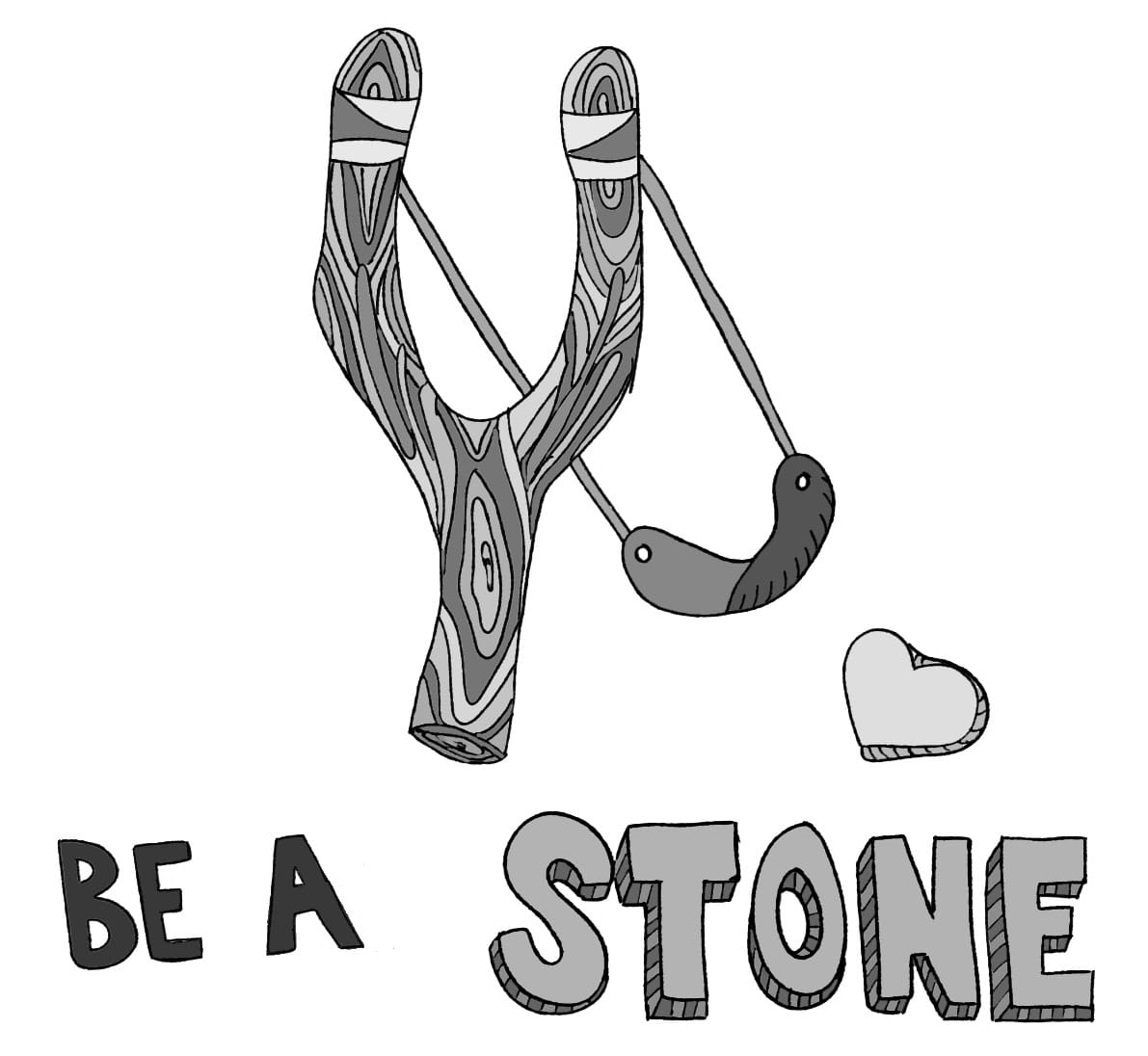
[Caption: David v. Goliath — by Nikolas Lee]
We have been told that power lives in cultural institutions: churches, schools, science and technology labs, mainstream media, political parties, mayors’ offices, city council chambers, governors’ mansions, legislative buildings, and presidential palaces. We are similarly told that people with access to the institutional levers are our “leaders”—the people who ultimately tell us what to do and declare which neighbors get to live with dignity and which neighbors are deemed disposable. All of this is a farce.
As academic and Holocaust survivor Viktor Frankel reminds us: “institutions have no souls; people do.” What he means, in that simple sentence, is that institutions, under duress, will always work to protect the institution, not the people to whom they are responsible—and they will make that choice to preserve an institution (a figment of our collective imaginations) over the very real lives of vulnerable people who get sacrificed in the name of “institutional resilience.”
Leadership has nothing to do with access to institutional levers. This point is worth unpacking, because too many people in uncertain times like these look to those with access to institutional levers and cry out: “Our leaders have abandoned us!”
Whether the person in question is the president of a college, the chief executive of a newspaper, or the president of a country, the uncomfortable truth is that those who ascend the ranks of institutions are not especially wise, compassionate, or accomplished. They’ve climbed the ranks, far too often, because they’ve demonstrated a willingness to corrupt the power loaned to them in order to do the bidding of elites. Their job is often to crush grassroots movements in order to keep the people who line their pockets comfortable.
We get out of this together, or we don’t get out of this at all. But one thing is for certain: we will get precisely nowhere by waiting on a bunch of sharpie-pushers to tell us what to do. Their plan is to hold fast to the calcifying institutional machinery and sacrifice ordinary people and the planet at the altar of corruption, consumption, and cowardice. That’s not a game plan any thinking adult (or child) should be willing to accept.
One does not uproot this kind of political abuse with ballots, bullets, or bribes—but with the bold action of ordinary people who refuse to leave the world worse off for future generations.
Leadership has always come from the ground up. Leaders exist all around us; they remind us that we have an inherent right to determine our future. They point neighbors in the direction of their own agency to achieve that future, particularly during uncertain times. Leaders know success isn’t about grandstanding but, rather, pooling our collective brilliance (on the ground) so that we gain the courage needed to embrace necessary risks and move in the direction of our collective liberation. They demonstrate, through example, that “feeling powerful” has always come from what we accomplish when we move together.
The problem isn’t that we don’t have leaders. It’s that we’ve been looking up to those who were never for us to begin with.
If you’re looking for leaders, start by standing in front of a mirror—and then go join the helpers in your neighborhood.
Use Flower-Power to Amass People-Power
Now that we’ve established what power actually is and what leadership means, the remaining pages of this guide help ordinary people shift from symbolic protest[1] to movement-building[2]. This is a critical step in reclaiming people-power, because it moves people from a defensive[3] position to an offensive[4] position.
Rather than appeal to those who have corrupted our institutions—so that material change has become seemingly impossible—this guide helps people move around corrupt institutions and, instead, leverage the skills and resources they already have to create change at the local level. This approach to people-power transforms our political, social, economic, and ecological cultures from the ground up.
Once we accept our responsibility to organize with and care for one another, we make it difficult for political abusers to withhold resources to control us. Crucially, once a people redirect their power to their neighborhoods, they are much less afraid of taking strategic risks together and weathering arbitrary punishments that abusers mete out in order to keep people under their control.
Whether at the microcosm of the neighborhood or the macrocosm of the nation-state, once people are no longer afraid of the bully, the bully loses power, and the entire infrastructure propping them up collapses under the tectonic shift of a fed-up people who have walked away to build their own way forward.
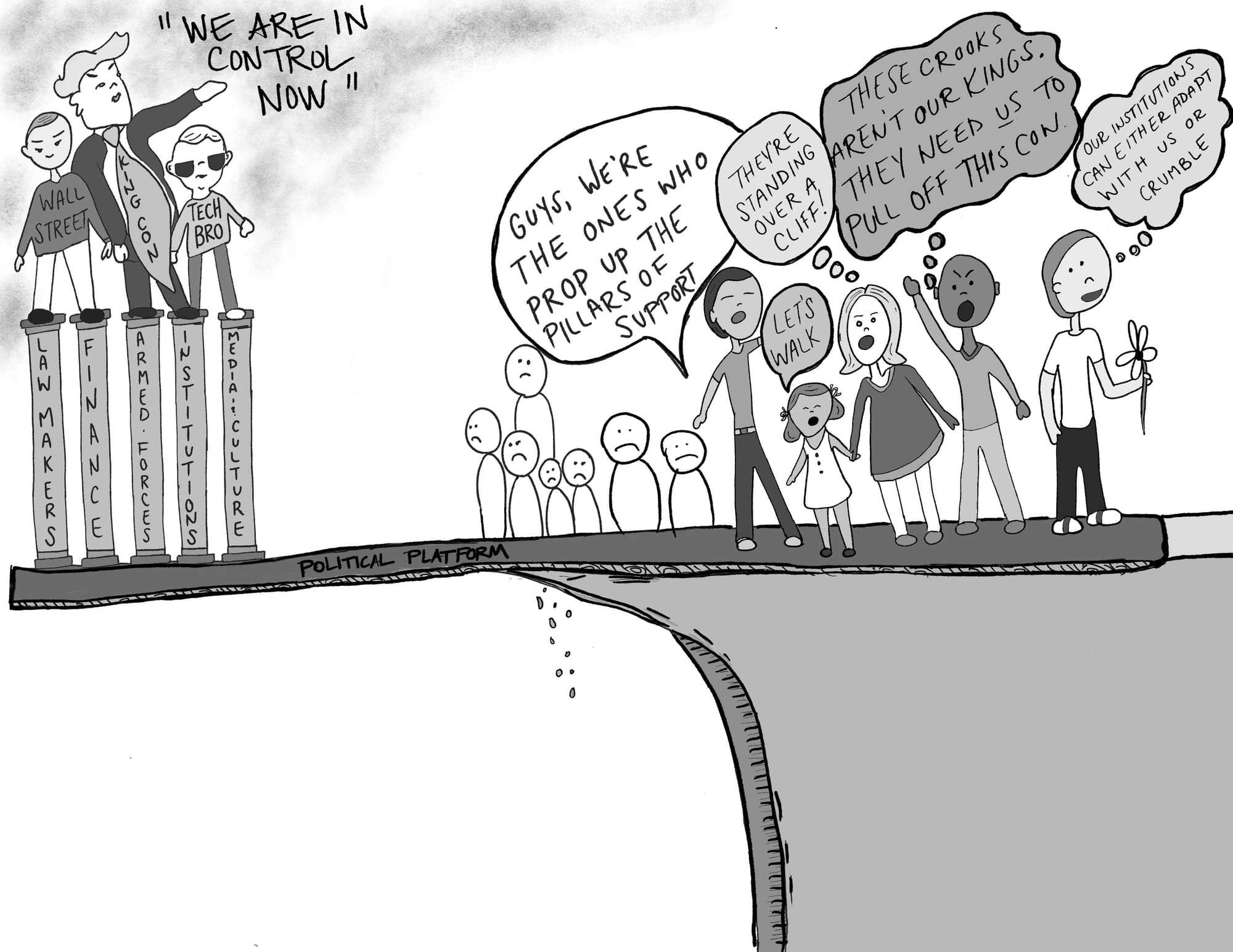
[Caption: All We Have to Do Is Walk Away — by Nikolas Lee & GPat Patterson]
This field guide encourages readers to play the long game. Our goal is to care for each other in the here and now, while also looking forward seven generations into the future. Because of this multi-generational approach to organizing, this guide welcomes people of all ages and experiences—particularly children and young people—to join neighbors in shaping a reality that makes space for the collective thriving of ordinary people and the planet.
Rather than operate from an insular attitude of “I’ve got me and mine,” which stokes division and serves the interests of political abusers, this guide encourages readers to recognize that our strength is rooted in our interdependence and communal expertise. For that reason, this guide calls upon a broad spectrum of neighbors’ time, talents, hobbies, skillsets, interests, experiences, and resources.
Neighbors That Play Together, Prevail Together
The goal isn’t to “win” the existing game, or to take over the game board and populate it with “our people,” because that would keep the same toxic structure in place. Rather, our goal is to build a better game—a way of living and collaborating—that works for everyone.
For similar reasons of avoiding old mistakes, we must avoid technocratic, militaristic CEO-speak, like “smart goals,” “strategies,” “tactics,” and “outcomes”—which tend to regard a community’s needs as data points on a spreadsheet. Instead of moving from a top-down homogenous strategy, the goal here is to shift our focus to practicing a more beautiful pattern that is more attractive to the vast majority of people. While the business world might call this “creating buy-in,” a more accurate term is cultivating right-relationship.
This guide harnesses our need for purpose, connection, and joy; it emphasizes our ability to grow the world we wish to see, in the here and now, in the neighborhoods right outside our doors, without ever asking permission from the political caste to make it so. When we begin to practice more attractive alternatives to the toxic status quo, making bold moves that community members can witness and feel in their neighborhoods, we are better able to recruit bystanders (who simply wish things would get better) into upstanders (who act to make things better).
Because neighborhood organizing is more holistic and horizontal, rather than top-down and task-oriented, we will be better equipped to bypass the inertia that keeps us locked in stasis and better poised to power our movement with a genuinely renewable source of collaborative energy.
Playing for Keeps: How We Reclaim Our Power
Our success will depend on our ability to: (1) recruit bystanders into upstanders, (2) educate neighbors about where our power actually lives, (3) refuse to play into our political abusers’ hands, and (4) grow the world WE want, without asking for political abusers’ permission.
The calculus here isn’t about “demanding change” from corrupt politicians and out of touch institutional figureheads: it’s realizing we already have the power to create change ourselves.
When people learn to move together, there isn’t a single thing we can’t accomplish: We can prevent our neighbors from being abused and stolen. We can prevent abusers from raiding our neighborhoods and spreading fear. We can build parallel food, medical, and housing systems to prevent abusers from making us desperate. We can refuse to break in the face of overt political abuse and share resources instead of turning on one another.
We can bypass the entire idea of a one-time general strike, in favor of creating massive parallel support systems that rip the tablecloth right out from under our political abusers for good.
It is time to walk away from our abusers. We deserve better, and so do our kids.
– ❀ –
Let’s move together.
Let’s play together,
offline, in our neighborhoods,
just like Mr. Rogers taught us to do.
“What Can I Practically Do, Besides Read This?”
If you want to show your appreciation for these words + illustrations, we would be honored if you spent 2-3 hours each week in humble service to your neighborhood: together, offline, off-screen, and outside institution-time.
Chapter 1 Footnotes
A symbolic protest doesn’t mean that the protest is ineffectual. It means that the protest is a symbol of community feeling about an issue. Symbolic protests might look like showing up with signs for an occasional mass demonstration. ↩︎
While some people use the term loosely, a movement actually means something critical about how communities move from a feeling to sustained widespread action. Specifically, movements build local power and transform culture, on the ground, through an ecosystem of small daily actions. ↩︎
A defensive position, in this case, would mean protesting abuses of power after the fact. That’s mainly what we’ve been doing. ↩︎
Going “on offense” means building what you want to see in the world, instead of appealing to people whose primary objective is to retain coercive control. ↩︎

Member discussion: