This field guide helps ordinary people uproot political abuse. It also helps ordinary people co-create the world they wish to live in—and protect the world we wish to leave behind for young[1] people—seven generations into the future. Crucially, if we want to prevail, we must also tap into our long-abandoned (childlike) genius that makes us open to creativity, curiosity, compassion, and play.
For every alarmed politician who has implored people to “rise up” and “wake up,” this field guide explains precisely how we go about doing that.
Hyper-scaling neighborliness at the hyper-local level isn’t just some nostalgic idea reminiscent of Sesame Street. The ideas articulated in this field guide illustrate precisely how we pull the rug out from under our abusers.
Power lives in our neighborhoods; it always has. If we don’t learn how to harness our collective power through playing together and moving together, we will allow ourselves to be steamrolled by amoral, untalented, and unrepentant villains.
What we face is not an insurmountable task.
We already have the time, talents, and resources to prevail.
We must be the adults in the room and act to disrupt political abuse.
We Must Stop Playing with Political Abusers
You may notice that I don’t mention elections or suggest appealing to elected officials in this field guide. My silence on these points does not suggest that people ought not vote or engage with local governments. Let me be clear:
🐦⬛
Do vote.
Do unionize.
Do run [2] for office.
Show up for your library.
Attend your school board
& community council meetings.
Such
actions
matter.
Many of us do take part in voting and engage in local government. At the same time, a good many more of us are dispirited—because we know, down to the quick of us, that simply engaging with these institutions is nowhere near enough to confront the challenges we face and the danger our country poses to neighbors around the world.
In the pages that follow, I invite you to recognize that ordinary people’s power is far more expansive than our capacity to vote or engage with boobytrapped institutions. Politics is the theater that lives on top of our actual power.
We are more powerful than our political abusers, even when they hamper our ability to participate in what have become increasingly unfree and unfair elections. We are still more powerful than our political abusers, when they escalate violence in a war[3] against their own people.
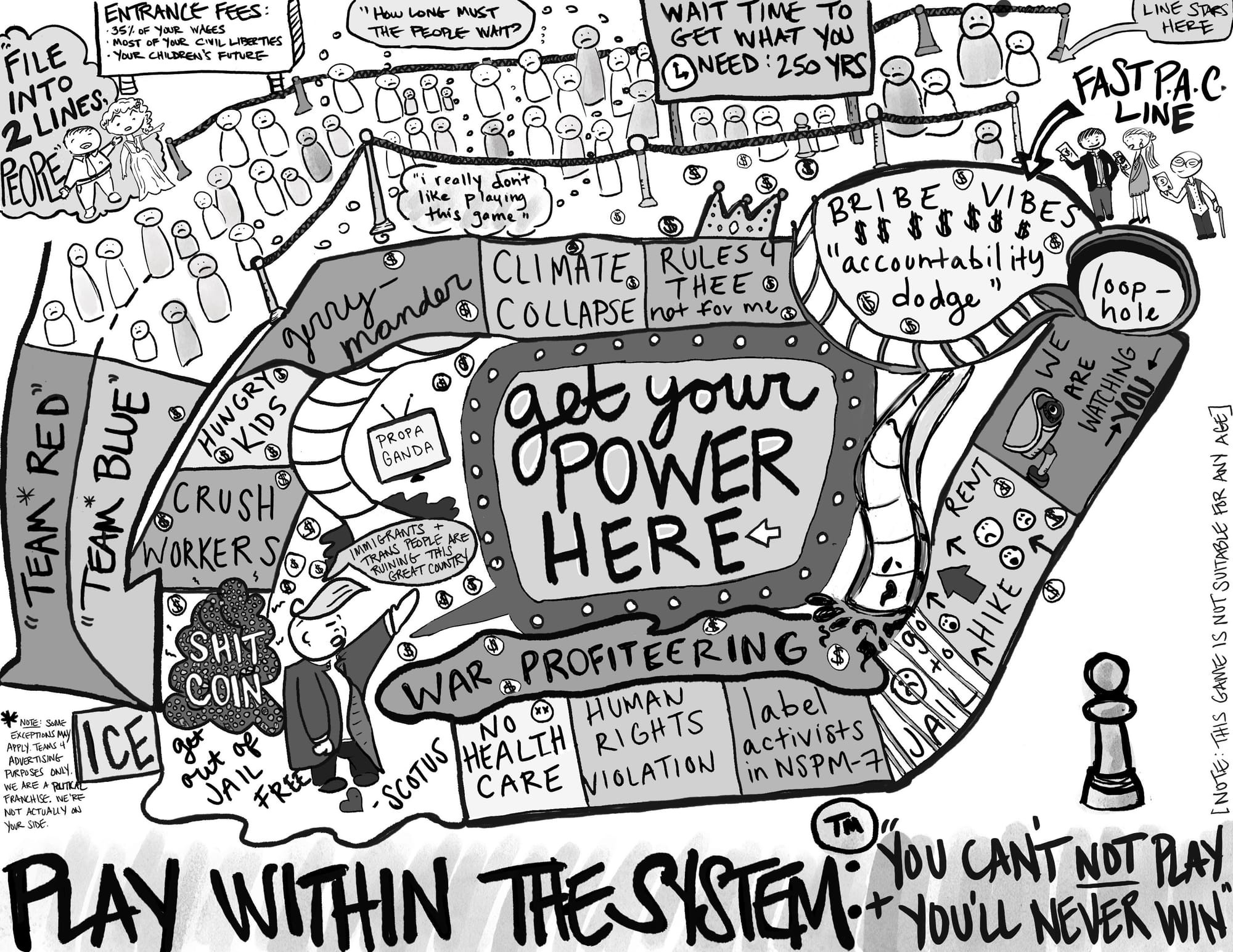
[Caption: Step Right Up & Play within the System — by GPat Patterson & Nikolas Lee]
This is a picture story.
Spend time with it.
Do you see yourself in it?
Do you actually like what you see?
Where do you feel the answer in your body?
Are you breathing or are you holding your breath—
or is someone else making sure you cannot breathe?
To even have a chance to prevail, we must recognize that our political power, as a people, has been hoovered up in an intentionally dispiriting game of Monopoly. Our institutional figureheads scam us, like carnival barkers, cajoling us to "step right up and change the system from within.” Have you won[4] the “big prize” yet?
This narrative that we can repair rigged systems from the inside has always been a trap, told on loop precisely because it keeps people exhausted, frustrated, resentful, and ultimately checked out. All the better to manipulate us with.
We’re not actually as stuck in this coercive game of Monopoly as we’ve been encouraged to believe: they need us to play along, they need us to comply, they need us to believe their lies, and they need us to turn our heads and look the other way when our neighbors are harmed.
Ordinary people have always been braver than the fools who self-identify as “leaders” while acting as looters. Bad actors have always projected their own misdeeds[5] onto our neighbors courageous enough to intervene. For the prevailing majority of us, raised on PBS, public schools, and public libraries: we must reject bullies and learn to trust our neighbors more than our lying screens, and stop playing political abusers’ games.
An Invitation to Start Playing a Different Game
Ordinary people have always held more power than political abusers. We just need to learn what power is and how to channel it together toward our collective liberation.
There are hundreds of ways we can use what we already have, where we’re at, to shift the balance of power out from under the people who are abusing us.
When we all play: we all win. Together. Offline. In our neighborhoods.
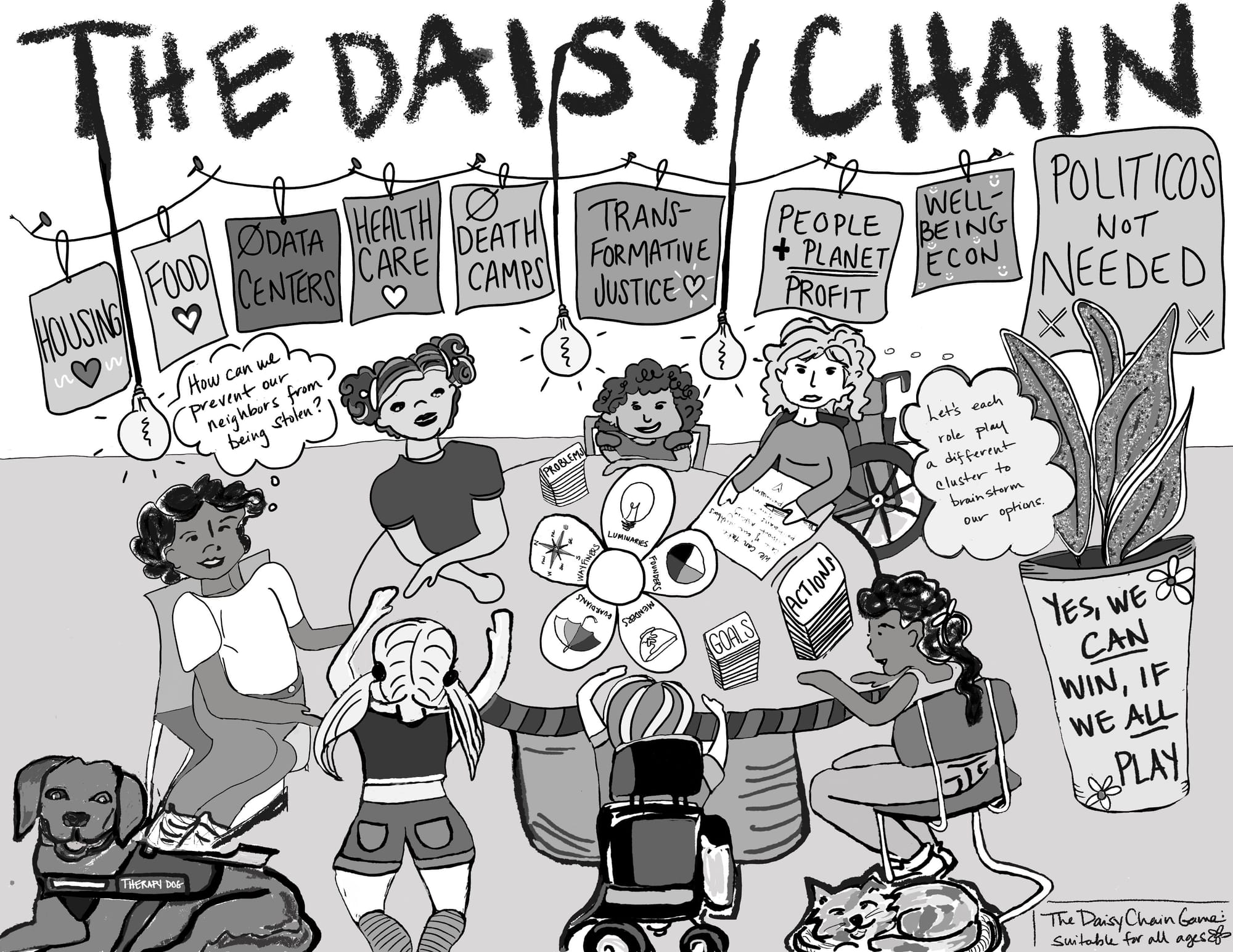
[Caption: Playing The Daisy Chain Game — by GPat Patterson & Nikolas Lee]
Rather than view ourselves as stuck in a rigged system where the people and the planet were never meant to win, our collective goal, right now, is to build a better game—one that moves outside and around the institutions that have been boobytrapped against us. The task before us is to pull the rug out from under our political abusers and co-create a world that works for ordinary people and the planet.
Given the scale of the challenges[6] we face, it’s not enough to simply say “no” to abuse. Ordinary people need a collective vision of the future that enables us to move off the boobytrapped game board together, with a clear sense of purpose of where we’re going and why it’s worthwhile for all of us.
Practically, we must reclaim the upper hand in this contest for “hearts and minds,” by shifting from vague calls to “get involved” and toward tangible involvement in our neighborhoods, because that is where we have the most power.
Crucially, we must remain nimble enough so that we can tailor our plans to our circumstances as they change, without losing the rhythm we’re holding together.
Audaciously, our organizing must remain joyful enough that we are able to sustain the energy needed to play our own long game—instead of remaining trapped in a coercive game[7] that’s been forced upon us.
We Reclaim Strength & Our Power by Playing Together
[Caption: Neighbors United Won’t Be Beet]
Our goal is to mobilize our numbers from No Kings, Standing Rock, Women’s March, Black Lives Matter, 50501, Sunrise Movement, Occupy, Water Protectors, Disability Rights movements, Immigrant Rights movements, and every Trans, Two-Spirit and Pride movement that’s ever birthed itself around the country and shape-shift from engaging in protests (when things go wrong) toward creating leader-full, networked neighborhoods—where we make things right, together, offline.
We must resolve to do for each other what our political abusers have claimed is “impossible,” precisely so that we remain weak, disconnected, and perpetually on the back foot.
They need us weak because there are more of us than there are of them.
Once we learn to move in formations around them, they’re cooked.
Take This Guide Seriously Enough to Play with It
Though I am a researcher[8], this field guide is not academic. We are well past the time for book clubs and armchair critiques. Go outside and play.
Though I am an educator, these are not top-down instructions[9], meant to be adopted, whole cloth, across communities and regions with unique topographies, vulnerabilities, strengths, resources, and cultural values. Tailor this to where you’re at.
Though I enjoy a good theory, this ain’t it. This field guide is about praxis: it mirrors back to people what we have always done during times of crisis. We evolve and help one another. If you find something brilliant in this field guide: that’s us, not me.
Though I have labored to make this worthy of your time, I acknowledge that it is not, cannot, and should not[10] be perfect. This document is meant to be played with, practiced, and adapted to your community.
Though some version of this field guide may find its way into print, it is a living document waiting to be adapted and animated by communities across the country. In fact, the only way to misuse this document is to keep it on a shelf—without taking it to your neighbors, developing home-court ideas, and doing the courageous and vulnerable labor of playing together.
Though I employ whimsy and homemade drawings to inspire, my aim is serious. This is a civilian-based defense plan[11] to help ordinary, unarmed people resist a coup. We are now living under an active siege on our democracies, and we are, thus far, without a coordinated plan for ordinary civilians to defend[12] our neighbors from tyranny. If my approach seems “cutesy,” consider that it’s much easier to teach people how to harness play[13] to organize under duress than it is to repeatedly point to the monster on the horizon, offer no material plan, and demand that “somebody do something”—all in full view of the children looking to us to provide them safety.
Things to Keep in Mind as You Read This Guide
If you are someone who has never had to organize from the margins of society, this guide may seem overwhelming to you[14]. Take breaks when engaging with it and remember that discomfort is a natural part of growth. Do not attempt to do everything on your own or micromanage others.
This field guide describes a living ecosystem of actions: If readers put 2-3 hours a week into playing in their neighborhoods—together, offline—we can and will shift our political course, especially if we recruit our friends and neighbors.
The goal of this field guide is not perfection but experimentation. We must create a neighborhood movement so rich, so joyful, so brilliant, and so textured with opportunities to get involved that bystanders transform into upstanders.
To make this guide more approachable, I include hand-drawn art that helps people better understand how to organize. For those inclined to tabletop gaming, some of the art in this guide can be printed out and turned into a DIY tabletop cooperative game to help your neighbors organize. (More on that in Chapter 5.)
Finally, I include footnotes for those who appreciate cited sources, additional reading, and commentary that feels relevant but may have otherwise disrupted the flow. If you’re not a footnotes person, skip ‘em.
– ❀ –
“What Can I Practically Do, Besides Read This?”
If you want to show your appreciation for these words + illustrations, we would be honored if you spent 2-3 hours each week in humble service to your neighborhood: together, offline, off-screen, and outside institutional time.
– ❀ –
Author’s Note Footnotes
We must honor all young people (human, animal, and critter), who will inherit the consequences of our actions and our inaction. ↩︎
Especially run for office if you have the integrity to resist accepting political bribes and refuse trafficking in propaganda. ↩︎
A coup is absolutely a war against one’s own people. Let that sink in. ↩︎
And if you think you have, does it feel good? Check in with your body. That’s the real question. ↩︎
In Capitalist Ussia, my neighbors and I live under the petty enforcement of those who have abdicated their responsibilities to the people in order to enrich themselves. To put a fine point on the matter, the (alleged) Commander in Chief, Vice President, Speaker of the House, Supreme Court, Secretary of Defense, Director of the Federal Bureau of Investigation, and head of the Department of Homeland Security of the United States have each stated, in turn, their intent to treat ordinary people, who object to their own abuse, as if they are “enemies of the people.” This is a lie from the pit of Wendigo. ↩︎
Our neighbors, human and non-human, are being mass-murdered in ever-widening circles, by people who live for the figment of finances—convincing themselves that their fan fiction about an “economy” or “industry” is worth the fabric of life itself. Our elected officials dishonor us, dishonor their elders, dishonor children, and dishonor themselves. ↩︎
For some of us, it’s been a long two-hundred-and-fifty years. For more of us, it’s been a long couple of centuries. It’s time. We’ve evolved. We’re smarter than we’ve ever been; we just need to get connected with each other and disconnected from Changing the System from Within, While It Eats Us Alive™️. It’s a brutal board game, but they only keep winning because we keep playing. ↩︎
I specialize in play-based adult education and people-powered technical communication. ↩︎
I am grateful to Marshall Rosenburg’s wise advice, in Nonviolent Communication, not to “should somebody.” That’s an excellent way to kill connection and squash potential. ↩︎
A single person cannot think of everything. It would be peak hubris to assume otherwise. ↩︎
For further reading on civilian-based defense, please refer to Gene Sharp’s book Civilian-Based Defense. It is free to download from the International Center for Nonviolent Conflict. Sharp is talking about how ordinary people engage in strategic nonviolence to upend authoritarian coups. ↩︎
Not only did the US never bother to develop a civilian defense plan, in the event of the rise of a strongman, but just as recently as September 2026, the US military refused to take part in multinational discussions about how to protect civilians during times of warfare. Both of these data points demonstrate homicidal negligence and brutal disregard of humanity and life itself. ↩︎
As a public educator, I find that focusing on our collective agency, insisting on our right to author our own future, and protecting our children—with creativity, courage, and joy—is the exact tone to strike for the challenging (but not insurmountable) moment before us. ↩︎
We have a responsibility (to our kids and to our neighbors) to act like grownups and alchemize our discomfort into meaningful action in the here and now. ↩︎

Member discussion: