
This is the last of a five-part appendix for The Daisy Chain: A Neighbor’s Guide to Mass-Cooperation. This appendix illustrates just some of the hundreds of ways people can activate the Wayfinders cluster to restore a felt sense of stability in our neighborhoods and a collective faith in the direction we’re headed, so that political abusers cannot make us feel like we are trapped[1] in their game with nowhere to go.
By playing with The Daisy Chain, we can rug-pull power away from our political abusers. One of the ways we do that is by restoring the sense of collective trust and collective agency in deciding the direction we’re headed. There is no way out from political abuse that does not include the following two criterion[2]:
- parallel leadership organizations that live outside hollowed out institutions
- clear transition plans that describe a better life and detailed transition plans for how we get there together.
We prevail by out-organizing our abusers. When we do this, people become more confident that a materially and experientially better life awaits us on the other side of abuse— we know it because we’ve written it down and created public buy-in around where we’re headed. This is precisely what the Wayfinders Appendix helps us accomplish.
Wayfinders in Action
Wayfinders move necessary information to neighbors, develop decentralized leader-full networks, and translate ideas about self-governance into processes our communities can act on. There are three petals of the Wayfinders cluster: investigate, unionize, and coauthor. Neighbors in this cluster investigate those enacting political abuse, unionize neighborhood groups to help people organize at the hyper local level, and listen to what neighbors would like to see in the world in order to document that vision into a plan.
This work prevents political abusers from manipulating the chaos they create to claim that a people are in too much disarray to govern themselves. Below, you’ll engage with a description of each of the three Wayfinders petals— along with an itemized list of things we can do (right now) to play with that petal in our neighborhood.
Investigate Petal
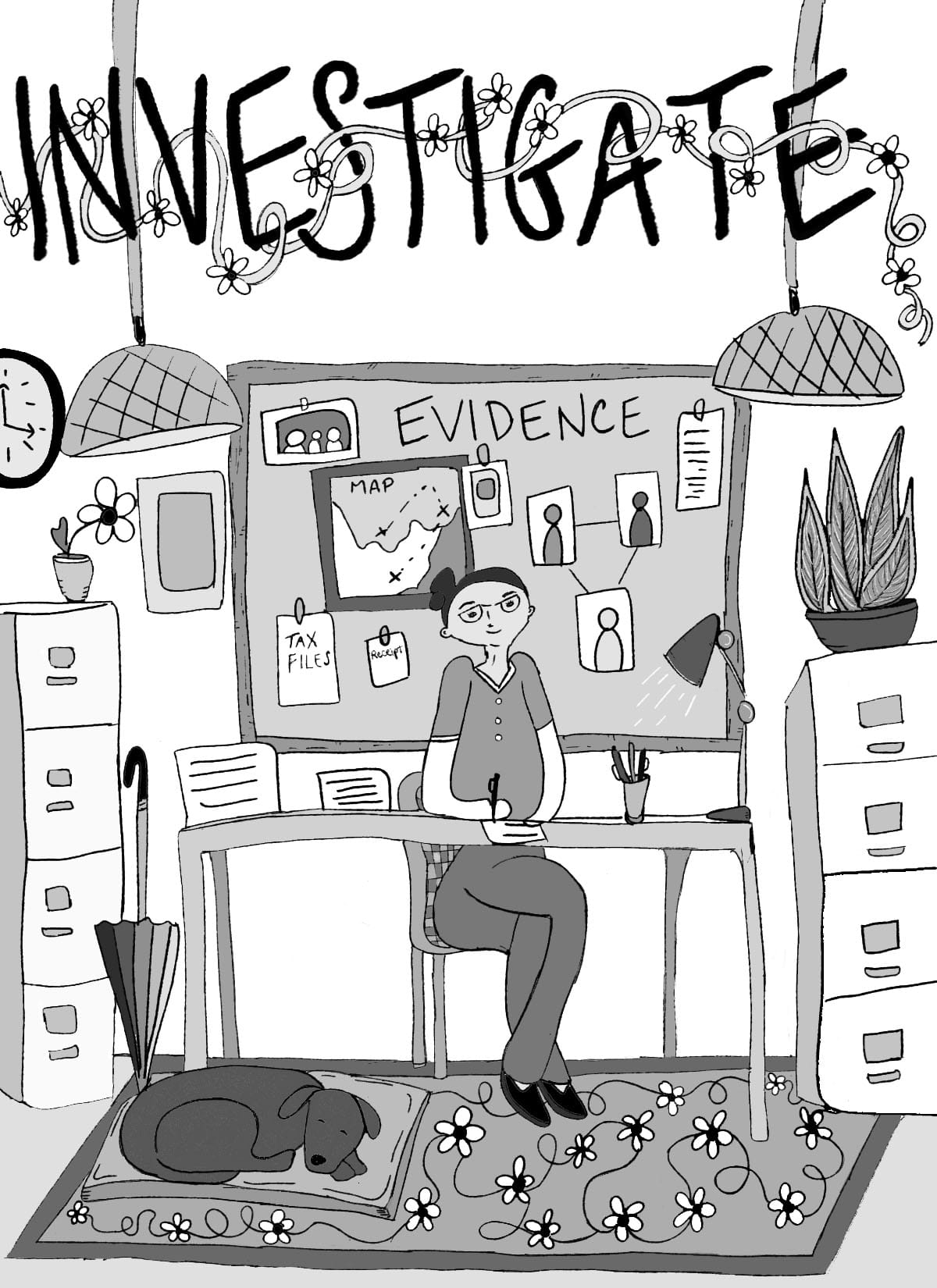
[Caption: Investigate Petal — by GPat Patterson & Nikolas Lee]
Investigators work at the neighborhood level to put abusers under the microscope, so that every misdeed they commit and every single accomplice to abuse has their actions recorded and documented. This is not about creating viral content online to further one’s journalistic[3] career; rather, this is to create thousands of hardcopy, digital, and analogue documents so that not a single abuser escapes the net of accountability. Neighbors in this petal collect and securely store evidence demonstrating political corruption, constitutional violations, war crimes, and other human rights abuses. In so doing, the Investigate petal restores community confidence that engaged neighbors will step in for each other, even if formal watchdogs neglect to honor their commitments. Those drawn to this petal may come from all walks of life but may feel especially aligned for journalists, archivists, photographers, videographers, scrapbookers, diarists, and those who are skilled in collecting and preserving people’s firsthand testimonies.
Note: The Investigate petal provides a counterweight to political abusers, who try to convince their targets that they won’t face any consequences for the abuse they cause. For details about the kinds of actions Investigators might take to uproot political abuse, see the list below:
{:start="289"}
289. assign “beats” to document as much information about political abuse as possible
290. ensure evidence of abuse is updated, backed up, and stored at secure locations in at least three locations across the neighborhood
291. establish a people’s chain of custody, to preserve authenticity of information collected
292. organize a group of diarists who record contemporaneous written accounts of neighborhood events and encounters of political abuse and collusion with political abuse
293. consult with lawyers and collaborate with the coauthor petal to develop trial and evidentiary protocols to hold abusers to account
294. collaborate with the document, lionize, and alchemize petals to develop future policies that prioritize the well-being of those harmed
Unionize Petal
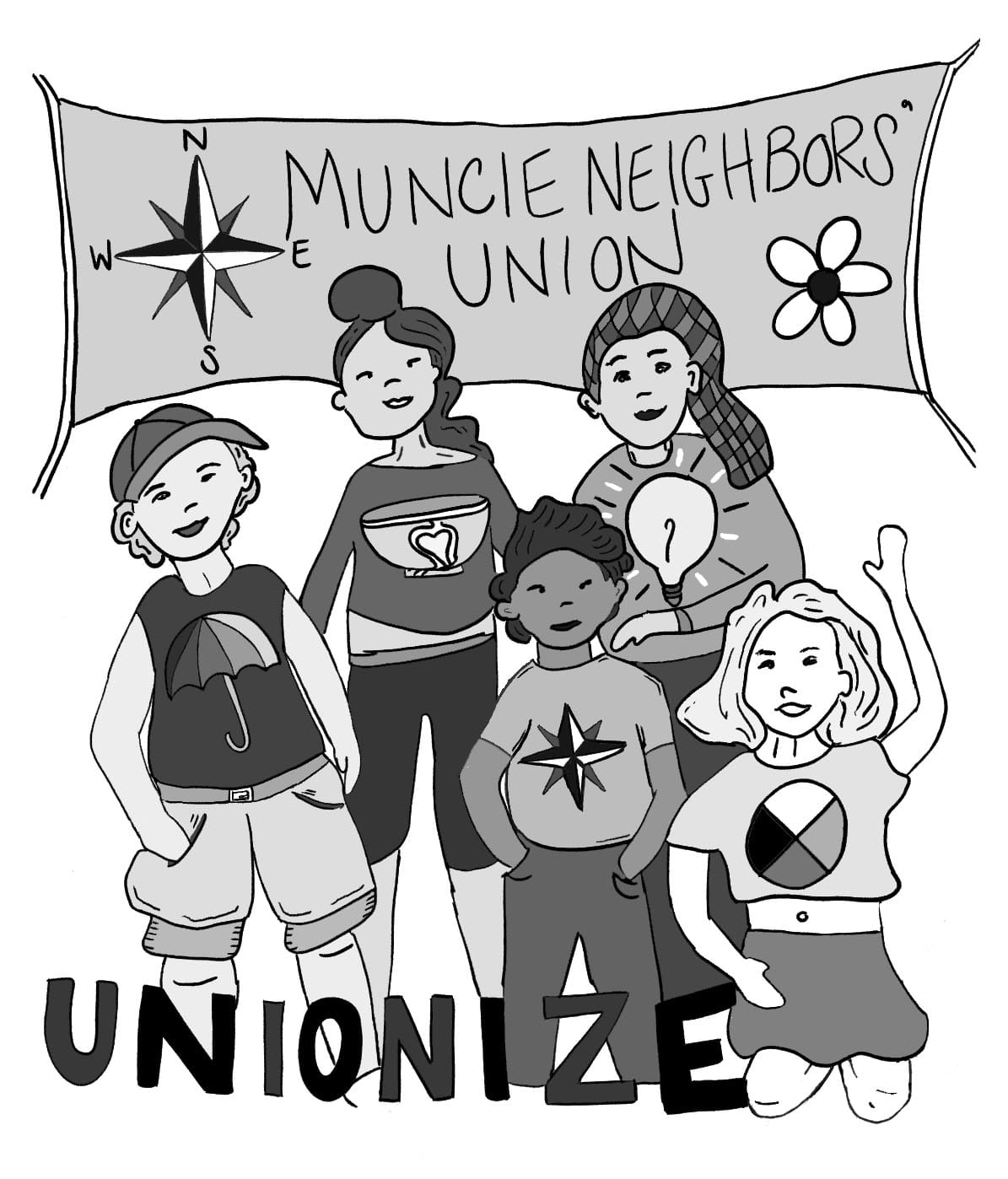
[Caption: Unionize Petal — by GPat Patterson & Nikolas Lee]
Neighbors engaging in the Unionize petal prevent leadership vacuums by reclaiming what it means to model leadership: they help their peers recognize how their already-existing talents, interests, and energy can be used to benefit the community. Those drawn to the Unionize petal will possess talents across the spectrum but are especially keen on employing the collaborative decision-making process called sociocracy[4] to help their neighborhoods develop and sustain parallel support systems that keep communities resilient. It is especially important for those operating in this petal to understand leadership as a form of lamp-lighting, not gatekeeping. Those operating in this petal also call back power to their communities by creating neighborhood unions, where people can reorient, access vetted information, and glean information about pertinent community action plans.
Note: The Unionize petal provides a counterweight to political abusers, who corrupt or otherwise cower to institutional figureheads so that people panic and think they have no leaders to help them orient through political crises. For details about the kinds of actions Unionizers might take to uproot political abuse, see the list below:
{:start="295"}
295. identify informational standards that garner community trust
296. develop city, county, state, and region-wide networks to communicate relevant information to neighbors
297. identify and correct misinformation, disinformation, propaganda and psy-op campaigns
298. collaborate with the create petal to develop propaganda-defense posters
299. deliver a free newsletter to be distributed via listserv, ideally on a weekly basis
300. develop low-tech papers, posted in high-visibility community areas (if internet is down)
301. practice sociocracy to solve problems and meet goals across The Daisy Chain
302. create a dispatch to communicate needs across The Daisy Chain
303. identify leaders across petals in other communities in your city, county, and state
304. work with democracy protectors, representative organizers, and other community leaders to develop a grand strategy to sequence, sustain, and hold a general strike until democracy is restored
305. mobilize neighbors to resist the building of data centers, concentration camps, and destruction of public lands
306. operate as a dispatch hub, alongside the guardians cluster, to mobilize in the face of natural and political disasters
307. work with local elections offices to ensure accurate reporting of election results and any attempt to interfere in voting processes
308. create a parallel city council to ensure the safety and well-being of all community members during a general strike
309. work alongside other petals to ensure a safe transition of power, whenever general elections are held
310. work with the coauthor petal and guardians cluster to develop a protocol for a nonviolent civilian defense plan, to prevent future coups
311. work with the share petal to connect community members who want to get involved in a specific petal
Coauthor Petal
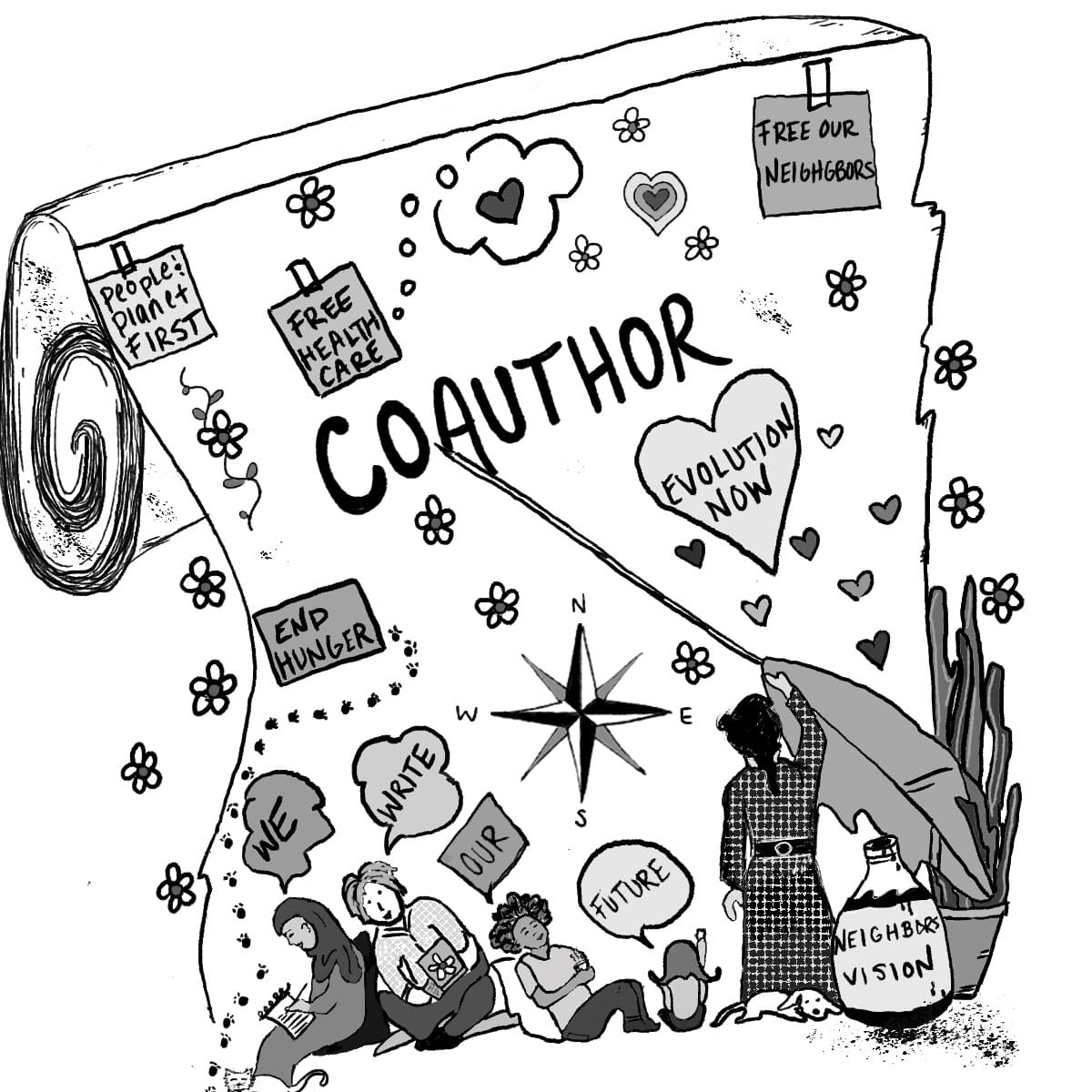
[Caption: Coauthor Petal — by GPat Patterson & Nikolas Lee]
Neighbors engaging with the Coauthor petal acknowledge societal destruction while also reframing it as an opportunity to collaborate toward a vision of society that works for everyone. People drawn to this petal work closely with those in the Imagine petal (Luminaries cluster) to facilitate local conversations about our democratic futures. They collaborate with Luminaries in other postal codes across the country, with the aim of coalescing into a representative group that drafts a mission statement and foundational documents for our collective political future. Their efforts boost community members’ resilience and ability to take on risks because they’ll know there’s a plan waiting for when political abusers’ plans inevitably fail. This work keeps people’s eyes fixed on self-governance and staves off additional future political abusers plotting in the wings.
Note: The Coauthor petal provides a counterweight to political abusers, who often rewrite laws and policies in order to fuse themselves to state (and other cultural) institutions. Abusers assume that if they destroy social norms and societal pillars, ordinary people will feel like there’s no way out and just collapse. For details about the kinds of actions Coauthors might take to uproot political abuse, see the list below:
{:start="312"}
312. document a process to create time banks at scale, noting the expansive ways work can be reimagined to serve everyday people and not the whims of opportunists whose model of profit is rooted in extraction and exploitation
313. create technical documents that help communities transition to a parallel time-based currency, which is un-riggable, un-hoardable and grounded in “spoon theory” (which doesn’t leave people with disabilities and elderly people behind)
314. create public-facing, easy to understand documents that explain how de-growth, well-being economies work and how people can transition to de-growth economies without seeking institutional or government approval
315. create public-facing, easy to understand documents that explain sociocracy as a way to reimagine leadership by relying on a dispersed horizontal (rather than top-down) model
316. create public-facing, easy to understand documents that not only explain restorative justice but also explains how communities can engage in practical de-escalation tactics that do not rely on calling armed law enforcement
317. create public-facing documents that explain how we live in a pay-to-play legal system in which the hoarding class engages in crime without ever facing accountability, while everyday people and families lose their lives to a prison system for crimes of survival
318. create public-facing transition documents to explain a rollout of a comprehensive system that reimagines what community safety means and how neighbors can develop compensated community roles that do not rely on draining public resources to fund a corrupt, militarized surveillance state that treats our neighbors like enemy combatants
319. create public-facing documents that explain the harms (and un-sustainability) of mono-agriculture, and offer practical steps for neighbors to reclaim food systems rooted in more sustainable indigenous farming, ricing, fishing, hunting, foraging, and food storage, that respects the land and all who live here
320. create public-facing documents that explain the ecological and political harms of the automobile industry, explain available means of already-existing biking and animal-based transportation—and how neighbors can adopt this transportation without asking for institutional permission
321. develop detailed but easy-to-understand policy that explains how already-existing highways can be converted into high-speed railways, with stops that include public banks of solar-powered electric bikes to get people between stops—being sure to articulate how those currently working in already-suffering auto industries will be retrained for these jobs
322. develop detailed but easy-to-understand policies to explain the benefits of converting auto-centric roadways into multi-use pedestrian travel, including comprehensive rest stops and a rewilding of green-spaces around these multi-use spaces to reclaim mutually beneficial space for our indigenous animal neighbors
323. create and amplify easy-to-understand, public-facing documents that accurately explain calls for Land Back as a return to “reciprocal, consensual attachment[5]” to the land, not a project of dispossession of peoples currently living on Turtle Island— explaining practical steps ordinary people can take to return land to First Nations with knowledge on how to rehabilitate lands that have been abused by extraction and terraforming
324. create public-facing documents that reimagine hyper-local universal healthcare, healthcare training, and (critically) hospice training and grief doulas so that people are supported and equipped to handle the cycle of life and mortality
325. create public-facing documents that help people take practical steps to codify (in practice) universal rights for children, people with disabilities, and our elders—in such a way that reclaims a deep respect for people in all stages and conditions of life, refusing a culture that repeatedly treats children as property, disposes of people with disabilities, and warehouses our elders with indignity instead of honoring them
326. create public-facing documents that help people identify practices to reclaim older, more expansive, village-level support for families and young people—in ways that refuse to trap people in isolated dyadic, nuclear family systems that create desperation, dysfunction, and the endemic abuse of women, children, and gender-expansive people
327. create public-facing documents that identify the universal harms of racial and gender-based hierarchies that leave all people (including those at the top of those unhealthy hierarchies) dispossessed—articulating concrete practices everyday people can engage in to codify universal rights in practice, including adopting processes of reconciliation and reparation of generational harm
328. offer clear, detailed processes for how we might learn from countries around the world that have adopted new constitutions[6] that honor human, animal, and ecological rights
– ❀ –
“What Can I Practically Do, Besides Read This?”
If you want to show your appreciation for these words + illustrations, we would be honored if you spent 2-3 hours each week in humble service to your neighborhood: together, offline, off-screen, and outside institution time.
Wayfinders Appendix Footnotes
Abusers often destroy political institutions to create the sense that there’s no point of return to “normal.” Peter Ackerman describes this move well in his book The Checklist to End Tyranny. There can be no denying we have passed a point in which entire institutions will need to be rebuilt from the ground up. What we cannot and must not do is leave this planning up to the arsonists and political enablers themselves, because such people have been very clear about the world they want for us, and it is one of subjugation and annihilation. This cannot stand. Grownups must roll up their sleeves and do the work. ↩︎
Gene Sharp, founder of the Albert Einstein Institution and author of From Dictatorship to Democracy is clear that when people fail to develop detailed transition plans, there is always some opportunist waiting in the wings to enact another coup. This is precisely what JD Vance, Elon Musk, Peter Thiel, Sam Altman, and others attempt to enact when the cult of Donald Trump collapses. We must be on the ready with our own detailed transition plans, created openly and with public buy-in, to undercut these political abusers at the pass. Such conversations and preparations should begin all over the country. We cannot wait until we have “won” or until the cult collapses to do this work— because, by then, it may already be too late. As I’ve mentioned the fascists in the wings already do have a dastardly plan. While they may have a plan in place, however, that doesn’t mean we are obligated to follow it. Plus, I encourage you to take heart, because these soft-handed, smooth-brained looters are nowhere near as talented as the rest of us. We’re smarter, and when we build plans to co-create a way forward together, we reclaim the very power they were hoping to snatch for themselves. Power belongs to the people and the planet. ↩︎
I saw this with deep admiration to journalists. Hear me as a researcher: we need heaps of evidence in order to triangulate data, beyond a shadow of doubt, so that our political abusers are tried in the International Criminal Court and put behind bars for the rest of their lives. People who rip at the tapestry of life itself cannot go unanswered; otherwise, as we have seen with the United States’ intentional failure to prosecute the Confederacy, the abusers will simply regroup and try again. The looting classes, the quislings, and their eager foot soldiers will be held to account for sedition, treason, crimes against humanity, and crimes against the Earth herself. We must break this cycle of abuse. ↩︎
Sociocracy is not a government process. [Take a deep breath, people.] Sociocracy is a vetted decision-making process that does not rely on top-down organizational strategies that so often result in bottlenecks, burnout, and (intentionally or not) silencing others. Think of sociocracy as a “Robert’s Rules of Order that Isn’t for ^ssholes.” People practice sociocracy in decision-making spaces all around the world, including here in the US. You can learn more about sociocracy and even take trainings to help your community adopt healthier decision-making practices at Sociocracy for All. ↩︎
This quote comes from Leanne Betasamosake Simpson’s book As We have Always Done: Indigenous Freedom through Radical Resistance (2017), published by Minnesota University Press. ↩︎
I frequently hear commentators and politicians claim we do not need a new Constitution, that we simply need to follow the laws on the books. What I invite people to sit with is that people who often forward this notion are people who have never been stamped from the beginning as less than human. Here, of course, I am talking about First Nations, Black Americans, women, children, and gender expansive people (to say nothing of the Earth herself) who have been enshrined in our Constitution as property, as chattel, or as “savages.” One of the things few people, particularly white people, seem willing to contend with is that part of the reason fascism has been enabled from the beginning is precisely because of the laws on the books— to say nothing of the fact that US law, as it is designed, protects, but does not bind, the looting class (predominantly white men from generational ill-gotten gains) while binding but not protecting everyone else. This is no more clear than the way our legal system has been designed to torture those who dare to stand up to systemic injustice. Moreover, our Constitution, which has always protected the extracting class, above all else, has enshrined protections for those who loot in the name of “national security,” foment endless wars, create subjugated racialized and gendered castes, and commits homicidal acts of vandalism on the ecosystem, upon which all of us survive to live. I do not, to be perfectly clear, think that the alleged “founders” of the US Constitution were among the best and brightest people, given the reasons I’ve previously mentioned, to say nothing about the blight of these men’s amoral historical biographies. We must see these men clearly for who they are, stop airbrushing their legacies, and commit to recognizing that a bunch of men in wigs, who thought they could own people, 250 years ago, ought to have their system of government venerated for all time. For all of these reasons, I sincerely and in good faith advocate that we labor toward a wholly new Constitution. I grant that we’ve had some good ideas in US American democracy that we will want to carry over, but I also emphasize that others must be excised and rewritten. It is not as if countries have not rewritten their Constitutions in the wake of ending racial and gendered apartheid. For example, South Africa created a new constitution—and reconciliation commissions—after the fall of centuries of racial apartheid. Their constitution is a model for human rights. I believe all people who currently reside in the United States, whether born or naturalized or documented citizens, should have an equal and equitable say in the direction we move forward together— and all of us should become citizens under this new Constitution so that the very villainy we’re seeing play out today can never be allowed to happen. I also personally believe we ought to accept mentorship from the United Nations in this process, given that such actions require a significant amount of coordination between people across regions and a significant amount of trust that we can proceed without bad actors. As it stands, clear guidelines for a Constitutional Convention, which were never expressly described and that can and must be remedied by people who have the moral clarity and integrity to recognize their responsibility to the fabric of our communities and to the tapestry of life itself. If this last point gives you pause, I do not wish to impose my beliefs upon you. Rather, I merely invite you to allow these words to percolate. Use what portions of this guide you do feel are useful, even if you happen to disagree about this latter point. To be clear, I am a community college teacher from Ohio, not an aspiring politician. I simply demand we do better by the people and the planet— especially our young people, who (whether or not they want to) will inherit the consequences of our action and inaction. We must be the adults we wish to see in the world. ↩︎

Member discussion: