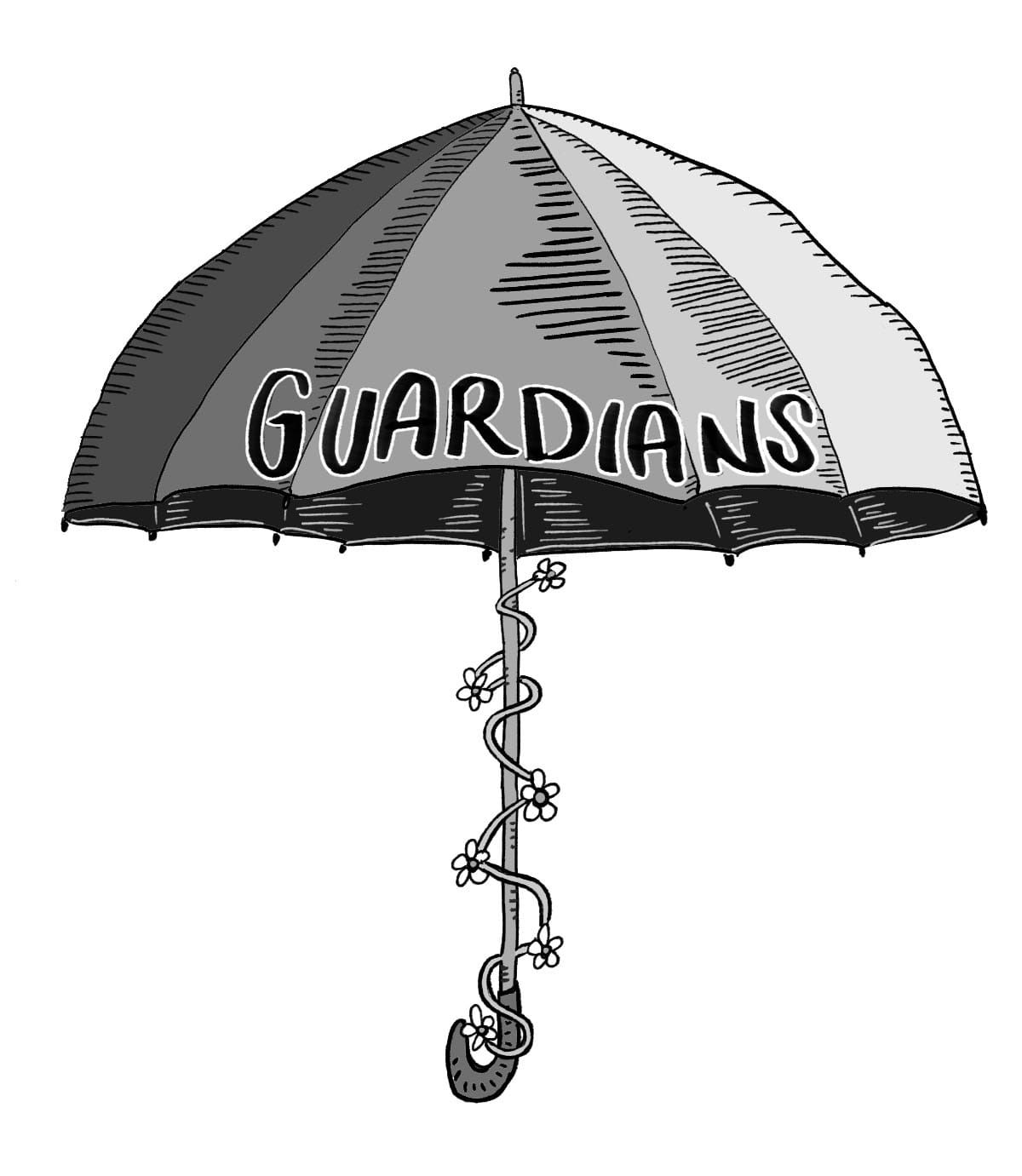
This is the fourth part of a five-part appendix for The Daisy Chain: A Neighbor’s Guide to Mass-Cooperation. This appendix illustrates just some of the hundreds (if not thousands) of ways people can activate the Guardians cluster to restore a felt sense of safety in our neighborhoods so that political abusers cannot make us feel afraid to leave our homes or even “feel at home” in our communities.
By playing with The Daisy Chain, we can rug-pull power away from our political abusers. One of the ways we do that is by creating a neighbor-initiated, felt sense of safety in our communities, something which political abusers try to take from us. When we take away our abusers ability to scare us at scale, we disintegrate the pillars of support propping up our abusers. This is what the Guardians Appendix of The Daisy Chain helps us accomplish.
Guardians Cluster in Action
Guardians create a felt sense of safety through establishing baseline community practices and emergency preparedness plans that provide a bulwark against the chaos and panic political abusers rely on to control people. There are four petals of the Guardians cluster: attend, shield, jumble, and rescue. Neighbors in this cluster attend to their communities and create a felt sense of safety, shield their community from prying eyes, jumble abusers’ ability to effectively target scapegoats, and rescue neighbors from ecological (or other) disasters that require an emergency response.
Below, you’ll engage with a description of each of the four Guardians petals— along with an itemized list of things we can do (right now) to play with that petal in our neighborhood.
Attend Petal
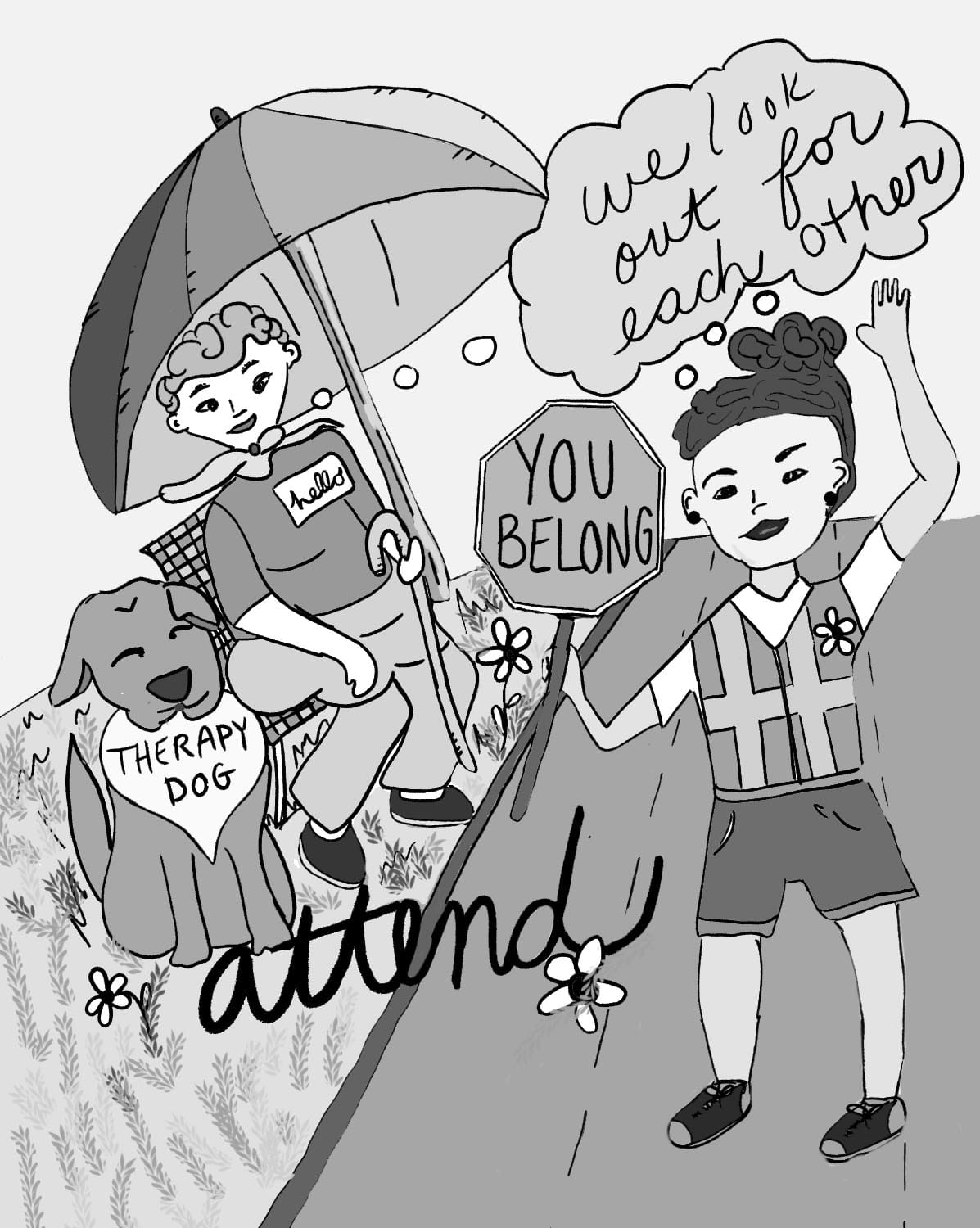
[Caption: Attend Petal — by GPat Patterson & Nikolas Lee]
Neighbors engaged in the Attend petal intentionally create a felt sense of safety in their neighborhood by establishing a visible friendly neighborhood presence—one that communicates to neighbors that each person is valued and looked after. Those drawn to the Attend petal are those who understand that, just like in childhood, ordinary people (even as adults) can gain a sense of security from a grounded, compassionate neighborhood presence. Rather than respond to a culture of fear by reverting into a ghost town, those who take part in the Attend petal do the opposite. They make it a point to coordinate a friendly ever-present fixture in their neighborhoods so that no neighbor ever feels preyed upon in their own community.
Note: The Attend petal provides a counterweight to political abusers, who manufacture, through propaganda and street violence, a pervasive sense of fear that leaves ordinary people afraid to move freely through their communities. For details about the kinds of actions Attenders might take to uproot political abuse, see the list below:
{:start="252"}
252. develop a network of crossing guards to serve as greeters and serve as neighborhood dispatch
253. develop first response units that minimize the need to call law enforcement officers
254. create artwork that communicates that marginalized neighbors are welcome
255. develop yard signs that say “you belong”
256. create a network of 24-hour safety escorts
257. develop a network of peer workers to identify and deescalate mental health crises
258. develop a network of domestic violence responders
259. develop a network of alliances to protect trans and queer spaces
260. host regular all-ages play-based community events
Shield Petal
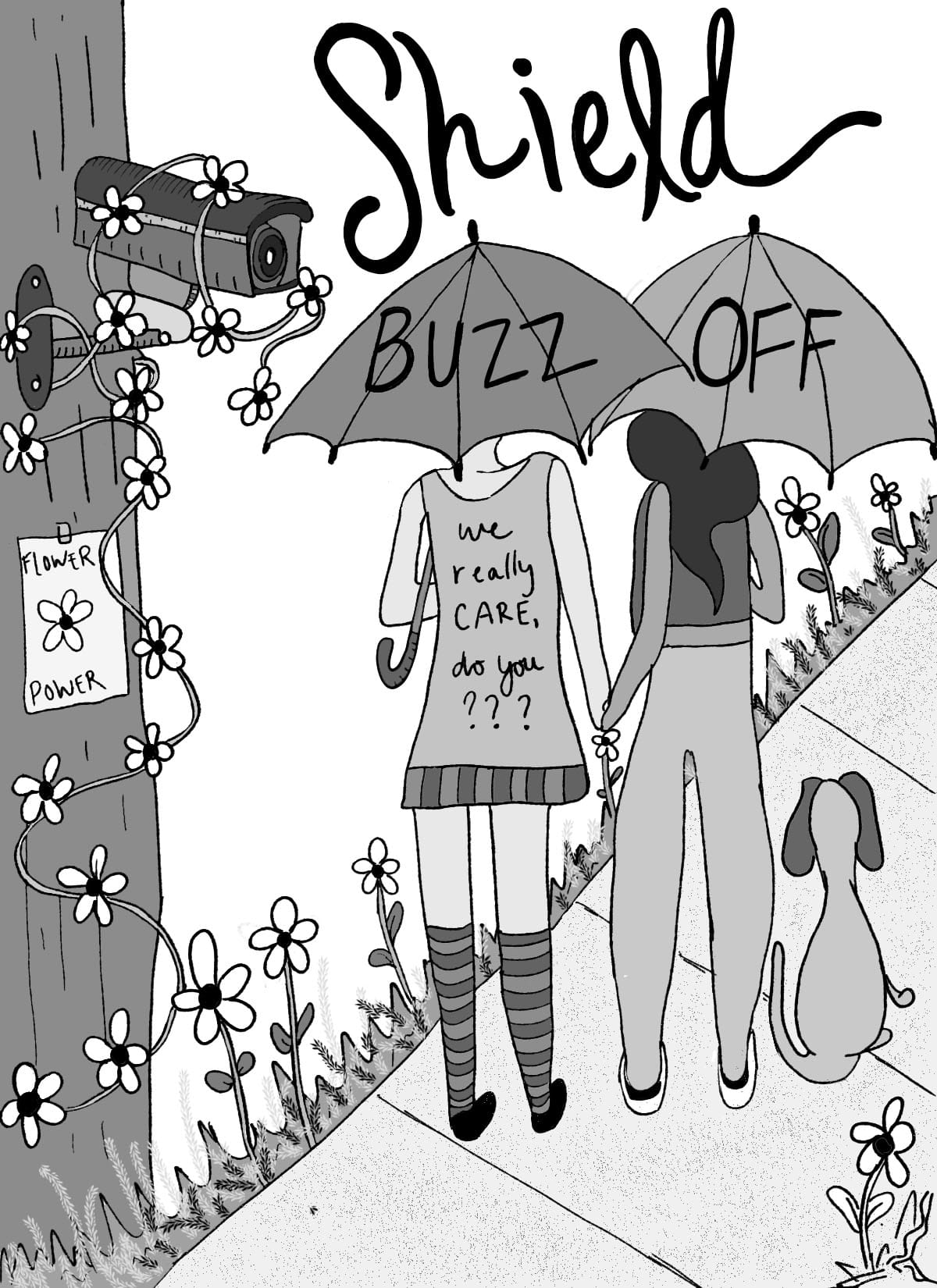
[Caption: Shield Petal — by GPat Patterson & Nikolas Lee]
Those engaging in the Shield petal offer a set of tools and practices, both old-school and technological, to help neighbors avoid being stalked and surveilled. Those drawn to this petal may include those with technological skills, counter-surveillance skills, communications skills, domestic abuse prevention skills, code-talking skills, map-reading skills, costuming skills, and a kaleidoscope of old-school luddite skillsets.
Note: The Shield petal provides a counterweight to political abusers, who stalk people, digitally and physically, in order to violate their personal boundaries. They rely on technology and psychological tricks so that people feel like they’re under constant surveillance. When this abuse continues uninterrupted, people begin to police themselves. They may even start to police their neighbors, thinking that collaborating with their abusers will garner them safety. For examples of some (not all) actions Shielders might take, see the list below:
{:start="261"}
261. educate neighbors about the dangers of Flock and Ring cameras and persuade neighbors to stop using them
262. educate neighbors about the risks of using AI chatbots, and persuade neighbors to stop using them
263. host drop-in workshops to help neighbors install Signal (and other encrypted chat apps) on their computers
264. help neighbors install security software their computers
265. educate neighbors about the risks of using Google Suite and iCloud to store sensitive documents and emails, and help them switch to alternatives
266. develop Linux clubs to help people de-Google and de-Apple their smart phones and laptops
267. develop mesh radio networks
268. collaborate with the attend petal to develop/acquire walkie talkies
269. create a neighborhood-wide coded language
270. help neighbors migrate off Meta, Substack, and X to federated social media sites
271. develop in-person protocols for sharing sensitive information
272. develop niche old-school, low-tech ways to communicate to neighbors across the zip code
273. develop a vouching system to vet neighbors before they can access sensitive information
Jumble Petal
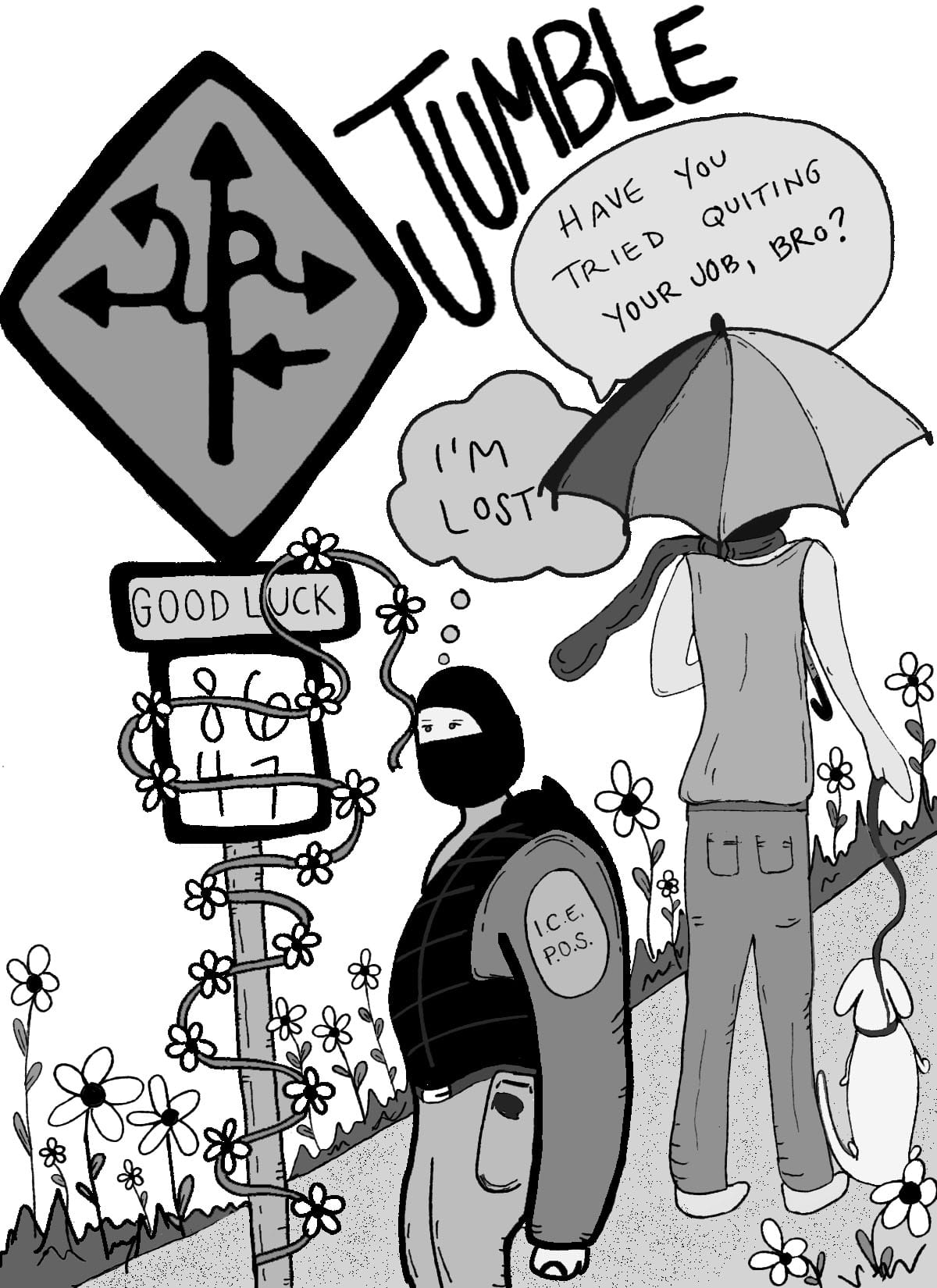
[Caption: Jumble Petal — by GPat Patterson & Nikolas Lee]
Neighbors who engage in the Jumble petal understand that a massive amount of local human capital is required for abusers to access the information and physical resources needed to terrorize local communities. Those drawn to this petal are keenly aware of the historical deployment of coordinated un-helpfulness to ensure that occupying or colluding forces have a difficult time orienting within neighborhoods, locating information, accessing needed surface area, or receiving basic services needed to harm communities. Rather than understanding this approach through the lens of hostility, it is more accurate to frame the Jumble petal as an expression of healthy emotional boundaries: good neighbors do not roll out the welcome mat for abusers.
Note: The Jumble petal provides a counterweight to political abusers, who rely on the compliance of ordinary people to oppress political scapegoats and, by proxy, the larger population. For details about the kinds of actions Jumblers might take to uproot political abuse. For examples of some actions those in the jumble petal might take, see list below:
{:start="274"}
274. work with the housing petal to develop hermit crab housing plans to obscure regime targets
275. obscure directional signage in case of an invasion
276. collaborate with the creatives petal to develop clever ways to obscure house and apartment numbers
277. work with unionize and attend petals to practice a pro-democracy car-park parade, which may be used to reduce usable surface area for neighborhood invaders
278. identify neighborhood nooks and other places to obscure targeted people
279. work with the attend team to alert the neighborhood in case of invasion and develop nonviolent safety plans for affected residents[^1]
280. work with the shield, attend, and unionize petals to develop an underground railroad for targeted groups
281. work with the shield, attend, lionize and unionize petals to develop an overground railroad to safely return our abducted neighbors to their families
Rescue Petal
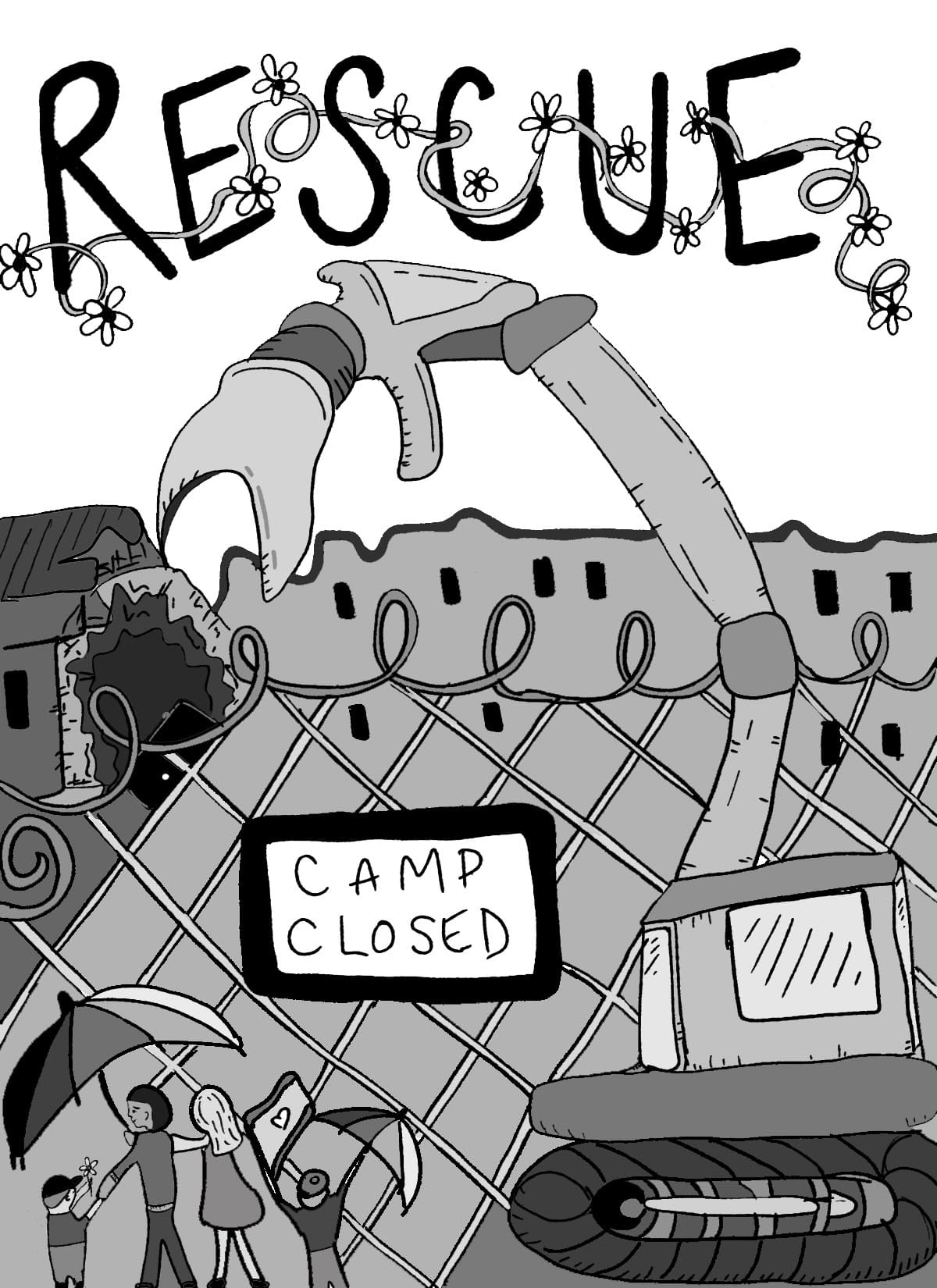
[Caption: Rescue Petal — by GPat Patterson & Nikolas Lee]
Neighbors engaging in the Rescue petal develop plans, practice drills, and respond to emergencies and disasters when they arise. Those drawn to this petal operate under the motto that no neighbor will be left behind, and no one in need will be turned away during a crisis. They know that, when crisis hits, following the credo of “every person for themselves” often ensures the downfall of an entire community. Neighbors who may find a sense of purpose in the Rescue petal include veterans, nurses, paramedics, firefighters, scouts, outdoorsmen, geographers, homesteaders, home repairers, and those skilled at planning and executing emergency drills. Above all, those who engage in the Rescue petal operate from a sense of compassion and communal wisdom—trusting what has always been true of the best of us: when crisis hits, we remember how to find each other, forge ties, and innovate to survive and thrive.
Note: The Rescue petal provides a counterweight to political abusers, who routinely abandon people to life-threatening conditions during emergencies; they often use disasters as opportunities to rob people of their resources and drive them from their communities. For details about the kinds of actions Rescuers might take to uproot political abuse, see the list below:
{:start="282"}
282. develop emergency evacuation plans in case of ecological disaster
283. develop shelter-in-place plans in case of political disasters
284. work with the shelter campaign to create emergency housing for displaced neighbors
285. develop rescue teams for vulnerable people and pets
286. develop a guild of people who know how to use chainsaws, bulldozers, rafts, boats, and other rescue equipment
287. develop a guild of medics willing to intervene in times of crisis
288. create long-term migration plans based on climate data
– ❀ –
“What Can I Practically Do, Besides Read This?”
If you want to show your appreciation for these words + illustrations, we would be honored if you spent 2-3 hours each week in humble service to your neighborhood: together, offline, off-screen, and outside institution time.
– ❀ –
Guardians Appendix Footnotes
1
Whistles and cameras are the last line of defense; the goal is to keep neighbors from being stolen.

Member discussion: