This is the third part of a five-part appendix for The Daisy Chain: A Neighbor’s Guide to Mass-Cooperation. This appendix illustrates just some of the hundreds (if not thousands) of ways people can activate the Menders cluster to reweave the fabric of our communities so that our political abusers cannot keep us disconnected, dispirited, and trapped in a cycle of abuse with them.
By playing with The Daisy Chain in our communities, rug-pull power away from our political abusers. One of the ways we do that is by making the offline (where we live) way more fun, engaging, encouraging, uplifting, and grounded than the online. We prevail by turning our neighborhoods into joyful love letters to each other. When we do this, abusers can no longer divide us, we become harder to manipulate and more willing to stand up for each other. This is what the Menders Appendix of The Daisy Chain helps us accomplish.
The Menders Cluster in Action
Menders repair and reinforce the social fabric, unthawing the isolation and driving out the scapegoating that keeps our neighborhoods divided. The Menders cluster includes four petals: play, alchemize, lionize, and deescalate petals. Neighbors in the Menders cluster play together to boost morale, collectively alchemize big emotions, lionize scapegoated community members, and deescalate security forces who have been manipulated to turn against their neighbors.
Below, you’ll engage with a description of each of the four Menders petals— along with an itemized list of things we can do (right now) to play with that petal in our neighborhood.
Play Petal
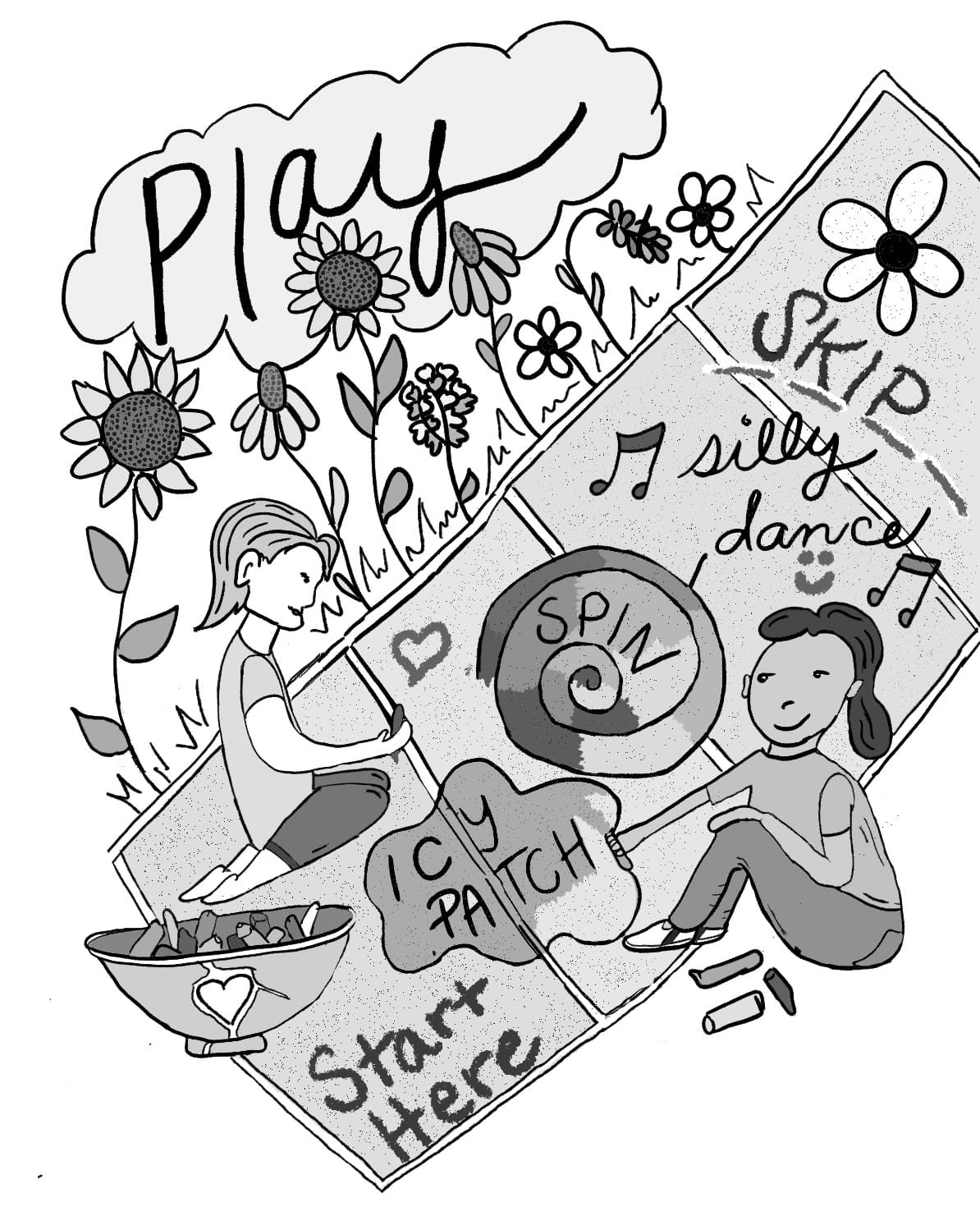
[Caption: Play Petal — by GPat Patterson & Nikolas Lee]
Neighbors who engage in the Play petal create regular opportunities for community members to spend time with one another off-screens. Those drawn to the Play petal understand that people who play together stay together. They may also understand the unique attributes play has on our neurobiology as human beings: creating opportunities for parallel play and non-competitive play helps people co-regulate their nervous systems, boosts creativity, increases positive community feeling, and lessens the isolation that allows political abuse to spread.
Note: The Play petal provides a counterweight to political abusers, who intentionally rip apart the social fabric, so that people feel hopeless, mistrustful, and apprehensive toward their neighbors. In this particular moment, political abusers benefit from people remaining behind their screens and stuck in echo chambers, thinking they have no common cause with the people down the street. For examples of some actions those in the play petal might take, see the list below:
{:start="191"}
191. use sidewalk chalk to create an interactive, invitational play experience for neighbors passing by [1]
192. create all-gender[2] groups for team sports
193. host regular public dance parties in your neighborhood
194. take part in pro-democracy caroling around your neighborhoods
195. create “know your human rights” trivia nights[3]
196. host regular community storytelling events as a way to build community cohesion and combat the scapegoating of our marginalized neighbors[4]
197. advertise The Daisy Chain at social gatherings
198. create a bingo-like game to incentivize neighbors to get involved with the community time bank
199. create dog-walking for democracy clubs, with the express point of meeting people you don’t yet know in your neighborhood
200. throw silly costume contests to soften potentially stressful tasks[5]
201. host block party celebrations that recognize upstanding neighbors
202. use The Daisy Chain as a tabletop game to brainstorm ways to address challenges, get unstuck, or meet community goals
203. host all-seasons weekend Occupy Parks events, where neighbors simply hang out together, share food, and engage in parallel play and communal leisure
204. create pro-democracy caroling during winter months to remind neighbors that they are not alone
Alchemize Petal
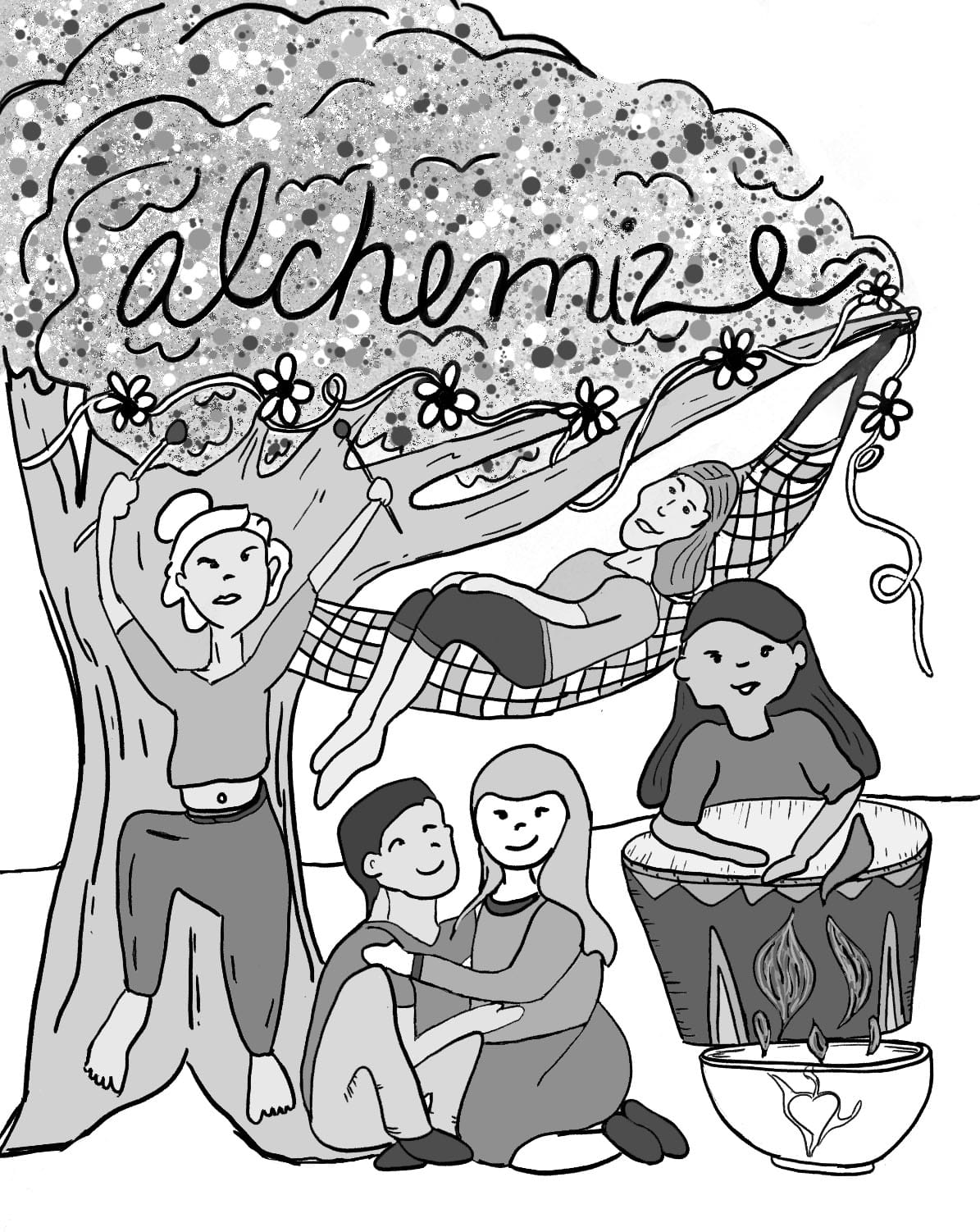
[Caption: Alchemize Petal — by GPat Patterson & Nikolas Lee]
Neighbors engaging in the Alchemize petal help their neighbors transmute strong emotions into grounded action to prevent their communities from becoming tinderboxes of frustration and despair that could boil over into senseless tragedies. Elders, healers, counselors, social workers, religious and spiritual leaders, body workers, grief doulas, and art- animal- and play-therapists may be uniquely equipped to help their neighbors ground with each other. Alchemizers attune themselves to the unique emotional, embodied, and spiritual needs of their neighbors—particularly those directly impacted by political abuse. They do this work, not from a formal top-down institutional (or nonprofit) space, but informally and with the spirit of peer to peer neighborly camaraderie.
Note: The Alchemize petal provides a counterweight to political abusers, who intentionally try to break people’s spirits with a stream of unrelenting cruelty, hoping that their targets will remain frozen in fear, numbed out in grief, or so angry that they make reckless decisions that play into abusers’ hands. Below are some ideas for how neighbors might take part in the alchemize petal:
{:start="205"}
205. develop safe spaces to express anger
206. create public community grieving rituals
207. host interfaith celebrations and ceremonies
208. create a visible interfaith community volunteer presence
209. host soul-retrieval ceremonies for abuse survivors
210. host celebrations of life for neighbors who walk on
211. host communal birthday celebrations
212. meditate, chant, and practice yoga in public parks
213. offer free mindfulness and somatic experiencing workshops
214. teach neighbors to relearn how to communicate with trees
215. host public sound-bathing ceremonies and drumming circles
216. create movement-based dancing ceremonies to alchemize emotion
217. create opportunities for communal art, play, and pet therapies
218. create low-sensory environments for neighbors to decompress
219. host workshops and book clubs on emotional and somatic literacy
220. host collective spaces for dreaming and journeying
221. create support systems for the healthy dissolution of relationships
222. create accountability and repair processes to address disputes
223. hold interfaith services to challenge coercive religious extremism
224. help neighbors remember folkways erased by colonization
225. host panels to educate neighbors on the importance of freedom of and freedom from state-imposed religion
226. create meal clubs to dispel inaccurate information about diverse spiritual practices and uproot religious scapegoating
Lionize Petal
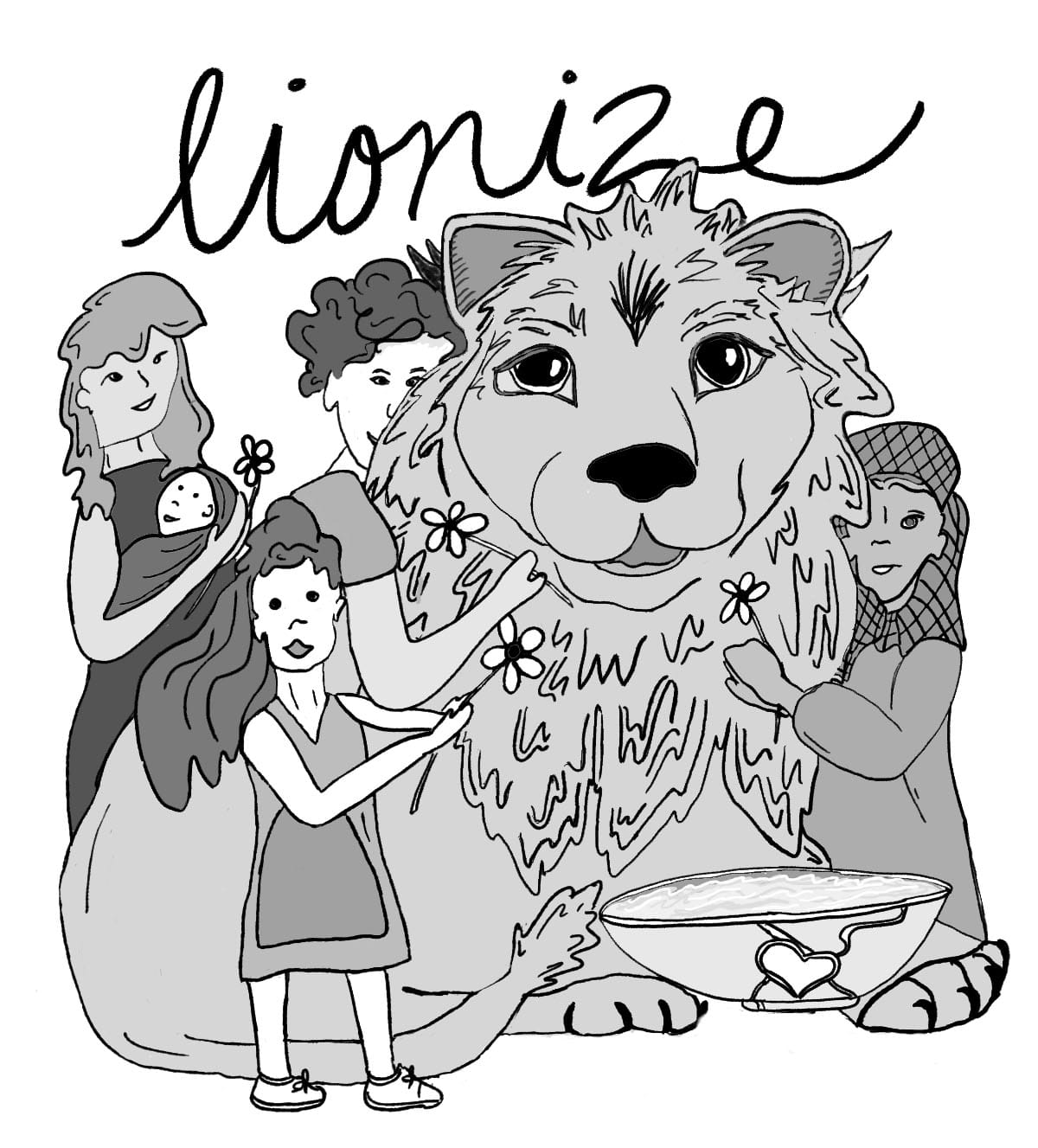
[Caption: Lionize Petal — by GPat Patterson & Nikolas Lee]
Neighbors engaged in the Lionize petal understand that the proper response to scapegoating is to loudly embrace their targeted neighbors and make sure they have tangible support from their community. Those drawn to this work also know that political abusers tend to target misunderstood social groups, not because they are “weak” but because these groups often possess unique insights about how to stand up to oppression—knowledge that directly threatens political abusers, who rely on a docile public. Rather than treat their targeted neighbors as pariahs, they lionize them as community leaders who, like all leaders during times of crisis, must be flanked and protected from bad actors.
Note: The Lionize petal provides a counterweight to political abusers, who intentionally offload their own misdeeds onto misunderstood social groups—targeting them with smear campaigns, flagging them for institutional abuse, and grooming bystanders into socially and physically abusing their neighbors. This kind of cruelty can leave targets afraid to leave their homes or, sometimes, afraid to remain in their communities. These campaigns of abuse can also cause bystanders to fear becoming targets themselves and leave them feeling helpless, without a solid plan to effectively stand up for those being targeted. For examples of some actions those in the lionize petal might take, see the list below:
{:start="227"}
227. develop off the grid safe houses
228. sit with grieving neighbors
229. visit and learn from elders
230. protect immigrants, trans people, and people who can become pregnant
231. create self-defense classes for women, kids, and gender-expansive people
232. create dispersed safe zones for sex workers
233. create para-institutional domestic violence networks
234. offer support for families of the abducted or murdered
235. create support groups for survivors of sexual assault
236. develop a community tip line to report sexual battery of minors and adults
237. write letters and send care packages for neighbors in prison
238. host vigils at concentration camps
239. oppose abusers who attempt to execute their political prisoners
Deescalate Petal
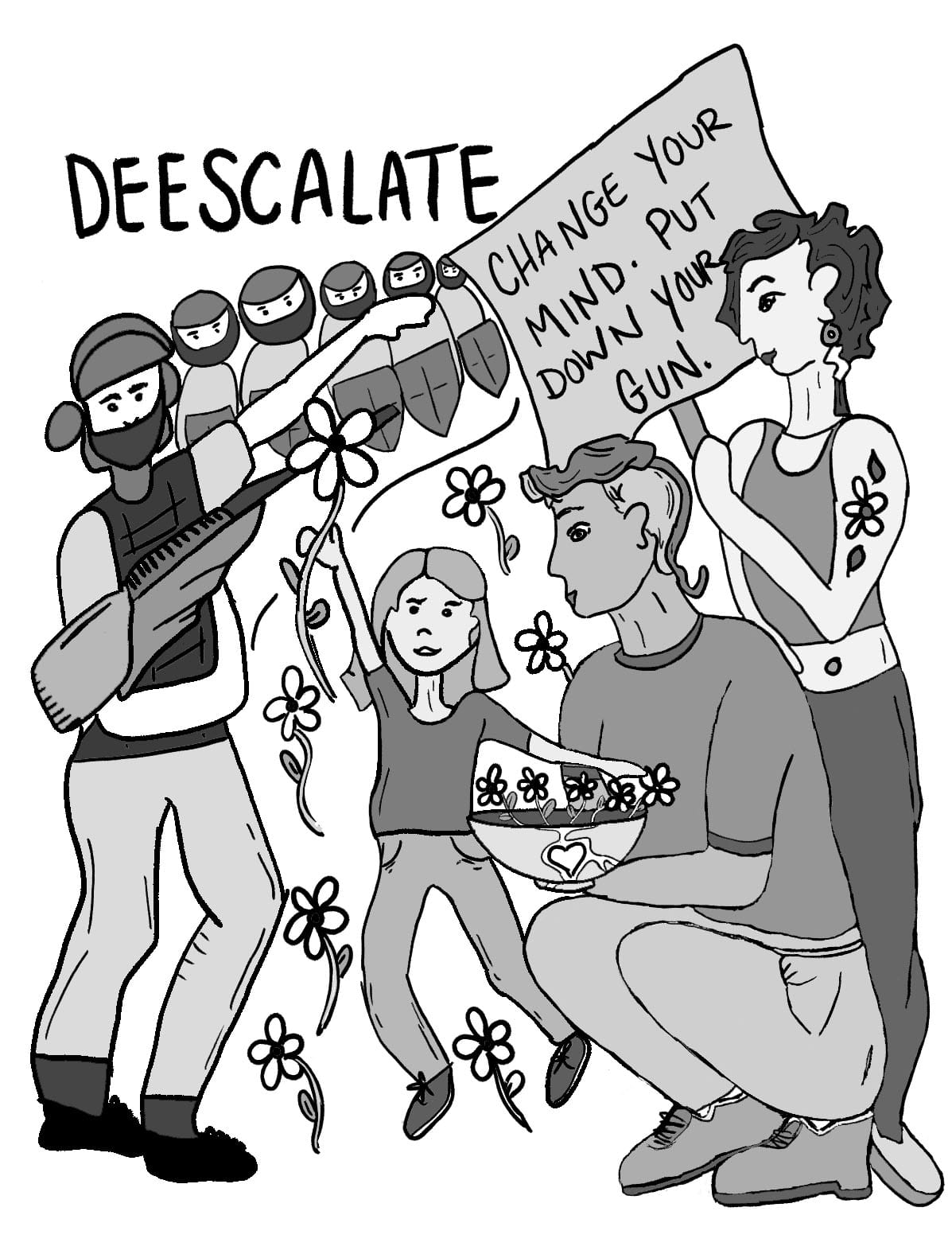
Deescalate Petal — by GPat Patterson & Nikolas Lee
Neighbors engaging in the Deescalate petal employ nonviolent communication to persuade security forces to refuse political violence and come home to their neighbors. They also model what it means to intervene in and resolve local community conflicts in healthy ways, minimizing neighbors’ unhealthy (and, too often, deadly) over-reliance on law enforcement to “solve” problems. People drawn toward the Deescalate petal have a keen awareness that those who rely on violence to scare their targets are actually moving out of profound weakness and lack of self-control. Such neighbors center the recovery needs of those directly harmed, rather than relying on the narrative that arbitrary forms of punishments and legal procedures lead to repair.
Note: The Deescalate petal provides a counterweight to political abusers, who intentionally engage in physical violence to intimidate neighbors into submission. Sometimes political abusers encourage law enforcement, military members, and paramilitaries to view their own neighbors as “enemies from within,” in order to dehumanize targets as a pretext for annihilation. For examples of some actions Deescalators might take, see the list below:
{:start="240"}
240. engage in conversations with active duty members of the military and national guard to honor the constitution and not obey illegal orders
241. connect active duty members of the armed forces to Conscientious Objector organizations
242. create peer support groups for active duty members and law enforcement officers who are invested in protecting democracy
243. create informal channels for security forces (police, military, etc.) to report violations of the Constitution, outside the formal chain[6] of command
244. create SOFFA[7] groups for military and law enforcement officers (LEOs) to develop skills to persuade these groups to honor the constitution
245. engage in children’s letter writing and drawing campaigns to ask LEOs, military members, and elected officials to stand up for democracy
246. organize children-led pots and pans protests
247. organize choirs outside of precincts and detention centers
248. organize boy scout and girl scout groups to recruit adults to get involved in the neighborhoods
249. organize local artist campaigns to persuade people to get involved in their neighborhoods
250. decorate the neighborhood with pro-democracy art that deescalates antagonizers and inspires others to get involved; share ways that people can contribute to their neighborhoods
251. organize offline men’s deescalation clubs to interrupt abuse
Appendix 3 Footnotes
Children often create these hop-scotch adjacent invitations on sidewalks outside of their home. Amplify their efforts. It’s time to pool together our sidewalk chalk and other crafting materials to help children help the rest of us reclaim our ability to play. ↩︎
All-gender co-ed team sports challenges the scapegoating of transgender and gender-expansive children and adults. The objections to trans people playing team sports has little to do with fairness, as trans athletes rarely outperform their cisgender (non-trans peers). Related, in competitive sports trans athletes have long faced stringent guidelines before being allowed to compete. Nor is this an issue of safety or the fear of shared locker room spaces. Indeed, it is worth noting that the political abusers engaging in this kind of scapegoating have horrific records of abusing women and children. A small group of predatory men are projecting their own predation of women and children onto a small, misunderstood group that is unable to defend themselves. Rather, much like the enforced racial segregation of Jim Crow, the point is to socially isolate trans people, because political abusers need people to remain suspicious of each other. Political abusers are aware that when people play together, they learn to become teammates in other areas of life, which threatens abusers’ divide-and-conquer model. Finally, the creation of gender segregated sports were, from the start, about men’s own unwillingness to play with women—for fear women would show them up at their own sports and, consequently, expose the lie that women were the “weaker sex” and thus “unfit to lead.” Rather than accept the bait from political abusers, our goal is to move around the barrier and create a more enjoyable experience—inviting people to “vote with their feet,” take part in real-time sports, and, in the process, and disprove political abusers’ talking points. (Note: Too often, toxic masculinity celebrates overt expressions of physical aggression that have little to do with the objectives of the sport and more to do with establishing dominance. Physical aggression has never been an expression of strength, but it is frequently celebrated in sports because it celebration of aggression offers a pretext for war and other “might makes right” expressions of exploitation. All-gender, co-ed sports can be a opportunity to return integrity to sports, strengthen communal values, and offer healing across genders.) ↩︎
While it can be helpful, in a functioning society for people to understand their legal rights, this is less helpful when it comes to politically abusive environments, where bullies manipulate policies and practices to get their way. Instead, the idea here would be to create trivia nights, as a consciousness-raising event to help people recognize their inalienable rights, as human beings. For example, in the context of the United States, it would surprise many neighbors to discover that access to free medical care and free, quality public education are human rights. For more examples of human rights you might not have known about, consider examining the United Nations publication titled Universal Declaration of Human Rights (2015). ↩︎
When it comes to community storytelling nights, consider the two complimentary examples. The first example is to replicate The Moth at a smaller scale, inviting people from all backgrounds to share their stories with one another; communal storytelling increases neighborly bonds. The second example is to riff off Drag Story Hour by inviting neighbors of all genders and walks of life to dress fabulously and read children’s stories to each other—but making it an event that is open to people of all ages. Once again, the point here is to challenge political abusers, who seek to divide and conquer. ↩︎
For example, imagine kids dressed as super heroes dropping off letters to their local police precinct, demanding they stop assisting in the abduction of their neighbors. Similarly, imagine neighbors dressed in silly costumes as they create a counter-presence to political abusers in their neighborhoods. Imagine that the privacy petal creates an umbrella-decorating contest as a way to use laughter to neutralize invasive surveillance tech by whimsically obscuring their views. There are all sorts of ways to turn otherwise intimidating things into acts of defiant joy. This form of play makes us brave. ↩︎
So much corruption and abuse happens when people rely solely on reporting abuses up the chain of command. Often, people who speak up get turned into “problems” and are scapegoated by abusive systems. Chains of command, much like Human Resources departments, are where workplace complaints go to die. We need to protect whistleblowers working in law enforcement, the military, intelligence agencies, and government contractors secure platforms to amplify what they’re calling attention to. Our collective attention on the whistleblower helps keep them safe. There are safety in numbers. The most dangerous place in any institution is behind a closed door. ↩︎
SOFFA stands for significant others, friends, and family. ↩︎

Member discussion: