This is the second part of a five-part appendix for The Daisy Chain: A Neighbor’s Guide to Mass-Cooperation. Rather than engage in losing games, which pit us against each other, this appendix helps us resist abusers’ “divide and conquer” strategy by pooling our time, attention, resources, and energy at the neighborhood level.
This appendix illustrates just some of the hundreds (if not thousands) of ways people can activate the Founders cluster to give back to each other what our political abusers try to steal from us in order to keep us desperate, disoriented, disconnected, and dependent on them.
By playing with The Daisy Chain in our communities, we rug-pull power away from our political abusers. This works because our abusers’ schemes rely on our active and passive participation in divide-and-conquer strategies. When we stop doing this, abusers lose their power. We prevail by locking arms and flocking together.
Founders Cluster in Action
Founders restore a neighborhood’s dignity and sovereignty by pooling community resources to make sure people’s most basic needs are met. The goal is to prevent political abusers from reducing communities to desperation and division. The Founders cluster includes the harvest, shelter, heal, and share petals, whose descriptions follow:
Harvest Petal
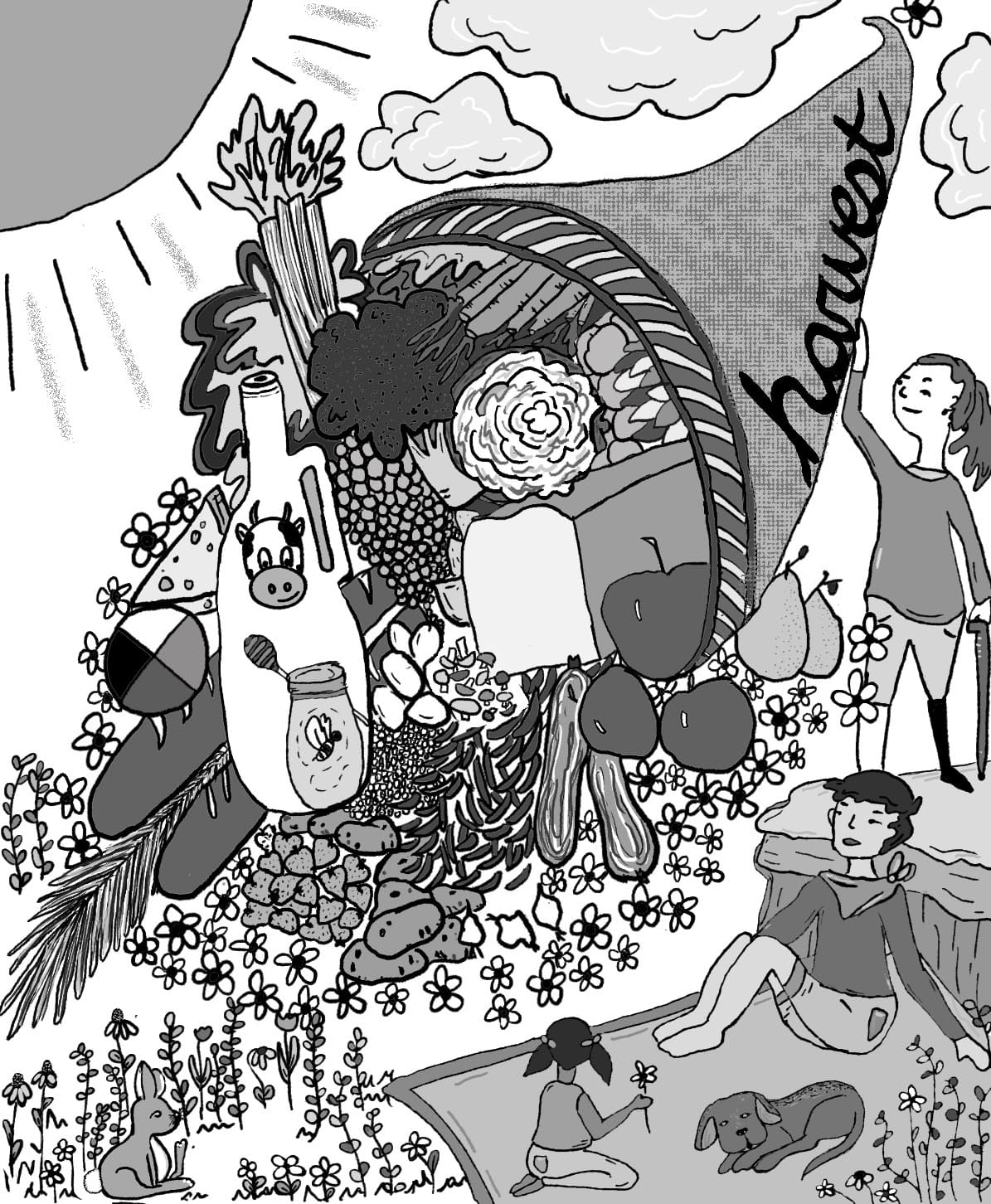
[Caption: Harvest Petal — by Nikolas Lee & GPat Patterson]
Neighbors engaged in the Harvest petal create a systematized way to grow, store, preserve, and share food. People drawn to this petal may have green thumbs, enjoy feeding their neighbors, and understand permaculture. They help neighbors relearn traditional ways of accessing food and water that don’t deplete the ecosystem we all rely on to survive. Those drawn to the harvest petal also understand that there’s no substitute for breaking bread together when you’re building, protecting, and sharing with community. Rather than hoard food for one’s insular group, the goal is to work together with neighbors to grow, store, preserve, and share food, all while having fun in the process of re-approaching food systems.
Note: The Harvest petal provides a counterweight to political abusers, who often collapse food systems and food inspection services as a way to create a hungry population willing to turn on their own neighbors just to be able to feed themselves and their loved ones. Below are just some ideas for developing a robust harvest petal, with the idea of meeting local neighbors’ nutrition needs while also potentially collaborating with nearby communities:
{:start="57"}
57. create a collective of disbursed home gardens, specializing in different crops
58. harvest and preserve fruits and vegetables, collectively, from a dispersed network of home gardens, responsible for growing different clusters of companion crops
59. install sun shades, rain barrels, greenhouses, fencing, and raised beds in dispersed and communal gardens
60. develop rain catchment and water purification systems
61. educate neighbors on water preservation methods and best times to water gardens
62. educate neighbors about soil testing, plant needs[1], and how to identify stressed trees, plants, and crops
63. plant native trees, flowers, and herbs to protect local pollinators and restore local soil ecosystems
64. protect community gardens from vandals
65. teach neighbors how to use non-toxic bug pest deterrents[2]
66. plant ground-level gardens as an offering to local critters[3]
67. deliver meals for elderly neighbors, grieving neighbors, targets of political abuse, and other vulnerable neighbors
68. feed neighbors who show up to community meetings and who show up to organize in their communities
69. host community potlucks to recipe-swap and build camaraderie
70. offer cooking classes rooted in local food systems[4]
71. develop collectives who can preserve and store local harvests[5]
72. mentor neighbors on how to raise free-range chickens, as well as hunt, fish, forage, and rice sustainably
73. create dispersed community-run food forests
74. develop community maps of fruiting trees and bushes
75. volunteer with local farming cooperatives
76. rescue unused food from local restaurants, grocery stores, and food banks[6]
77. offer workshops on how to keep food fresh for longer and how to regenerate food from kitchen scraps
78. teach neighbors how to compost and create raised compost garden beds
79. create initiatives to donate food scraps, leaves, grass clippings, and sawdust for community compost bins
80. teach neighbors how to fertilize garden beds with legumes at the end of the season and overwinter garden beds with water-resistant tarps
81. teach neighbors how to plant within their gardening zones and use companion planting to maximize space and avoid stressing the soil
82. organize free breakfast, lunch, and dinners—making a point to treat this as a community gathering and not toxic, top-down charity
83. create disbursed food pantries and community fridges
84. volunteer your basement as a communal food storage location
85. volunteer your lawn as a communal garden space
86. create a lending library of garden tools, fencing tools, hunting tools, food preservation tools, and cooking tools
87. build garden beds with fresh veggies in playgrounds, and teach young people about how to grow, harvest, and preserve food
88. create food forests on public school grounds and college campuses
89. campaign your neighbors to convert their lawns into gardens
90. educate neighbors on the dangers of pesticides and weed killers
91. host community harvest celebrations to celebrate neighbors who have volunteered in the community garden
92. feed neighbors at community events and house parties
93. teach neighbors how to grow from seeds, instead of buying plants from big box[7] stores
94. teach neighbors how to preserve seeds for the following year
95. create free seed banks so neighbors don’t have to rebuy seeds
96. develop a gardening calendar, which educates neighbors on planting across multiple growing seasons and neighborhood spots[8]
97. educate neighbors in dry-landscaping and rain garden techniques
98. develop a neighborhood cookbook library
99. Create a registry of local grocery stores, farmers markets, and food forests— encouraging neighbors to shop there as a way to to avoid “surveillance pricing” and punish grocery chains for food gouging
100. create food banks for pets, and develop locally made pet food to upend our collective reliance on factory farming
101. educate neighbors about how factory farms and food packing industries abuse our undocumented neighbors working in those industries; work with our neighbors develop alternative employment pathways that upend predatory employment practices
102. organize boycotts of food brands, gardening/ grocery stores that exploit workers, despoil our environment, and support political abusers
103. educate neighbors on how to use and produce natural fertilizers
104. develop neighborhood collectives to eradicate invasive plants and bugs that kill indigenous trees and other indigenous plants
105. create legal and para-institutional mechanisms to protect our trees, ecosystems, bodies of water, and public lands
106. organize to shut down data centers in your neighborhood, and create public pressure campaigns to boycott the use of all AI products
107. create rooftop gardens and rooftop trees for carbon-capture purposes and to create much-needed shade in city spaces
108. teach neighbors how to preserve gray water and reuse it to garden
109. create pet waste composting campaigns for fertilizing trees and other non-edible bushes and plants[9]
110. create campaigns to return to ecologically smart burial practices[10]
111. create food forests and pollinator gardens in local cemeteries[11]
112. educate neighbors about the ecological harms of golf courses[12], using city zoning laws to reclaim golf courses to re-wild habitats and create local food forests
113. volunteer with public and city park systems to protect and restore woodland habitats and waterways
Shelter Petal
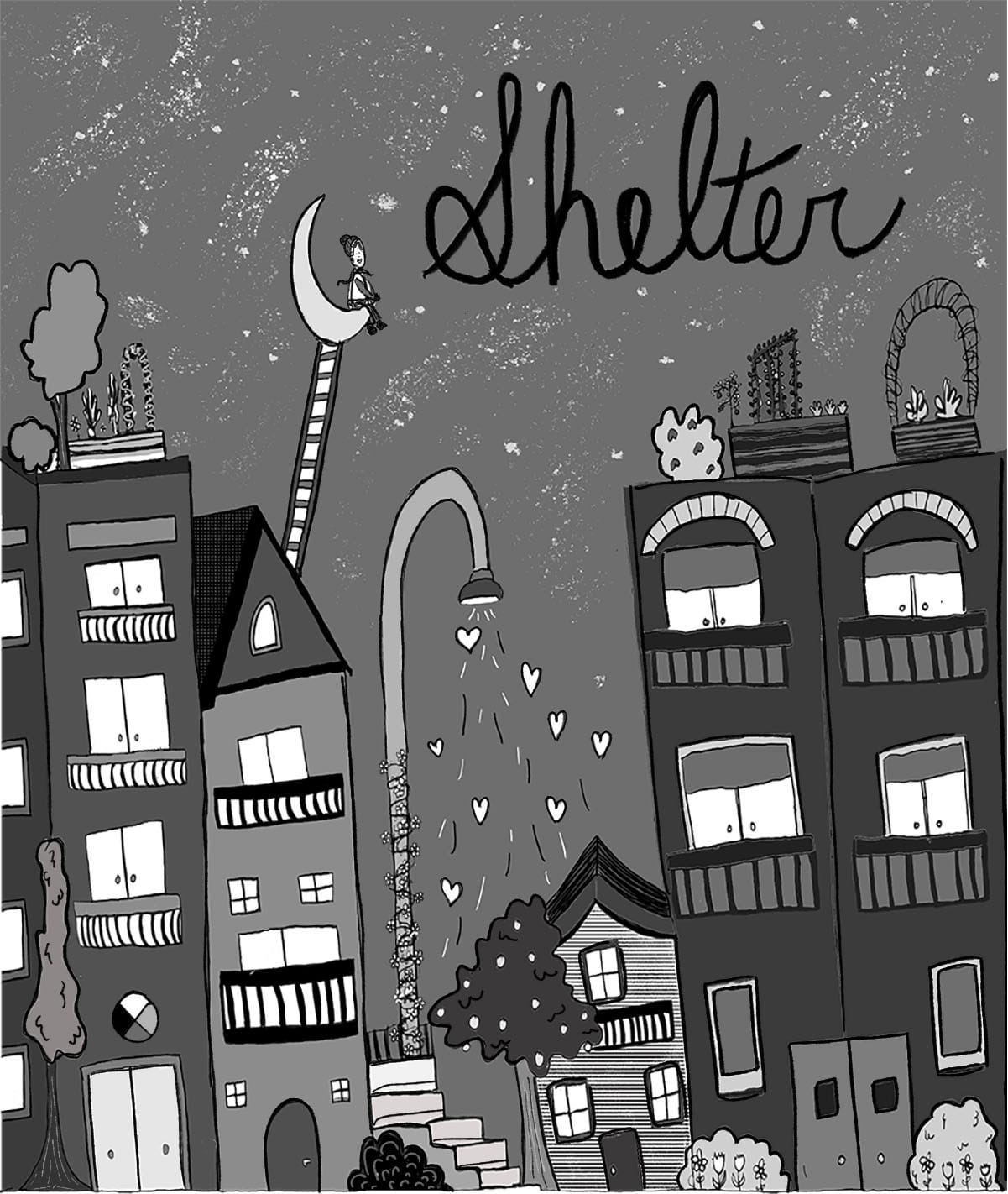
[IMAGE: Shelter Petal — by GPat Patterson & Nikolas Lee]
Neighbors who engage in the Shelter petal find creative ways to keep neighbors housed with dignity. Those drawn to this petal understand that communities cannot make affordable housing materialize overnight, but they understand the value of using the already-existing resources in their communities to coordinate housing for displaced neighbors. They also work to make sure those with housing do not lose their homes because of an inability to keep up with repairs and other housing costs. Rather than rely on colonial versions of housing that center around a couple and their children and pets, those drawn to the Shelter petal have a vision for reclaiming ancestral models of housing that reclaim the village and center around collective housing models.
Note: The Shelter petal provides a counterweight to political abusers, who often run people out of their homes—whether through intimidation, property seizure, property destruction, criminalizing homelessness, or by intentionally creating conditions that make being able to afford a place to live impossible. Below are some (not all) actions those engaged in the shelter petal might take:
{:start="114"}
114. transform houses and apartment buildings into intentional living communities
115. develop roommate matching systems, including matching empty-nesters with compatible roommates
116. coach new roommates on conflict resolution and boundary setting
117. develop home repair collectives so neighbors don’t lose their housing due to an incapacity to care for it on their own
118. develop housing contingency plans between peer groups, church groups, student groups, elder groups, and other affinity groups
119. identify a network of safe houses for domestic abuse survivors and other neighbors who become vulnerable to political abuse
120. develop housing networks for displaced pets
121. develop a network of root cellars, basements, and tornado shelters for neighborhood use in emergencies
122. develop a neighborhood map of emergency heating and cooling centers; if such locations don’t exist, organize to create them
123. work with nearby neighborhoods to crowdsource emergency evacuation and emergency housing plans
124. coach neighbors on packing go-bags for themselves and their pets, in the event of ecological or political disasters
125. disperse and shield homeless encampments from being discovered by political abusers[13]
126. create neighborhood cultures that normalize public resting, napping, play, and leisure time; organize against “loitering” and “vagrancy” laws
127. develop hermit crab housing for targets of political abuse[14]
128. organize a cooperative of contractors to help neighbors finish basements and garages, as a way to offer more expansive living arrangements[15]
129. organize rent strikes in the face of predatory landlords
130. learn your homeless neighbors’ names and treat them with dignity
131. connect homeless neighbors to resources outside systems that punish and pathologize homelessness
132. volunteer with homeless outreach groups in your neighborhood
133. ensure that Daisy Chain organizers have back-up housing options so they are not displaced from their communities[16]
134. ensure organizers traveling between Daisy Chain networks have access to free housing and food
Heal Petal
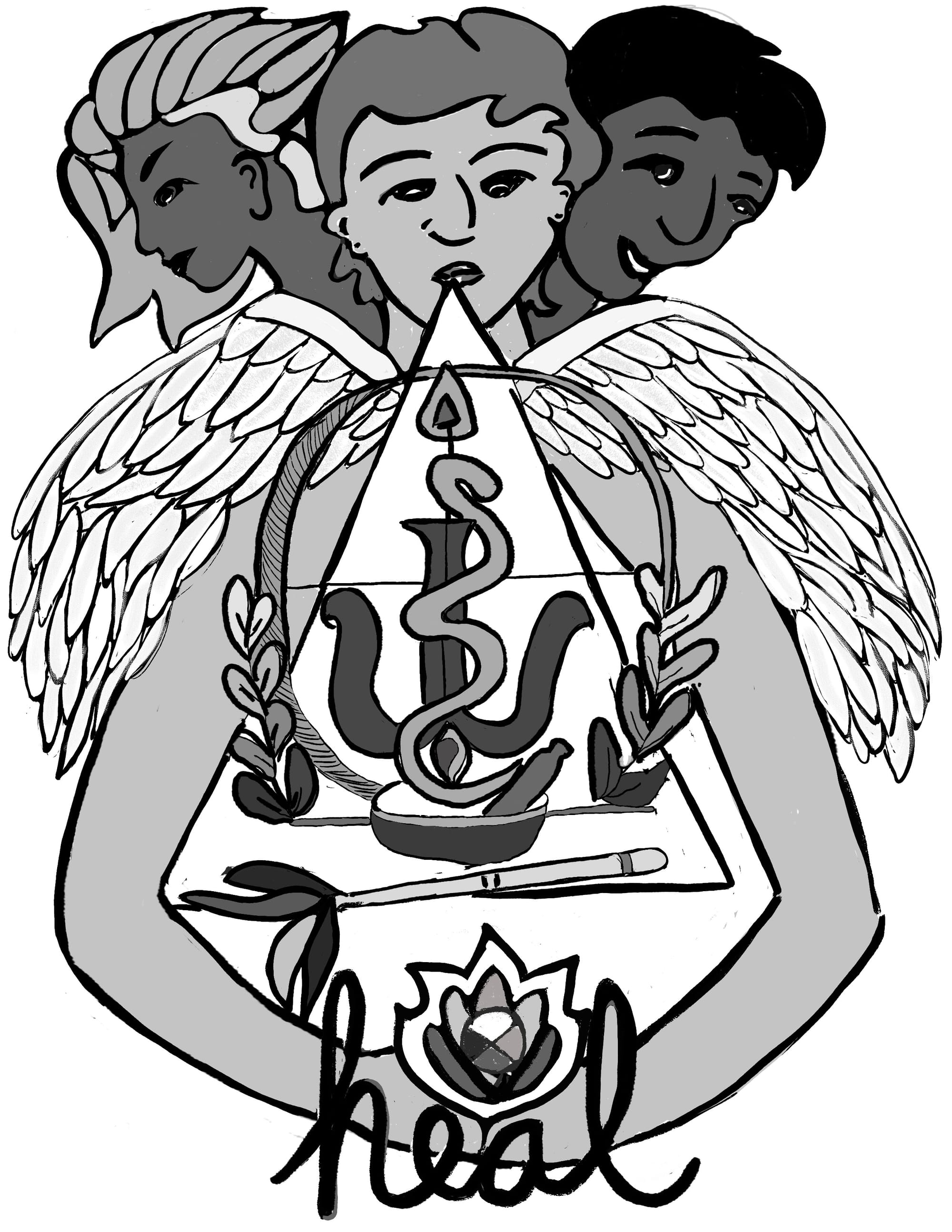
[Caption: Heal Petal — by GPat Patterson & Nikolas Lee]
Neighbors in this petal rely on their community’s collective skills and resources to provide each other with various forms of medical care. People drawn to the Heal petal may include current or former nurses, doulas, doctors, dentists, herbalists, veterinarians, chiropractors, bodyworkers, and any other person who practices the healing arts. Those engaging in the Heal petal understand why the United Nations and the World Health Organization articulate universal healthcare both as a matter of human rights and national security: when abusers overwhelm people’s ability to take care of themselves and their neighbors, it pushes entire communities into trauma and makes them easier to control. The heroes of the healing petal refuse to let that happen when they have skills on hand to help.
Note: The Heal petal provides a counterweight to political abusers, who frequently sabotage people’s ability to access medical care, be it through criminalizing healthcare access, exposing people to contagious diseases, pricing people out of healthcare, or even shuttering medical facilities. Below are some ideas for developing a robust heal petal:
{:start="135"}
135. teach neighbors how to treat anaphylactic shock, administer CPR, apply tourniquets, create slings, and set broken bones
136. train neighbors how to administer Naloxone and other harm-reduction services for people experiencing addiction
137. train and organize volunteer paramedics
138. create community apprenticeships for community nursing
139. create a collective of neighborhood birth, death, and grief doulas
140. mentor people in proven herbal and home remedies[17]
141. offer pop-up free dental and medical clinics
142. identify sterile spaces for performing medical procedures[18]
143. develop care networks for pregnant, transgender, HIV+, and other neighbors whose access to medical care becomes criminalized
144. create open-source chemistry labs to create free insulin, asthma, blood pressure, hormone, and other medicines for neighbors with chronic conditions
145. train volunteer paramedics who are able to provide critical care during weather emergencies and war zones
146. create dispersed pharmacies for storage of medicines
147. develop low-tech refrigeration methods for critical medicines
148. mentor teams of neighbors to identify, forage, store, and use indigenous plants as medicines[19]
149. normalize and celebrate community-wide masking protocols, during seasons where respiratory and viral infections spread[20]
150. develop a network of (birth, death, and grief) doulas, social workers, counselors, bodyworkers, breath-workers, yogis, peer-coaches, and seasoned elders to create informal emotional and mental health support networks
151. collaborate with the share petal to include elder care, hospice care, child care, and disability care into local time bank frameworks[21]
152. develop a network of acupuncturists, chiropractors, massage therapists, and physical/ occupational therapists who disperse free care across their communities[22]
153. create a directory of medical supplies— including medical equipment that could be pooled together to create a library of shared medical supplies and equipment—including defibrillators, oxygen tanks, saline bags, braces, ramps, crutches, canes, lifts, wheelchairs, scooters, IV-drips, unused needles and syringes, etc.
154. create community collectives to build, repair, and refurbish medical equipment and mobility devices
155. develop local medical, dentistry, and counseling guilds—specifically to offer young people hands-on skills that may otherwise be unreachable outside of formal training[23]
156. create alternative emergency medical transport systems and, similarly, return to house calls, mobile care units, and pop-up clinics
157. create a guild of veterinarians, vet assistants, and vet techs[24] to offer free veterinary care—particularly to mentor young people (and other adults) who are interested but are limited due to expensive barriers to formal education
158. offer comprehensive sex education classes, including information on reciprocity, pleasure, shame-avoidance, and consent[25]
159. create safety zones to provide emergency care and prevent infectious disease for those who use high-risk drugs
160. create a directory of semi-public spaces where neighbors can wash their hands, use the toilet, and access showers[26]
161. build pop-up wheelchair ramps for common use in community spaces
162. offer free group counseling and somatic workshops[27] for neighbors experiencing PTSD.
Share Petal
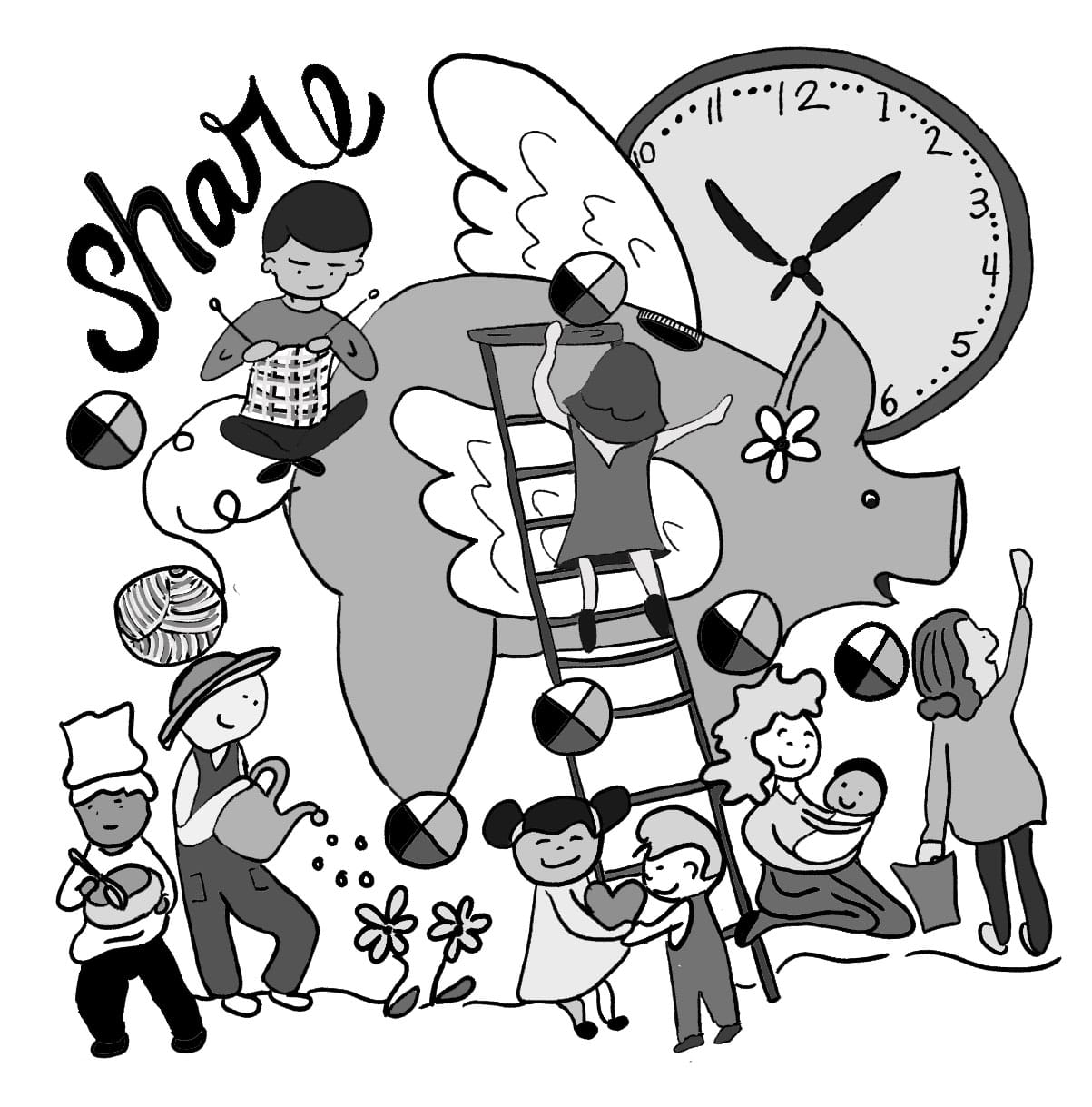
[Caption: Share Petal — by GPat Patterson & Nikolas Lee]
Neighbors engaged in the Share petal take part in solidarity and well-being economies that prioritize people over profit. People drawn to the Share petal come from all walks of life and experience. They may include neighbors with interest in time banks, those practiced in bartering, swap-meeting, skill-sharing, and creating communal libraries of commonly needed items. The people in the Share petal understand that creating parallel “we-conomies” prevents neighbors from turning on neighbors. It strips abusers of the upper hand they seek in controlling resources.
Note: The Share petal provides a counterweight to political abusers, who intentionally impoverish their targets, through encouraging mass layoffs, barring certain groups from being able to work, busting labor unions, driving down the value of currency, or looting treasuries and communal resources. Below are some ideas for developing a share petal, with the idea of meeting local neighbors’ needs while also potentially collaborating with nearby communities:
{:start="163"}
163. create a local time bank[28], with an expansive vision of what counts as a time bank contribution
164. develop a parallel currency[29] based on time
165. normalize sharing, borrowing, and gift economies[30]
166. take part in collective debt jubilees[31]
167. create parallel ride-share and grocery-delivery co-ops
168. celebrate thrift store fashion over fast fashion and haute couture
169. offer free repair workshops to prevent landfill waste
170. develop bimonthly curb-sharing of unneeded goods
171. collaborate with the educate petal to develop a free book, zine, and DVD library, with particular focus on banned books
172. create free events for people to gather
173. develop a free tool + makers library
174. host free pop-up repair collectives[32]
175. collaborate with the heal petal to create a medical device library
176. host practical skill-share meetups
177. develop apprentice collectives to learn hands-on critical skillsets
178. organize swap-meets alongside farmers markets
179. create a neighborhood directory of low-waste and up-cycled shops
180. create a local directory of for-barter[33] services
181. assist people to transfer their money to local credit unions[34]
182. create neighborhood babysitting and elder care collectives[35]
183. develop local pet care collectives
184. aid disability groups, immigrant groups, trans groups, and other groups to build mutual aid networks[36]
185. develop local garden co-operatives and farm cooperatives[37]
186. develop ride-share and bike-share collectives
187. develop ethical protocols so people can swap skilled trades for housing
188. create an all-gender, all-bodies community closet and alterations co-op
189. create all-gender, all-bodies salon and grooming co-ops[38]
190. develop parent/guardian support collectives[39]
– ❀ –
“What Can I Practically Do, Besides Read This?”
If you want to show your appreciation for these words + illustrations, we would be honored if you spent 2-3 hours each week in humble service to your neighborhood: together, offline, off-screen, and outside institution time.
Founders Appendix Footnotes
Plant needs include considerations about spacing, sunlight, soil nutrients, and watering requirements. It is also important to consider good neighbors: some plants make excellent companion plants because they can be planted close together and help each other grow. For example, an entire bed of nightshade plants (tomatoes, eggplants, potatoes will exhaust your soil). Spread those friends out and use companion plants. ↩︎
Rather than use chemicals, invite natural predators of bug pests into gardens—including birds, ladybugs, and other beneficial critters. ↩︎
Using fencing and netting to protect human plants is appropriate, but we must also care for our local neighbors who also require food. Planting ground-level crops, legumes, clover, and other offerings creates a healthier habitat climate for our animal neighbors. For ideas about how to create gardens that become ecosystems, refer to Nancy Lawson’s The Humane Gardener (2017), and refer to her website: https://www.humanegardener.com/. Refer, also, to Robin Wall Kimmerer’s Braiding Sweetgrass (2013). ↩︎
Given the ways humans have abused the earth, recognize that corporate agriculture and food supply chains that rely on long-distance deliveries will likely crumble under the weight of climate collapse. This does not mean we are without options for food but, rather, that we need to relearn how to eat within our neighboring biospheres and prepare hyper-local meals. Our First Nations neighbors, who understand traditional food systems better than the rest of the settler world, possess wisdom. Seek them out for mentorship and reciprocal aid. Refer to the Indigenous Food Systems Network. ↩︎
Because our industrialized food systems and electric grids may fail, neighbors must learn older ways of harvesting, preserving, and storing food that don’t require so much energy. Our elderly, First Nations, rural neighbors, and neighbors who camp for long periods of time have invaluable insight to offer us here. If you have this knowledge, mentor your neighbors. ↩︎
Outrageous though it may seem, community food banks often waste fresh food and allow canned food to expire. This has little to do with incompetence and more to do with food banks needing more volunteers. When there are less helping hands, there is more waste. Consider these innovative examples of food rescue initiatives: Second Harvest, Feed It Forward, FoodShare, Be One to Give. ↩︎
The Daisy Chain celebrates local nurseries who are in good standing with their communities. In contrast, it is a rare thing to find a single box store chain that enacts pro-community values. ↩︎
Many novice gardeners do not realize one can start growing from the very early spring, all the way through autumn—unless, of course, you live in a very cold climate. Refer to your gardening zones. ↩︎
To avoid parasites, never use pet poop from your meat-eating critters as fertilizer for fruits and veggies. Chicken poop, bat poop, rabbit poop, and manure from non-carnivorous critters can be used in the garden. That sh!t is magic for plants. ↩︎
The way many Western cultures treat human remains isn’t ecologically sound, and it’s also very expensive. For ideas about better options, refer to this resource by the David Suzuki Foundation. ↩︎
Much like golf courses, cemeteries rarely employ ecologically smart ways to sustain the grounds, which are often covered in useless grass and treated with pesticides that endanger our ecosystem. People can organize to pressure local cemeteries to honor the circle of life by making better choices. ↩︎
While golf is a perfectly fine sport, it is also true that there are far too many golf courses, that they take up too much water, and they they are maintained with chemicals that hurt our ecosystem. For more information, see Kit Wheeler and Jon Nauright’s “A Global Perspective on the Environmental Impact of Golf,” (2006), published in the academic journal Sport in Society. Local golf courses should double as food forests; that is not a difficult ask. Think of it as a very grown up version of “mini golf.” ↩︎
Homelessness is not a personal failure but an indictment of governments that engage in political abuse by favoring corporate handouts over taking care of community needs for affordable housing, good-paying jobs, emergency shelters, and housing-first initiatives. Homelessness is a solvable problem, but abusive governments keep a people docile by creating fears around becoming homeless themselves—which allows big businesses to exploit workers. To hide evidence of their amoral incompetence, city, state, provincial, and federal governments have taken to criminalizing homelessness, which is a depraved response to suffering human beings. Not having access to housing is traumatic. Our neighbors deserve our solidarity, as their scapegoating affects the health of an entire community. To learn more about how governments offload their shame onto our homeless neighbors, refer to this resource by the National Coalition for the Homeless. ↩︎
Sometimes, it is not possible for neighbors targeted by political abusers to flee to a safer area. In those circumstances, neighbors can create hermit crab housing, by engaging in randomized residence-swapping to obscure the location of our targeted neighbors. This will require you to rely on some version of burner phones, swapping phones, bricking phones to work, given the fact that we live in a surveillance state. (Yes, I do know that our political abusers often demand a “registry” of some of our most vulnerable community members’ home addresses. That doesn’t mean our neighbors can’t be on an “extended vacation.” At the end of the day, you need to care more about human beings than the weaponized and inhumane, petty policies of our political abusers. Some of you really worry a lot about criminalizing vulnerable people and not enough about the criminals currently playing in your faces; think on that and ask yourselves why that is. Finally, such hermit crab initiatives require coordination with the lionize and privacy petals. ↩︎
In some parts of Canada, it is not uncommon for 2-3 families to live in a house, with each family living on one floor. These are sometimes affectionately referred to as “Vancouver specials,” which tickles me. While these are often rental situations, it is also possible for 2-3 families to pool financial resources to collectively buy a home and live in a similar arrangement without the fear of rent hikes. If the zoning laws don’t work, get rid of your city counsel and put in those who will make it work. This isn’t that hard. Zoning laws are often used to reinforce white supremacy. It’s past time to start asking yourselves why, exactly, the US has been so invested in enforcing “single-family” homes; that’s not an access— it’s an intentional barrier for neighbors to have access to safe, reliable housing and robust neighborhoods. (Ask yourselves why the US government doesn’t gaf (give a fart) about multiple families living in the same residence units in rural areas. That, too, is not an accident. ↩︎
It is a good practice to offer back-up housing options to all of our neighbors, in general. Daisy Chain organizers are singled out here, because it can be destabilizing for a community to lose a key organizer. ↩︎
This will be critical in the wake of medicine shortages. While Western medicine is the dominant way of seeking pharmaceutical treatments, other more resilient medicinal practices exist that don’t rely on big pharmaceutical companies and the mass-production of medicines. ↩︎
Political abusers are shutting down hospitals, criminalizing certain forms of healthcare, and stalking their political targets to the point that they are reluctant to seek medical help. The solution is to create dispersed sterile spaces around our neighborhoods where our vulnerable neighbors can access healthcare. ↩︎
A surprising amount of plants we’ve been encouraged to call weeds actually have medicinal uses that predate modern medicine and commercialized first-aid. As healthcare and pharmaceutical systems collapse, it will be important for people to relearn effective skills often dismissed as “folk medicine.” For more information, see North American Traditional Food System’s website. Refer to the this list of resources about herbal and folk medicines. ↩︎
Working with the create petal to design reusable and artistic-looking masks may raise people’s spirits around masking. This is particularly important in closed spaces, like stores, public transit, places of worship, schools and medical facilities. Coordinate with the play and lionize petals to thwart the kind of scapegoating of people with chronic illnesses and hostility around masking (much of it astro-turfed by social media influencers) that was so common in North America during the COVID-19 pandemic. ↩︎
Mutual aid frameworks can work within kinship communities, but expanding that level of reciprocity to the neighborhood requires creating a time bank that not only identifies the help that’s needed but also incentivizes neighbors helping neighbors and helps central caregivers avoid burnout. Exhaustion and care-work are constant companions, and the only way to escape cycles of isolation that push people to their breaking points is to disperse that care across the community. ↩︎
In so many of the examples listed above, it’s a very good idea to incorporate free community care into a local time bank model—not only to incentivize team lifts but to prevent burnout and, critically, learn from peers who work in your wheelhouse. Every person can stand to improve upon their current talents and skillsets (which also often includes learning from the people who are receiving care). ↩︎
Please note the word apprenticeship here. While this suggestion will, for some, raise institutional concerns about practicing without a license, it is important to remember the dire social contexts in which we live—where political abusers have not only made medical care harder to reach but have also created unnecessary barriers that make the medical trades prohibitively expensive. This is not an accident but, rather, is designed to keep the underclasses sicker and weaker than political abusers. Healthcare is a human right, and institutional red tape must not be used as an excuse to allow our neighbors to suffer, especially when there are so many neighbors who want to learn medical trades but cannot afford the education. This is why informal apprenticeships matter. Perhaps in better times, those apprentices will have an even easier time making their way through (free) medical school programs. This is not, however, our current circumstance—and there is no reason to allow coercive scarcity to control our behavior. ↩︎
In times when access to physicians and nurses are limited, those working in the veterinary professions can fill in critical gaps. While this may cause disquiet in some, it is worth noting that many veterinary skills are transferrable to humans and, for what it’s worth, veterinary training is quite rigorous, as students must learn the anatomy and nervous systems of more than one mammal (to say nothing of working with birds and reptiles). Now is not exactly the time to get snooty about one’s credentials. (Sidenote: If you are wondering why the federal government is also attacking funding for animal-based medicine, this is because our political abusers are aware of how easily veterinary care can translate to medical care for humans (who are also mammals). The entire point ins’t just about attacking the field because more women seem to be drawn to this field; it is an intentional act of medical sabotage, to keep a people sick and desperate. The only evidence you need that they’re attempting to keep people sick is to look at the intentional practices of RFK Jr., who has no medical license and was, yet, placed in this role by political abusers. Sometimes abuers mask sabotage as incompetence; there’s a name for this: weaponized incompetence. Please pay attention to these people’s moves, beloveds.) ↩︎
So much unnecessary shame and abuse proliferates, owing to the paltry education when it comes to these topics. Once more, this is not an accident. Political abusers benefit from a population filled with shame, under-educated on consent, ignorant of pleasure and reciprocity, and miseducated when it comes to articulating boundaries around bodily sovereignty. The only people who benefit from such grievous illiteracy are those who engage in sexual abuse, coercion, and harassment to control others. ↩︎
The lack of safe and accessible all-gender toilets is a public health crisis. This is also, however, not an accident. Refusing to create spaces for our homeless neighbors, our neighbors with disabilities, our neighbors with young children, and our transgender neighbors engineers social spaces designed to make some of our neighbors feel unwelcome, unsafe, and undignified. While creating a parallel system of semi-public toilets may seem unusual, this kind of neighbor-led initiative also benefits pregnant people, people with IBS and weak bladders, people who cannot afford to pay for the use of a public toilet, and any other person who simply finds themselves “having to go” at an inconvenient time. ↩︎
Somatic refers to the body. There is a common misunderstanding that trauma lives in a person’s head, but peer-reviewed data shows that most traumatic experiences are held (trapped) in our bodies. Somatic workshops help people release that trauma without having to relive or speak about traumatic experiences. Some studies indicate that this can work better for people with complex trauma than talk therapy. For more on this topic, see Peter Levine’s Healing Trauma (2008) and Diedre Fay’s Attachment-Based Yoga & Meditation for Trauma Recovery (2017). [I’m sure there are others. My recommendations here are limited the books and resources I have actually read. If you want your resource listed, reach out.] ↩︎
If you’re wondering what a time bank is and how to start one, check out the resources at TimeBanks.org. ↩︎
To understand this concept, check out Michaela Haas’s Banking the Most Valuable Currency: Time (2024, Reasons to Be Cheerful). ↩︎
To understand the concept of solidarity economies, check out A Shareable Explainer: What is the Solidarity Economy? (2024, Canadian CED Network). ↩︎
For more information on debt jubilees, refer to the following resources: The Debt Collective’s explainer on Debt Abolition and IPD for Public Dialogue’s The Jubilee Report: A Blueprint for Tackling the Debt and Development Crises and Creating the Financial Foundations for a Sustainable People-Centered Global Economy (2025, Commissioned by Pope Francis, published by The Pontifical Academy of Sciences). If you want to understand white political abusers who are attacking the Catholic Church (the largest body of Christians worldwide), it is precisely because the leaders of the Catholic Church, who serve parishioners worldwide, see the escalating suffering of capitalism and climate collapse, and they are using their substantial platform to call for policies that benefit the people and the planet. This is exactly why JD Vance and Peter Thiel are attack that Church; they didn’t “find God.” They’ve identified a threat to their dominance and they are attempting to neutralize it by hollowing it out from within. It is time for Catholics of integrity to start paying close attention to Catholic leadership and getting very involved and very loud to protect your church from white nationalists who are trying to hollow our your faith. ↩︎
For an example of what this looks like, check out Toronto’s Repair Cafe. ↩︎
It may be helpful to list these barters alongside your local time bank. ↩︎
Remember that power flows based on where we devote our time, attention, and energy. Unaccountable banks have been underwriters to some of the worst human rights abuses in history, and yet we are lured into continuing business with them. It is time to vote with our feet. If neighbors across every locality transferred their money to more accountable community credit unions, power would collapse under the feet of our financial and political abusers. See the following resources: Don’t Tax My Credit Union’s Big Banks Start Campaign to Destroy Credit Unions and Democracy Now’s Bank Transfer Day: Kristen Christian on How She Inspired Mass Exodus from Big Banks to Credit Unions. ↩︎
Connecting this kind of care to the time bank is important, because care-work can be mutual in intimate settings, but when participating in mass-cooperation it is important that care work be compensated, especially given the abysmal treatment of people in the caring professions and in other spaces where what is deemed “domestic work” remains uncompensated. All that being said, with proper vetting, it may also be possible to address an elder loneliness crisis by intentionally cultivating relationships between the very old and young that would benefit both groups. This is something that Malidoma Patrice Somé discusses in Ritual: Power, Healing, and Community (1997, Arkana Press). Dr. Grace Lee Boggs similarly mentions how crucial it will become to intentionally rebuild connections across age groups in her book The Next American Revolution: Sustainable Activism for the Twenty-First Century (2012, University of California Press). ↩︎
If the concept of building peer-group mutual aid and care-work networks is new to you and this is something you’re interested in exploring, consider the following resources: Cara Page & Erica Woodland’s Healing Justice Lineages: Dreaming at the Crossroads of Liberation, Collective Care, and Safety (2023, North Atlantic Books), Shira Hassan’s Saving Our Own Lives: A Liberatory Practice of Harm Reduction (2022, Haymarket Books), Dean Spade’s Love In a Fucked-Up World: How to Build Relationships, Hook Up, and Raise Hell Together (2025, Algonquin Books of Chapel Hill), The Care Collective’s The Care Manifesto (2020, Verso Books), Hil Malatino’s Trans Care (2020, University of Minnesota Press), and Dean Spade’s Mutual Aid: Building Solidarity During This Crisis and the Next (2020, Verso). ↩︎
For a better understanding of what farm cooperatives might look like, consider watching the documentary Occupy the Farm. ↩︎
Given the way that “body fascism” creates hierarchies of good bodies and bad bodies, it should be no surprise that trans people, fat people, elderly people, people with disabilities, and other groups who are frequently the target of body-shaming often find it difficult to seek out hair cuts and other grooming services out of fear that they might be judged. Rather than waiting for people to change their biases, an alternative is for these groups is to pool resources and skillsets to provide each other these services. The offering of these co-op services, like all community networks and mutual aid groups, should be included in the community’s time bank. ↩︎
Children were never meant to be raised in an over-taxed, closed-loop system of the dyadic couple. With proper vetting, it is possible to create neighborhood mutual aid groups, specifically for those with children. To keep this truly revolutionary, it shouldn’t matter whether the child has one parent, two parents, more than two parents, or whether their parents are in a monogamous or open relationship. Legal guardians, grandparents, older siblings, and other caregivers should also be included in this collective. The point is to understand that “it takes a village” isn’t just about kids needing more support; it is also about primary caregivers also needing additional support. Many of us live in politically and economically abusive societies that intentionally force people into isolated family units and then refuse to support them when it comes to child care. This is not an accident: it is an intentional move to force parents (specially women and those who don’t live according to white nationalist models of the “ideal family”) into ruination. ↩︎

Member discussion: