300 + Methods of Mass-Cooperation
The title of this appendix acknowledges the invaluable work of Gene Sharp and The Albert Einstein Institution’s (AEI) synthesis of his scholarship, titled “198 Methods of Nonviolent Action.” Sharp’s crucial work highlights how ordinary people have worked with the talents and resources they had to resist political abuse. The Daisy Chain’s departure from AEI’s list is that its focus is less on protesting political abusers and more focused on meeting each others’ needs to resist political abuse by building parallel systems of support.
The appendix is organized by thematic clusters. Underneath each cluster, you will find the corresponding petals discussed in Chapter 2: Luminaries, Founders, Menders, Guardians, and Wayfinders.
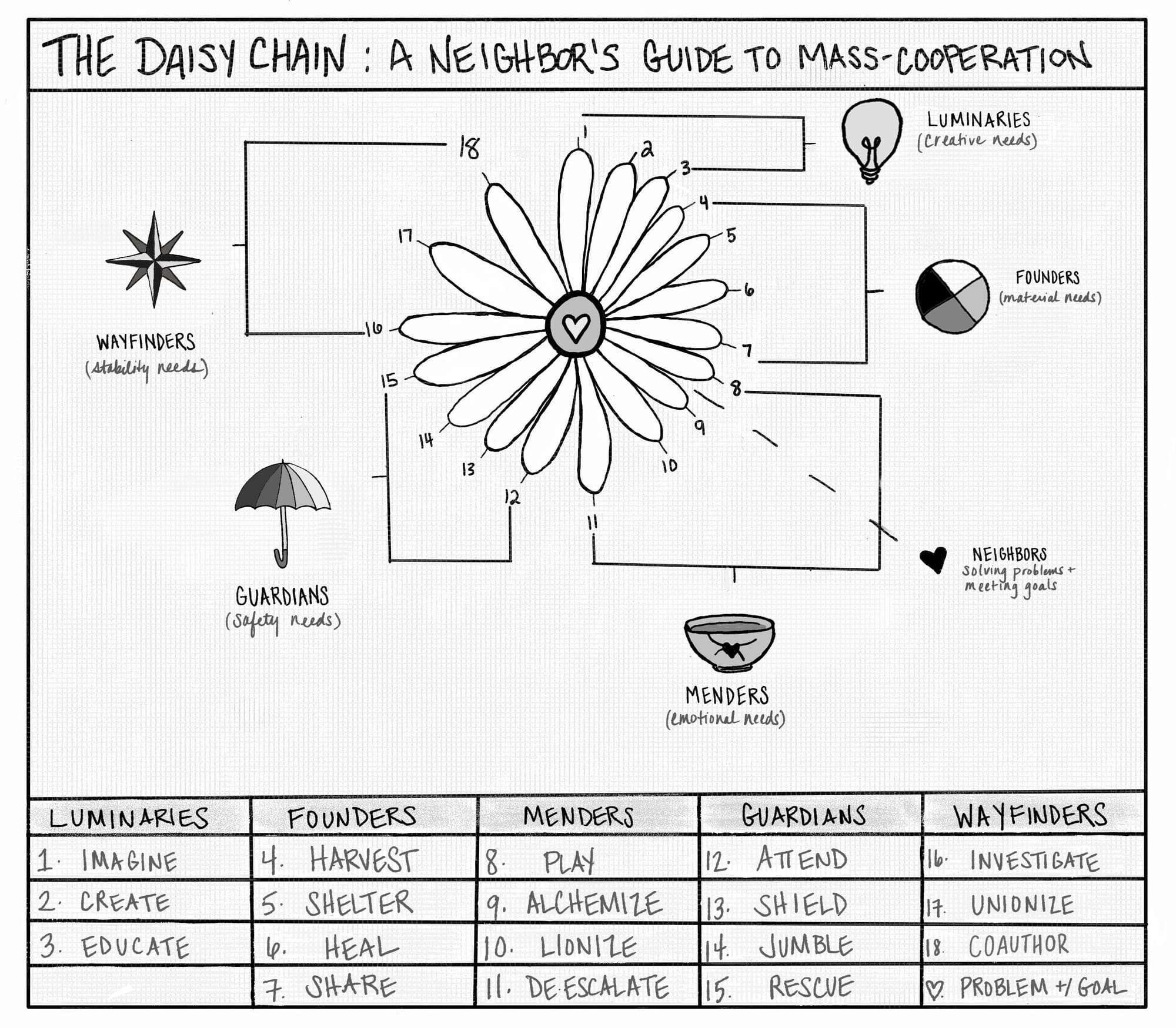
[Caption: The Daisy Chain Blueprint — by Nikolas Lee & GPat Patterson]
Underneath each petal in this appendix is a playing card illustration of the petal, alongside a numbered list of concrete actions ordinary people can take together that relate to the petal. The numbering of actions across sections is continuous. This is a design choice to help people who are “playing” The Daisy Chain as a tabletop game to identify concrete actions in the appendix, so no one has to go searching for a section marker—just a number.
The goal of this appendix is not to be exhaustive. Instead, it’s meant to help neighbors brainstorm the myriad of ways people can approach a problem or meet a goal together.
As people adapt The Daisy Chain to their neighborhoods, they will inevitably come up with actions not listed here. They may even choose to grow another petal. If you continue to play The Daish Chain to help plan community responses, adjust your petal numbers as things adapt.
We begin with the Luminaries section of The Daisy Chain Appendix. Four other subsections of the Appendix will be published in subsequent posts to discuss the petal-actions in Founders, Menders, Guardians, and Wayfinders clusters.
―⚘―
Luminaries Cluster in Action
Luminaries give us permission to believe in the world we want. They freely offer various forms of community art and craftsmanship to boost neighborhood morale. They hold an exquisitely expansive vision of education that embraces local genius and supports local learners of every age and experience. Luminaries are an essential cluster of The Daisy Chain because they help us shift from simply responding to political abuse to shaping the world we wish to bring into being. The Luminaries cluster includes the imagine, create, and educate petals, whose descriptions follow:
Imagine Petal
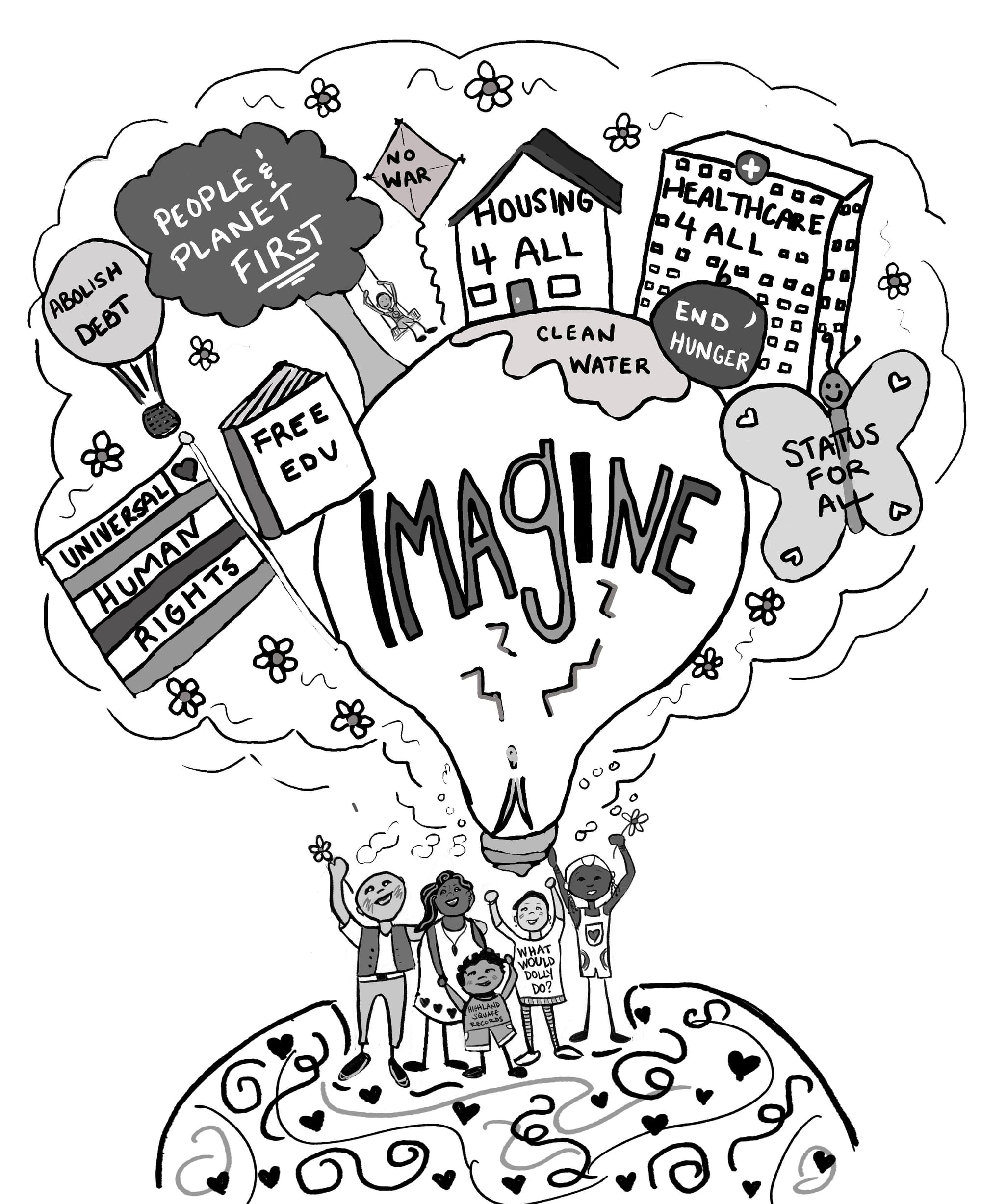
[Caption: Imagine — by GPat Patterson & Nikolas Lee]
Imagineers host events and create spaces for their neighbors to come together and discuss a vision of our near (and far) future that would actually feel life-affirming for ordinary people and life-protecting for the planet, which sustains life itself. Because of their systems-level thinking, Imagineers center often ignored voices, because they understand that to build a genuinely functional society, no one can be left behind. Similarly, Imagineers seek out young people’s perspectives about the world they will inherit, and they amplify young leaders in the movement toward our collective liberation and evolution. Neighbors who are drawn to this petal are those allergic to cynicism and micromanagement. They rebuke gatekeeping phrases like “that’ll never happen” and, instead, listen to their community’s desires for a functioning society by responding, “yes, tell me more!” Imagineers collaborate across all petals of The Daisy Chain, but they have a special relationship with the Coauthor petal, of the Wayfinders cluster.
Note: The Imagine petal provides the counterweight to political abusers, who claim their vision of the world is the only one that exists so that ordinary people assume things can never change for the better. For details about the kinds of actions Imagineers might take to uproot political abuse and meet long-term community goals, see below.
Imagine Petal Actions
Below are some actions those engaged in the imagine petal might take:
- collaborate with the play petal, the coatuhor petal, and other pertinent petals to create fun events that invite our neighbors to imagine what a constitution that works for ordinary people and the planet might look like
- collaborate with the unionize and coatuhor petal to create fun events that invite neighbors to imagine what fair and equitable representation looks like when it doesn’t rely on political franchises that develop policies to enrich themselves at ordinary people’s expense
- collaborate with the share petal and the coatuhor petal to create fun events that invite neighbors to envision a de-growth, well-being economy, that prioritizes people and the planet
- collaborate with the deescalate, lionize, and alchemize petals to host a candlelight event to imagine a truth and reconciliation process[1] that offers restitution to neighbors targeted by political abuse
- host a community dinner with neighbors in the harvest and rescue petals to imagine how we adapt to ecological collapse and attempt to repair our wounded ecosystem
- collaborate with the art petal to install community chalkboards where neighbors write what they want in a healthy neighborhood
- collaborate with the play petal to create open mic nights/afternoons where neighbors of all ages can talk about what they want their future to look like, where the vision of the world isn’t what corrupt politicians and greedy bad actors tell us it is
- collaborate with the education and unionize petals to create a community newsletter that invites people to write about the near future[2] they want to see
- collaborate with the deescalation and coatuhor petal to imagine what a legal system and justice would look like if it actually prioritized the needs of ordinary people, instead of protecting elites and the propertied classes
- collaborate with the coatuhor, share, and heal petals to imagine policies for universal housing, income, and healthcare.
Create Petal
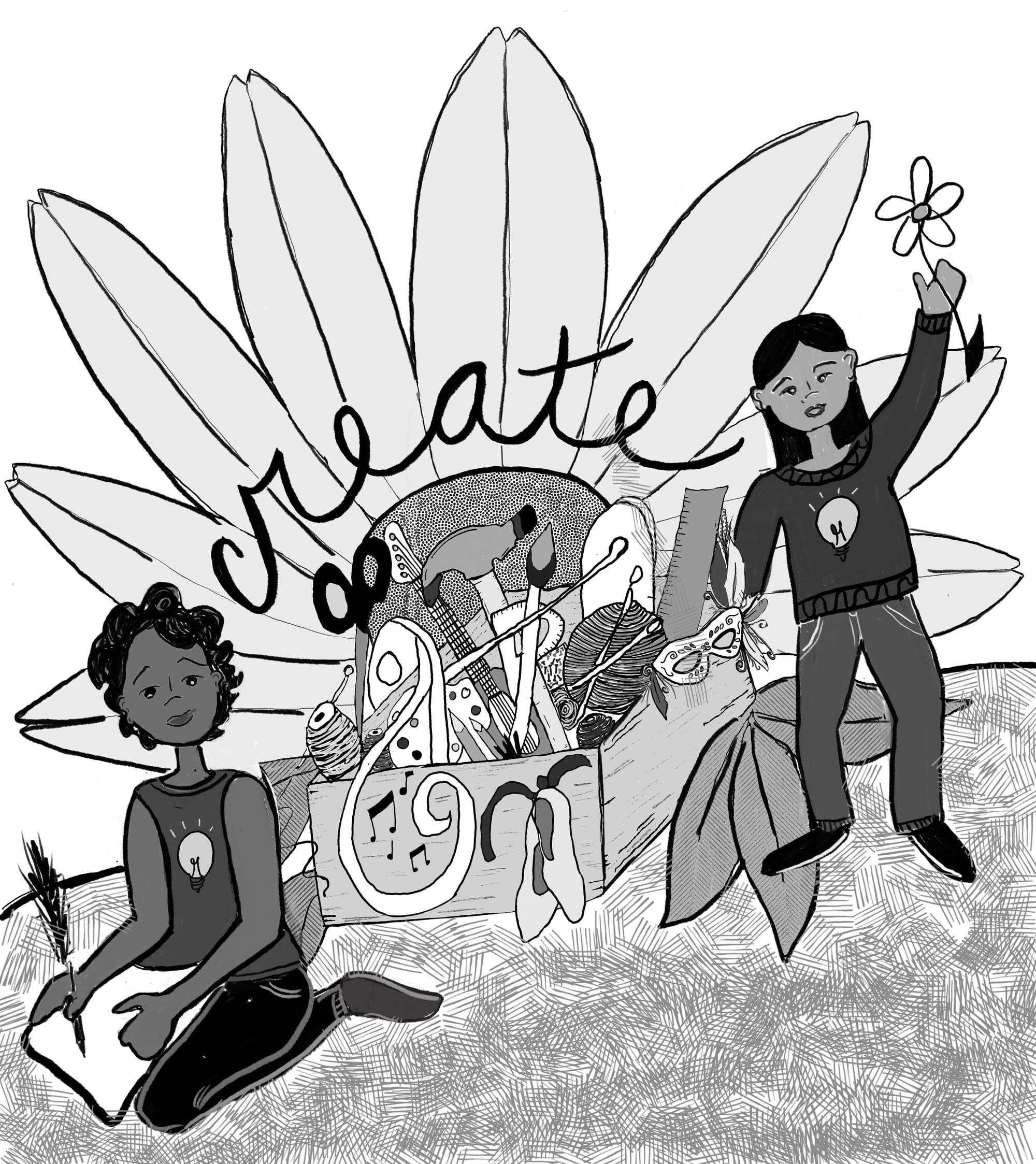
[Caption: Create — by GPat Patterson & Nikolas Lee]
Neighbors engaging with the Create petal ground a movement in possibility by creating community art (of all kinds) that amplifies our agency and asserts our collective right to self-determination. People drawn toward this petal understand that art transforms pain into possibility, which is why there is often a proliferation of artists who burst through the cracks during troubling times. In particular, those drawn to the create petal rebuke the snobbery of alleged perfection and are especially drawn to collaborative art, freely given to the People as a way to boost community spirit.
Note: The Create petal provides a counterweight to political abusers, who often strip people from their culture and impose sterile and cruel caricatures of art in the form of national propaganda. For details about the kinds of actions Creators might take to uproot political abuse and meet long-term community goals, see below.
Create Petal Actions
Below are some actions neighbors engaging in the create petal might take:
{:start="11"}
11. create public art celebrating scapegoated communities
12. create beautiful public memorials to those martyred by political abusers
13. host free, pop-up concerts, celebrating people power
14. write call + response protest songs and other folks songs for the moment
15. create flags, iconography, + cute mascots to champion your neighborhood
16. display children’s art + vision for the world in all public spaces
17. create posters that expose political abusers’ propaganda
18. decorate houses + apartments to celebrate democracy
19. create murals displaying the first amendment
20. leave “protest” post-its in unusual places decrying political abuse
21. create sidewalk chalk messages encouraging neighbors to be brave
22. host outdoor public films that celebrate people rising up against abuse
23. create yard signs with QRN codes linking back to The Daisy Chain
24. create zines that celebrate the helpers in your neighborhood
25. display public art identifying political officials who caved to political abusers
26. artfully rename street signs in honor of local and national democracy[3] heroes
27. create art of all kind that celebrates actual human intelligence + creativity
28. perform open-air plays and dance recitals celebrating collective resistance
29. create public sculptures, using found objects, that remind neighbors that the future belongs to the people, not our abusers
30. create puppet shows that help kids (of all ages) celebrate kindness, process difficult emotions, and remind neighbors of their inherent strength
31. create pins advertising your participation in specific Daisy Chain petals
32. perform stand-up comedy that mocks political abusers + their colluders.
Educate Petal
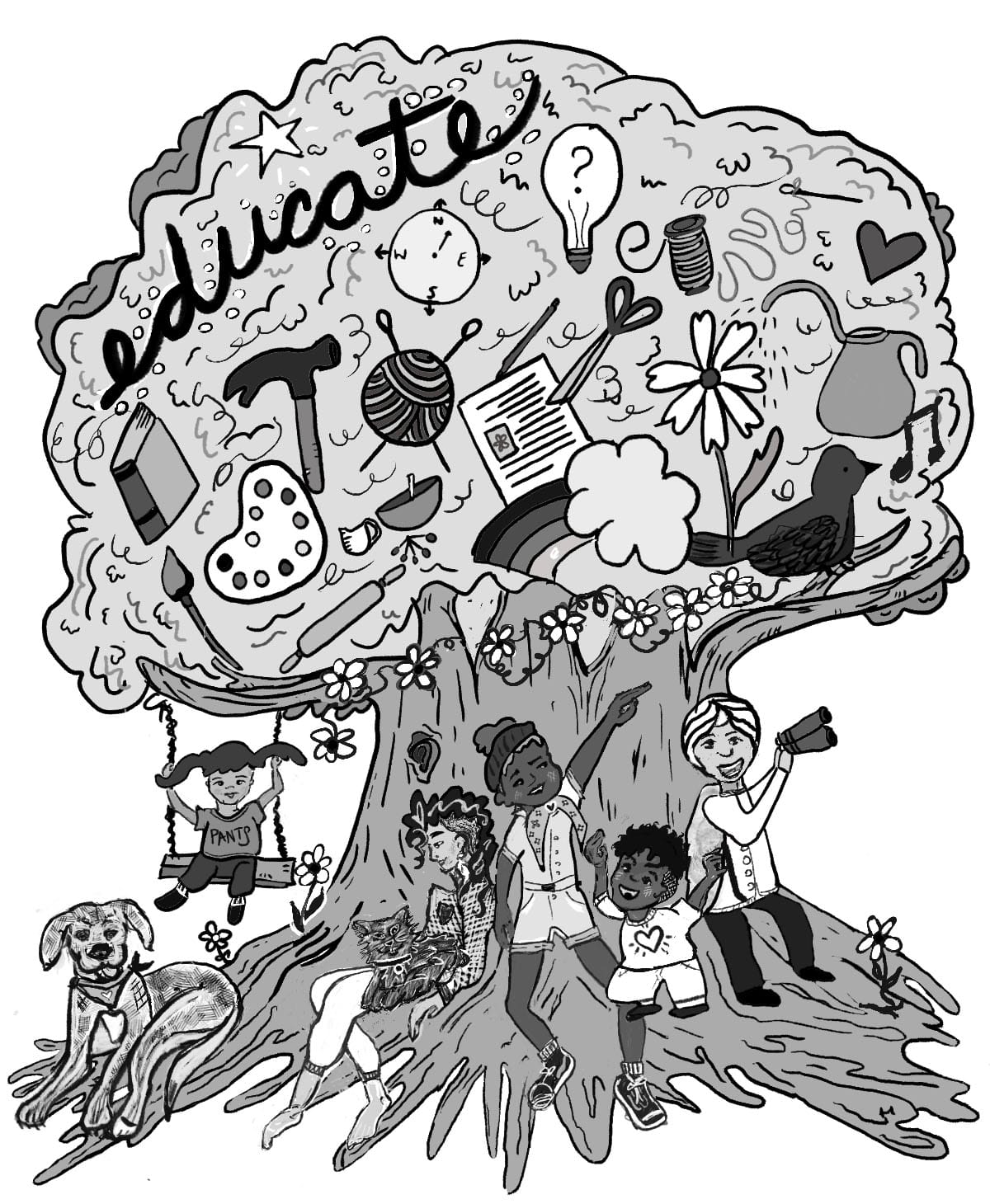
[Caption: Educate — by GPat Patterson & Nikolas Lee]
Neighbors engaged in the Educate petal preserve communities’ diverse cultural knowledge and educate people, of all ages, in ways that preserve pro-social values and skillsets that ensure our collective survival. People who might be drawn to this work may certainly include those currently or previously employed in education, but this petal has an expansive view of what it means to educate. This includes teaching that includes hands-on skillsets and life-ways that are just as important as traditional scholarly content. Those drawn to the Educate petal understand the particular usefulness of play-based models of education.
Note: The Educate petal provides a counterweight to political abusers, who tell people what to think and punish independent thinking that points toward our collective liberation. For details about the kinds of actions Educators might take to uproot political abuse and meet long-term community goals, see below.
Educate Petal Actions
For examples of some actions those engaged in the educate petal might take, see the list below:
{:start="33"}
33. preserve banned books and films through underground libraries
34. work with the heal petal to provide comprehensive age-appropriate sex education, including education around seeking consent[4] and articulating boundaries
35. host free night classes that teach neighbors home economics skills, including cooking, preserving, canning, and storing food
36. offer hands-on home repair skills for neighbors[5]
37. collaborate with the health petal to host first aid classes
38. teach neighbors how to repair bikes and how to build custom cargo bike rigs[6] so that people can travel around without relying on their cars
39. collaborate with the deescalate petal to teach deescalation techniques, rooted in nonviolent communication[7]
40. collaborate with the alchemize petal to offer emotional literacy[8] and somatic awareness classes to neighbors of all ages
41. offer classes on authentic communication[9] so that neighbors learn to speak to understand each other
42. work with the harvest and heal petals to teach neighbors about recognizing and responsibly foresting edible and medicinal indigenous plants
43. host book clubs with the lionize petal that educate neighbors on accurate U.S. American history[10] so that neighbors can better understand the long-term betrayals felt by those targeted for political abuse
44. collaborate with the lionize petal to offer free classes in gender and sexuality studies, with the goal of helping neighbors better understand themselves and be more equipped to resist the scapegoating of gender and sexual minorities[11]
45. collaborate with First Nations[12] local to your area to teach First Nations languages and cultural stories
46. work alongside our Black American neighbors to teach accurate, hyper-local African American history— taking care to ground that work in somatic experiencing[13] so that our non-Black neighbors can resist a knee-jerk reaction to dismiss or simply intellectualize “inconvenient truths,” both moves which keep communities stuck in cycles of trauma
47. collaborate with the lionize petal to host cross-cultural and interfaith[14] discussions that help neighbors better understand one another and become better able to resist the scapegoating of our vulnerable neighbors
48. collaborate with the privacy and create petals to educate neighbors about the risk of favoring “artificial intelligence” over actual intelligence, as uncritical adoption of predatory technology only exacerbates the spread of political abuse and leaves people ill-equipped to recognize when they are being manipulated
49. collaborate with the privacy petal, outdoorsy people, and longtime locals to teach neighbors how to navigate their neighborhoods by way of maps and an embodied knowledge of their neighborhood[15]
50. collaborate with the unionize petal to offer brief but effective workshops on sociocracy[16], as this will allow neighbors to avoid gatekeeping, micromanaging, and unproductive conflict
51. collaborate with the lionize, deescalate, imagine, and coatuhor petals to teach neighbors about ways to address conflict[17], interrupt harm, and achieve meaningful repair without relying on the “punishment system,”which often engages in violence and treats people as disposable
52. collaborate with the harvest petal to offer hands-on experience in sustainable hunting, fishing, trapping, animal husbandry, butchering, and meat processing
53. collaborate with the harvest petal to offer hands-on education in community gardening, water catchment systems, and permaculture
54. collaborate with the heal, lionize, deescalate, and alchemize petals to create a workshop to help neighbors recognize manipulation tactics[18] so that neighbors are less easily manipulated by political abusers
55. work with the create petal to help neighbors identify and creatively expose propaganda
56. develop educator collectives to practice teaching rooted in play-based, liberatory education[19]— in contrast to a punishing teaching style that encourages students to feel worthless.
– ❀ –
“What Can I Practically Do, Besides Read This?”
If you want to show your appreciation for these words + illustrations, we would be honored if you spent 2-3 hours each week in humble service to your neighborhood: together, offline, off-screen, and outside “work-time.”
– ❀ –
Luminaries Appendix Footnotes
There are countries around the world, including South Africa, that have successfully developed processes like this. We would benefit from seeking out our global neighbors’ advice here. ↩︎
Consider accepting drawings and audio recordings from young people who are less able to speak or write in full sentences. ↩︎
Consider including a QRN code to your neighborhood newsletter that includes a writeup of the heroes you’re celebrating and why they should be emulated. Call for nominations for more street-sign reclamations. ↩︎
Betty Martin’s The Art of Receiving and Giving: The Wheel of Consent (2021), published by Luminare Press, is an excellent resource and was written to be experienced in a workshop setting. ↩︎
A good way to imagine this is as a remix of Habitat for Humanity, where people with skills teach neighbors how to engage in all types of home repairs through volunteer neighborhood apprenticeships. It is especially important to practice non-discrimination when advertising such workshops, as women, gender-expansive people, and our BIPOC neighbors are often excluded from these skill-shares. This leaves these communities vulnerable to predatory business practices and harassment. ↩︎
For information on cargo bike rigs, please see this resource: https://www.instructables.com/build-a-2-wheel-cargo-bike/. ↩︎
The following books are valuable resources for those new to nonviolent communication and authentic communication: Marshall Rosenberg’s Nonviolent Communication: A Language of Life (2003, Puddledancer Press) and Oren Jay Sofer’s Say What You Mean (2018, Shambhala Publications). ↩︎
The following books are valuable resources for those new to emotional and somatic literacy: Dr. Rjaja Selvam’s The Practice of Embodying Emotions (2022, North Atlantic Books), Karla McLaren’s The Language of Emotion (2023, Sounds True Press), Lama Rod Owens’s Love and Rage: The Path of Liberation through Anger (2020, North Atlantic Books), Dr. Myisha Cerry’s The Case for Rage (2021, Oxford University Press), Pete Walker’s The Tao of Fully Feeling (1995 Azure Coyote Book). ↩︎
The following books are valuable resources for those new to authentic communication: Michael Sorensen’s I Hear You (2017, Autumn Creek Press) and Ryel Kestano’s Authentic Relating (2022, Art International). ↩︎
Books and resources that may be helpful include: Howard Zinn’s A People’s History of the United States: 1492-Present (1995, Harper Perennial), Roxanne Dunbar-Ortiz’s An Indigenous People’s History of the United States (2014 Beacon Press), Jeanne Theoharis’s A More Beautiful and Terrible History (2018, Beacon Press), Kahlil Greene ongoing project History Can’t Hide, and Rebecca Nagle’s First America: The Podcast. ↩︎
This is of special importance during a time when political abusers scapegoat gender-expansive people as a means to hoodwink people into allowing for the oppression of one marginalized group, with the ultimate aim of controlling all people’s bodily autonomy. ↩︎
During a time of ongoing genocides across the world and in the United States, it is especially important to understand that the core of US imperialism and its support of racial apartheid is rooted in the ongoing genocide of our First Nations neighbors, who are still here and who hold critical knowledge that will lead to our collective liberation. ↩︎
An excellent resource here are two books by Resmaa Menakem: My Grandmother’s Hands (2017, Central Recovery Press) and The Quaking of America (2022, Central Recovery Press). ↩︎
At the moment of this writing, Islamophobia runs rampant in North America, particularly in the United States. Qasim Rashid, Esq. ongoing project Islam Today is a valuable resource. ↩︎
This isn’t simply about the merits of limiting our reliance on “smart phones,” which are now being weaponized against ordinary people. It is also important to not give away local information to unknown outsiders about a neighborhood’s known nooks and crannies. Keeping that knowledge on a need-to-know basis could save a neighbor’s life. ↩︎
While conflict is, in fact, a source of community evolution and adaptation, very few people are skilled in recognizing conflict as anything other than “bad.” Learning to practice sociocracy is important, because it allows people practical tips for collaborating across large groups without stepping on people’s toes. For a valuable resource, refer to this website: https://www.sociocracy.info/sociocracy-for-one/. Consider, too, trainings from Sociocracy for All. ↩︎
For those new to the idea that people can resolve conflicts without relying on law enforcement and in/justice systems, consider the following resources: Susan Raffo’s Liberated to the Bone (2022, AK Press), Mariame Kaba’s We Do This ’Til We Free Us (2021, Haymarket Press), Ejeris Dixon and Leah Lakshmi Piepzna-Samarasinha’s Beyond Survival: Strategies and Stories from the Transformative Justice Movement (2020, AK Press), Mariame Kaba and Shira Hassan’s Fumbling Toward Repair (2019, Project NIA and Just Practice), Education for Liberation Network & Critical Resistance Editorial Collective’s Lessons in Liberation: An Abolitionist Toolkit for Educators (2021, AK Press), adrienne maree brown’s We Will Not Cancel Us (2020, AK Press), and Southerners on New Ground’s resources for organizers. ↩︎
Consider these resources as a starting point for organizing a workshop: Gavin DeBecker’s The Gift of Fear (2000, Bloomsbry Publishing), Pete Walker’s Complex PTSD: From Surviving to Thriving (2013, Azure Coyote Books), Dr. Harriet Baiker’s Who’s Pulling Your Strings (2004, McGraw-Hill), and Dr. Robin Stern’s The Gaslighting Effect (2018, Harmony Press). ↩︎
For those new to the idea that quality education doesn’t need to be punishing to be effective, consider the following resources to ground your guild of liberation educators: Lisa Forbes & David Thomas’s Professors at Play Playbook (2022, ETC Press), Niccola Whitton and Alex Moseley’s Playful Learning (2019, Routledge), Peter Gray’s Free to Learn (2013, Basic Books), Peter Gray’s The Harm of Coercive Schooling (2020, Tipping Point Press), Neil Postman & Charles Weingartner’s Teaching as a Subversive Activity (1969, Delta Publishing), Gholdy Muhammad’s Unearthing Joy (2022, Scholastic), bell hooks’ Teaching Critical Thinking (2010 Routledge), bell hooks’s Talking Back: Thinking Feminist, Thinking Black (1989, South End Press), bell hooks’s Teaching to Transgress (1994 Routledge), Becky Thompson’s Teaching with Tenderness (2017, University of Illinois Press), and Education for Liberation Network & Critical Resistance Editorial Collective’s Lessons in Liberation: An Abolitionist Toolkit for Educators (2021, AK Press), and Southerners on New Ground’s resources for organizers. ↩︎

Member discussion: